Paul Krugman Should Love President Trump’s Infrastructure Plan
Why Krugman Ought to Applaud Trump’s Plan

Institute for Energy Research , Bio and Archives--February 3, 2018
Global Warming-Energy-Environment | Comments | Reader Friendly | Subscribe | Email Us
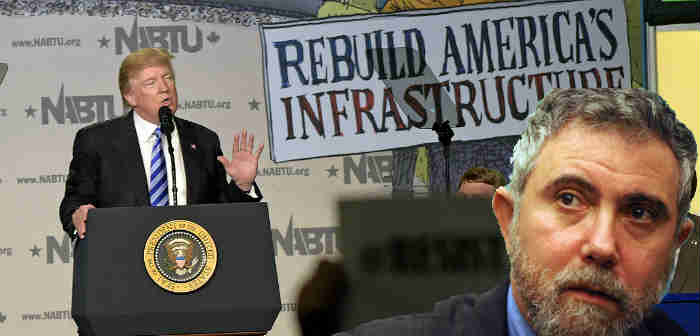 America’s most famous Keynesian, economist Paul Krugman, predictably used his New York Times column to excoriate President Trump’s State of the Union infrastructure proposal. Yet ironically, Krugman’s own positions on the economy and climate change should lead him to applaud Trump’s ideas. This is just another episode where Krugman displays his partisanship, rather than fidelity to his ostensible goals for the public.
Right off the bat, Krugman is in an awkward position, because back when he thought Hillary Clinton was going to be the next president, Krugman stressed the need for more infrastructure spending. For example, in a column from August 2016 titled, “Time to Borrow” (!), Krugman wrote:
The campaign still has three ugly months to go, but the odds — 83 percent odds, according to the New York Times’s model — are that it will end with the election of a sane, sensible president. So what should she do to boost America’s economy, which is doing better than most of the world but is still falling far short of where it should be? There are, of course, many ways our economic policy could be improved. But the most important thing we need is sharply increased public investment in everything from energy to transportation to wastewater treatment. How should we pay for this investment? We shouldn’t — not now, or any time soon. Right now there is an overwhelming case for more government borrowing. [Bold added.]Well, it turns out that the NYT’s model gave Krugman a false sense of security, since his “sane, sensible” choice didn’t end up winning. After Trump’s surprise election, Krugman—being Krugman—suddenly flipped in his economic analysis. After the August 2016 column we just cited—titled “Time to Borrow,” remember—Krugman then wrote a column in early January 2017 titled, “Deficits Matter Again.” (Of course they do—a Republican is in the White House again!) And, if Krugman flipped on the wisdom of government deficits, he also now must be a massive opponent of Trump’s proposed infrastructure plan.
How Can Krugman Oppose a Giant Infrastructure Plan?
So how does the Nobel laureate pull this particular rabbit out of the hat? Here’s Krugman’s case, from the recent column following Trump’s State of the Union address:[W]hile we desperately need new investment in public capital, Trump’s proposal – Trumpfrastructure? – isn’t remotely serious. At best, it would be a trivial sum of money pretending to be something big. At worst, it would amount to an orgy of crony capitalism, privatizing public assets while generating little new investment. So, what’s being sold here? Trump gave a big number, $1.5 trillion. But a leaked draft of the plan says that it will involve only $200 billion of federal money. The rest is supposed to be induced spending from private investors. That’s quite a trick. How does it work? The answer is, basically, that it doesn’t. Private investors won’t spend on public infrastructure unless guaranteed a return. This only works if they’re given ownership, and the ability to collect future revenue from the public. …[E]ven where it does work — say, on toll roads and bridges — that private investment doesn’t come free; it’s in return for the ability to collect fees from the public, which is just taxation in another form. And there’s no evidence that doing public investment this way saves any money. On the contrary, it usually ends up costing taxpayers more than just having the government build the thing.So there you have it: Krugman thinks he’s reconciled his earlier calls for massive infrastructure spending, with his current opposition to Trump’s call for massive infrastructure spending. But even on his own terms, and in light of his other writings, Krugman’s case doesn’t hold up.
Why Krugman Ought to Applaud Trump’s Plan
On Krugman’s own description of it, Trump’s plan has private investors put up a bunch of their own money to do the lion’s share of infrastructure spending, in exchange for the revenues that flow to the projects over time from fees levied on the citizens who use the items (bridges, roads, etc.). In other words, the plan is economically equivalent to financing public works projects through privately financed deficits, except it cuts out the IRS middleman. Krugman should be a huge fan of this approach. After all, Krugman tells us that sure, the economy seems to be doing OK in the first year under Trump, but that “when the next big shock comes…we’ll need an effective, coherent response from officials beyond the world of central banking.” This is because—Krugman claims—we are dangerously close to the “zero lower bound” world of the liquidity trap, so that the Fed can’t just cut interest rates when the next shock hits us. In that context, then, Krugman should be ecstatic to learn that the Trump Administration has already gotten the wheels in motion for private investors to put up $1.3 trillion on the front end to build infrastructure, in exchange for revenues to be collected over the following decades. That is exactly the kind of plan to promote investment spending via deficit finance that Krugman thinks is necessary when the Fed is rendered impotent because interest rates hit 0%.Better for the Environment, Too
I am not being facetious; my analysis above flows directly from Krugman’s writings in the years following the financial crisis. Back then—when it was Barack Obama rather than Donald Trump in the White House—Krugman even stressed the fact that it was foolish to worry about costs. Indeed, it was a virtue for the government to spend more money than “necessary” on things; worrying about cost-effectiveness was the last thing to do in the midst of a depression. So again, in that spirit, Krugman should be happy for Trump’s plan to go through, even if it works exactly as Krugman has described it in his latest column. Finally, if we’re talking about roads and bridges, then even “price gouging” is great, from Krugman’s perspective. If a private owner sets tolls to maximize profit, then this will ensure a smooth flow of traffic. As economists have been arguing for decades, the familiar and agonizing traffic jams plaguing our major cities are not a force of nature—they are instead the predictable consequence of government setting prices below their market-clearing levels. And so, even in the “worst case” scenario where private owners charge higher tolls than would occur on government-owned roads, this will reduce traffic congestion and cut back on vehicle emissions. Not only will it enhance economic efficiency (which is why free-market economists welcome it), but it will reduce the threat of catastrophic climate change, which Krugman claims to be very worried about. In short, even if President Trump’s infrastructure proposal works out exactly as Paul Krugman has described it, Krugman should be applauding it. According to Krugman’s own stated views, Trump’s plan will be an insurance policy to maintain aggregate demand in the event of another shock to the economy. Furthermore, the more bridges and roads that are transferred into private hands, the less traffic congestion and carbon dioxide emissionsView Comments
Institute for Energy Research——Bio and Archives
The Institute for Energy Research (IER) is a not-for-profit organization that conducts intensive research and analysis on the functions, operations, and government regulation of global energy markets. IER maintains that freely-functioning energy markets provide the most efficient and effective solutions to today’s global energy and environmental challenges and, as such, are critical to the well-being of individuals and society.