Premiers Rally For Infrastructure To Counter U.S. Tariff Threats
With U.S. tariffs looming, Premiers push for border security, pipelines, and interprovincial trade reform

Frontier Centre for Public Policy --Maureen McCall, Bio and Archives--March 14, 2025
Canadian News, Opinion | Comments | Reader Friendly | Subscribe | Email Us
Frontier Center of Public Policy
After more than eight years of federal policies that have challenged the oil and gas industry, imagining Canadian energy policy in a post-Trudeau era is no easy task.
However, recent meetings addressing the threat of United States tariffs may offer hope for revisiting energy policies through provincial collaboration.
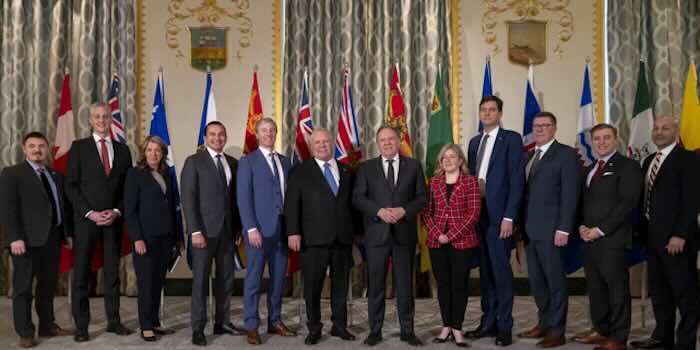
The January 2025 Council of the Federation meetings, attended by all 13 provincial and territorial premiers, produced several key value propositions.
- After spending a week in Washington, D.C., meeting with Donald Trump and his administration, Alberta Premier Danielle Smith highlighted the provinces’ resource strengths.
- British Columbia can leverage germanium—a critical mineral essential in defence applications that China will no longer export to the U.S.
- Saskatchewan’s uranium supply offers an alternative to reliance on Kazakhstan and Russia.
- Canadian provinces can provide resources that align with U.S. energy goals.
Any provincial initiatives must also address U.S. priorities, including tighter border security and increased defence spending.
To meet U.S. energy security needs, Canada must remove policy barriers hindering development. Policies like the Clean Energy Regulations (CER), the emissions cap, and the net-zero vehicle mandate (starting January 2026) are significant challenges. Provinces must collaborate to amend or remove these policies, ensuring they do not survive the next federal election. Alberta and Saskatchewan have already opposed the CER, and the proposed emissions cap remains under review.
The federal government acknowledges that these policies must be re-evaluated to avoid obstructing shared energy goals, including:
- carbon pollution pricing
- methane regulations
- clean fuel standards
- carbon capture incentives
- emissions reduction funding
- clean growth programs
- best-in-class guidelines for new oil and gas projects under federal review.
The U.S.’s energy deficit—20 million barrels consumed daily versus 13 million produced—creates an opportunity for Canada. Achieving this requires dismantling interprovincial trade barriers and developing infrastructure projects from coast to coast. The Council meetings have initiated such collaboration, with ongoing bilateral discussions expected. Infrastructure projects like pipelines to the East and West coasts would enable Canada to supply the U.S. and other global markets, reducing reliance on hostile regimes.
Newfoundland and Labrador Premier Andrew Furey stated: “I see energy as Canada’s queen in the game of chess. We don’t need to expose our queen this early. The opposition needs to know that the queen exists, but they don’t need to know what we’re going to do with the queen.”
Saskatchewan Premier Scott Moe and Alberta Premier Danielle Smith have rejected measures that would affect Canada’s energy exports to the U.S.
“When you look at the pipeline system, how oil is actually transported into the U.S. and back into Canada,” Moe said, “it would be very difficult, and I think impossible operationally to even consider.”
Manitoba Premier Wab Kinew emphasized the importance of national unity, stating that energy decisions must not fracture the country. Ontario Premier Doug Ford warned that tariffs could cost Ontario 500,000 jobs, while P.E.I. Premier Dennis King noted that tariffs could cost 25 per cent of P.E.I.’s GDP and 14,000 jobs—a catastrophic loss for the province.
The Council meetings highlighted three key priorities:
- Demonstrate Canada’s commitment to border security and meet its two per cent GDP NATO target.
- Build oil and gas pipelines east and west to diversify markets and remove interprovincial trade barriers, enabling a stronger national economy.
- Secure provincial consent before imposing export tariffs or restrictions that could harm individual provinces.
This emerging consensus underscores that Canada’s energy future depends on proactive, constructive diplomacy with U.S. lawmakers, supported by a unified provincial front and practical energy policies that benefit both nations.
Maureen McCall is an energy business analyst and Fellow at the Frontier Center for Public Policy. She writes on energy issues for EnergyNow and the BOE Report. She has 20 years of experience as a business analyst for national and international energy companies in Canada.
View Comments
The Frontier Centre for Public Policy (FCPP) is an independent Canadian public policy think tank. Founded in Winnipeg in 1997, the Frontier Centre received charitable status in 1999 and currently has offices in Alberta, Saskatchewan and Manitoba.
Our research aims to analyze current affairs and public policies and develop effective and meaningful ideas for good governance and reform. We provide a platform for public debate and engage with the public through our numerous publications and events.