Reminds me of 1886 The Haymarket Riot
Survival in Tough Times: Take note of those who in 1886 or even today want the power to define fairness for themselves only;
Dr. Bruce Smith , Bio and Archives--May 3, 2026
HeartlandLifestyles | Comments | Reader Friendly | Subscribe | Email Us
News item: May 4, 1886, Chicago, Illinois. Only one day after a demonstration at the McCormick reaper works had turned deadly with two demonstrators killed, an open air labor rally for the 8-hour day drew a considerable crowd not far away at the Haymarket on West Randolph Street at the intersection with Des Plaines street. Most were employed at the McCormick reaper works.
Police were nearby in case things got out of hand. In the middle of one of the speeches, someone hurled a dynamite bomb into the crowd toward the policemen. The explosion and the melee that followed claimed the lives of seven policemen and four demonstrators. There were no photos taken of the demonstration or the explosion. Eight anarchists were arrested for the crime, and four were hanged for it. One received a prison sentence, two who received the death penalty had their sentences commuted to prison, and one died by suicide before the hanging.
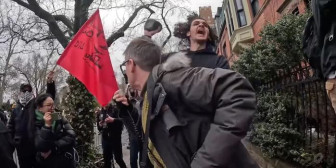
News item: March 8, 2026, New York City. Two teenaged youths approached a demonstration in front of Gracie Mansion, home of New York’s mayor. Demonstrators both anti-Muslim and pro-Muslim were present, hoping to get the mayor’s attention on issues of the day. Two men aged 18 and 19 from Bucks County, PA attempted to detonate bombs at the rally. Neither bomb exploded. The incident was captured on film and the suspects quickly arrested. Charges have been filed in the case and both have pleaded not guilty. Maximum sentence in the case would be life in prison.
The two events make a remarkable parallel from then and now. For the 2026 demonstration there were dozens of phones and cameras recording different areas. When the alleged bomb thrower came up into the shot behind another person who was on camera, the result was the image above. Close your eyes, then open them slowly to look at the photo again. Picture yourself at the Haymarket on that May evening just 140 years ago. Notice the red flag that hangs limp beside the bomb thrower just as there were red flags and black flags at the Haymarket in 1886. It’s an urban setting, with many people feeling anonymous among crowds of strangers. Some are there advocating a cause, some are there to stare and hear the speakers, some just want to get home for the night, and some want to sow chaos and anarchy that will bring a revolution.
The anarchists and revolutionaries fervently believe that their wished-for revolution will give them a victory over the owners and bring the dawn of an ill-defined “social justice.” Their spiritual leader, Karl Marx, dead just three years that day, had written in the revolutionary year of 1848 that they must throw off their chains, that they had a world to win that could be theirs if they would just rise up and violently seize the levers of power.
When I close my eyes I can stand there on the edge of Haymarket Square in Chicago, on the edge of the crowd on that May evening, trying to hear the fragments of what the speakers are saying. Those sounds must come out of throats because there is no loudspeaker system in those days, no amps, and little or no stage. The speakers must lean forward and shout, or some would call it bellow, to try to project their voices out across the heads of the crowd. Everyone is standing because there is no place to sit except in a doorway or on short steps going up to the door of someone they don’t know. Plop down on a curb and you would hear little or nothing and be in considerable danger of being stepped on or trampled if the crowd shifted. Real orators are needed for this work, but there are few of those because these are plain working people, ordinary citizens, standing on an open spot in an already great city that only 55 years before had been a marsh along the shore of a vast freshwater lake.
It’s only 15 years since the Great Chicago Fire destroyed much of the Loop area on a windy and dry October evening. Some of those present are content with their work and grateful for it, but others feel the sting of envy and discontentment. They have perhaps read the socialist and anarchist screeds and tracts that circulate, urging the workingmen to rise up and throw off their shackles, to seize the factories and places of work so their demands will be irresistible to those who own them. Most of those present are caught up on the maelstrom of freedom and license and work and want, trying to make sense of it all and hoping to keep their own little corners calm and prosperous for themselves and their families.
It’s early on a Thursday evening in the time before our own, when people worked 12-hour days so there is a warm and humid atmosphere of noise and sweat and dirt and labor. There is the smell of cooking and the sting of smoke from factories and rail yards. The lucky ones will have their baths when Saturday night arrives, not before. And why a Haymarket? What’s a Haymarket for? Fifteen years before, Mrs. O’Leary’s cow needed hay every day, and in 1886 there were 80,000 horses in this titanic city on the lake that must have something to eat every day. The day after the Haymarket riot there will still be 80,000 horses to be fed again.
The area where the wagons come in piled high with loose hay is a convenient place to assemble a crowd. When one doesn’t own a major news paper, smaller papers and shouting voices have to do. Word went out to come to the Haymarket to rally for the eight hour day. Many showed up. When the orators shouting at the crowd had the crowd warmed up and as they continued, someone threw a dynamite bomb from the back over the heads of the crowd toward the police who were in a group nearby.
Look at the photo from 2026 again. Look at his eyes. Whoever threw the bomb at the Haymarket that night in May, 1886 would have looked much the same had someone caught the image. The eyes are wild, enraged. How many actually saw the bundle of sticks go toward the massed crowd up ahead? Could they see the smoke trail from the burning fuse? For just a second or two it was visible, and then the terrible roar of the explosive split the crowd ahead and sent people running in every direction. Some of the policemen recovered and discharged their revolvers, the investigation reported, but in the confusion, and with a hundred differing accounts of what happened, it is not entirely clear what took place. The bomb would have made flame and acrid smoke, and the weapons discharged would have added to the smoke and the confusion. Flesh was torn and blood was spilled on the brick pavement near the Haymarket that night, and that has a distinctive smell, too.
Just ninety-one years after the Haymarket riot, during my brief attendance at the University of Chicago in 1977 I went out of my way to take the Illinois Central up to the Loop and hike over to the near west side. I wanted to see a place that was still an open sore in American history, the Haymarket. It’s located at DesPlaines Street and West Randolph Street, and today it’s right next to the Kennedy Expressway.
I found it by means of my map and the street signs. I looked around, savored the place, put myself back in time in 1886. I studied it from several angles, read the historical marker, imagined what it was like on those days of streetcars, foot traffic, and horses. To go back in time in Chicago, one can pause under the El and listen to the thunder of the 19th century overhead when a train passes. It was hard to believe it had once been a hay market. The sound of traffic on the Kennedy Expressway competed in my head with the horses and crowds and orators that were playing in my head.
Today the Haymarket area is still a market, but now it’s for vegetables and produce from the surrounding countryside and from further away, too. On the day I was there, I bought a basket of cucumbers, took them home to the 3rd floor walkup apartment and made pickles as I waited for the quarter to begin in September. I studied my French verbs and tried to psych myself for the start of a new academic adventure. It was hard to believe I was actually there where my mentor had taken his PhD in 1961. Every day I walked across the Midway on the former grounds of the 1893 Columbian Exposition as I learned my way around campus and nearby Hyde Park on the South Side of Chicago, the baddest part of town.
To this day, professors and graduate students still revisit the events of May, 1886. It’s a must-understand event. No one tells you to dig into it. But it’s a turning point, a crisis in American economic history. To understand the times, one must understand what happened at the Haymarket, and at Homestead in 1892, at Pullman in 1894, and in the Great Railway Strike of 1877, and at Troy, New York where in 1865 entrepreneurs poured the first successful batch of steel from a Bessemer converter. That rally for the eight hour day? What you will find in no textbook anywhere is that the demonstrators wanted the definition of a day’s work changed from 12 hours to 8 hours, but with no reduction in pay. Understanding that little fact made all the difference in my understanding of what I consider to be the most remarkable decades in all of human history. As the population swelled with immigrants and natural increase, industrial jobs, wages, material advances, education, and faith all grew alongside it all. For me it is the greatest period of advancement in the human condition ever recorded.
There are heroes and villains scattered all through the story of American economic history in that period. There are entrepreneurs and builders, discoverers, engineers, architects, statesmen, and millions of ordinary people who came here to work in an atmosphere of freedom like had never been seen before. There are villains, too, slavery advocates, socialists, Copperheads, labor agitators, would-be anarchist assassins like Alexander Berkman who walked into Henry Clay Frick’s office in Homestead, Pennsylvania and shot him through the neck.
Labor historians have often had the loudest voices and many of them have occupied tenured positions in prestigious universities, especially during the last 50 years so that those with differing views have been excluded from the classrooms and the academic journals for that many years, too. Go to Forest Park Cemetery today and you will find the monument to the Haymarket “martyrs” there. It is testament to the power of interpretation after the fact.
But Frick had the last laugh. He wrapped a cloth around his neck and continued working for the rest of the day while Berkman went off to the slammer for his evil deed. Frick broke the Homestead strike and helped Andrew Carnegie transform the American landscape with steel rails and steel girders.
The bomb throwers at the Haymarket and on other occasions have always hoped to spark a collapse of capitalism. Considering that capitalism has long been the engine behind unparalleled advances in human prosperity and happiness, it was always difficult to understand why some would attack it with such energy and hatred. I think it has always boiled down to who or what gets to decide what “fair” means. For some, fairness can only be designated by the “oppressed” and the disaffected, or by the Marxist academics and their followers. For others, fairness must always be left to a disinterested market place that takes human nature into account, then drives producers to create needed products and services at prices that others will pay voluntarily. Only with the absence of coercion in the marketplace can freedom’s full potential be achieved. Take note of those who in 1886 or even today want the power to define fairness for themselves only. That distinction has always helped me choose the best side, and the bomb throwers and anarchists who relish the exercise of force and coercion have always been on the other one.
View Comments
Dr. Bruce Smith (Inkwell, Hearth and Plow) is a retired professor of history and a lifelong observer of politics and world events. He holds degrees from Indiana University and the University of Notre Dame. In addition to writing, he works as a caretaker and handyman. His non-fiction book The War Comes to Plum Street, about daily life in the 1930s and during World War II, may be ordered from Indiana University Press.