Ryan unveils GOP plan to repeal (mostly) and replace ObamaCare
Undoing a disaster

Dan Calabrese , Bio and Archives--June 22, 2016
American Politics, News | Comments | Reader Friendly | Subscribe | Email Us
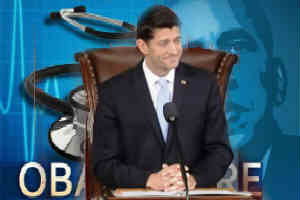 For all the supposed intrigue about whether Paul Ryan is really willing to support Donald Trump (assuming Trump actually does become the Republican nominee, which I still think is going to happen), nothing Ryan says about endorsements or anything else matters as much as what he did yesterday. If you're not all that thrilled about Trump as the nominee, and you need a concrete reason to swallow hard and vote for him, there can only be one thing at the top of the list:
Trump will sign a repeal of ObamaCare. Hillary will not.
And yesterday, Ryan put meat on the bones of that argument by unveiling the House Republicans' alternative to ObamaCare. It's not perfect, but it goes a long way toward undoing the disaster that the Democrats shoved down the nation's throats back in 2009 and 2010.
For all the supposed intrigue about whether Paul Ryan is really willing to support Donald Trump (assuming Trump actually does become the Republican nominee, which I still think is going to happen), nothing Ryan says about endorsements or anything else matters as much as what he did yesterday. If you're not all that thrilled about Trump as the nominee, and you need a concrete reason to swallow hard and vote for him, there can only be one thing at the top of the list:
Trump will sign a repeal of ObamaCare. Hillary will not.
And yesterday, Ryan put meat on the bones of that argument by unveiling the House Republicans' alternative to ObamaCare. It's not perfect, but it goes a long way toward undoing the disaster that the Democrats shoved down the nation's throats back in 2009 and 2010.Reuters has a decent summation:
"Obamacare has limited choices for patients, driven up costs for consumers, and buried employers and health care providers under thousands of new regulations," a draft of the Ryan plan said. "This law cannot be fixed." But Ryan's proposal would keep some popular aspects of the law, including not allowing people with pre-existing conditions to be denied coverage and permitting children to stay on their parents' coverage until age 26. The Obama administration says some 20 million Americans have become insured as a result of the Affordable Care Act. The Ryan plan recycles long-held Republican proposals like allowing consumers to buy health insurance across state lines, expanding the use of health savings accounts and giving states block grants to run the Medicaid program for the poor. For people who do not get insurance through their jobs, the Republican plan would establish a refundable tax credit. Obamacare, by contrast, provides subsidies to some lower-income people to buy insurance if they do not qualify for Medicaid. The Republican proposal would gradually increase the Medicare eligibility age, which currently is 65, to match that of the Social Security pension plan, which is 67 for people born in 1960 or later. Like Obamacare's so-called Cadillac tax on expensive healthcare plans offered by employers, the Republican proposal would cap the tax deductibility of employer-based plans. The Republican plan includes medical liability reform that would put a cap on non-economic damages awarded in lawsuits, a measure aimed at cutting overall healthcare costs.I have long believed that health insurance should operate like other insurance, which is to say it's protection against risk rather than a program that pays all your expenses. Auto insurance doesn't pay for your oil changes, after all. It protects you if you get in a serious and expensive wreck. Ideally, I would like to see health insurance that pays for your doctor visits and other basic care eliminated, with people paying premiums only for coverage to protect against catastophic and very expensive needs. The Republican alternative doesn't exactly do that, but it does make it easy for people who want to take that approach, contrary to the ObamaCare approach that penalizes you for trying.
Here's the passage that deals with this issue in the plan itself:
While Obamacare tried to sideline consumer-directed health care by placing substantial fines on certain accounts and limiting the use of others, Republicans have long supported expansions to these popular arrangements, especially HSAs. HSAs are tax-advantaged savings accounts, tied to a high-deductible health plan (HDHP), which can be used to pay for certain medical expenses. This insurance arrangement— in which a person is protected against catastrophic expenses, can pay out-of-pocket costs using tax-free dollars, and in turn takes responsibility for day-to-day health care expenses— is an excellent option for consumers. HSAs tied to HDHPs are popular tools that lower costs and empower individuals and families. This type of coverage also helps patients understand the true cost of care, allows them to decide how much to spend, and provides them with the freedom to seek treatment at a place of their choosing. For these reasons, our plan eliminates the roadblocks put in place by Obamacare and institutes several commonsense expansions to HSAs. For instance, our plan would do the following:Our plan encourages the use of direct or “defined contribution” methods, such as health reimbursement accounts (HRAs), which give individuals more freedom over their health care choices. Before the President’s health care law tried to eliminate HRAs, some employers reimbursed some health expenses of their employees, including their premiums. In certain cases, employers provided HRAs, even if funding a group health plan was beyond their business resources. These employer payment arrangements allowed employees to purchase coverage in the individual market, serving as an example of true portability: If the employee lost her job, then she could still keep the health insurance plan she liked. Our plan encourages the expansion of this arrangement, which once again empowers individuals to choose the insurance plan that best fits their needs.
- Allow spouses to make catch-up contributions to the same HSA account;
- Allow qualified medical expenses incurred before HSA-qualified coverage begins to be reimbursed from an HSA account as long as the account is established within 60 days;
- Set the maximum contribution to an HSA at the maximum combined and allowed annual deductible and outof-pocket expense limits; and
- Expand accessibility for HSAs to certain groups, like those who get services through the Indian Health Service and TRICARE. Our plan also creates space for innovative purchasing platforms, like private exchanges, to expand.
Banning the rejection of people with pre-existing conditions is good politics but bad policy. Insurers need to be free to choose who they insure, and this ObamaCare-spawned idea that people can simply wait until they get sick and then buy the same coverage as everyone else distorts the risk pool, making it harder for insurers to control their own costs and limit the premiums of healthy people who were paying them all along. Making health insurance more portable should somewhat reduce the occurrences of people doing this, but it's still a bad idea. My preferred health insurance reform would be much more of the rip-it-out-at-the-roots-and-start-over variety, but given the viability of reforms in the current political environment, this is about as good as you're going to get. And it's pretty close to Trump's own plan, although he doesn't spend a lot of time talking about that on the stump. He should start. Americans know ObamaCare is a disaster, but they're not sure what to do about it. If Trump and Ryan can unite on a method of replacing it, they'll go along way toward answering the question of why a disillusioned Republican should nevertheless vote for Trump. You may not like him, but his personality isn't hurting people. ObamaCare is.
View Comments
Dan Calabrese——Bio and Archives
Dan Calabrese’s column is distributed by HermanCain.com, which can be found at HermanCain
Follow all of Dan’s work, including his series of Christian spiritual warfare novels, by liking his page on Facebook.