Senate releases 'secret health care bill' for all the world to see
• Individual mandate and most ObamaCare taxes gone
• Medicaid expansion rollback slower than House version
• Tax credits for health insurance more generous

Dan Calabrese , Bio and Archives--June 22, 2017
American Politics, News | Comments | Reader Friendly | Subscribe | Email Us
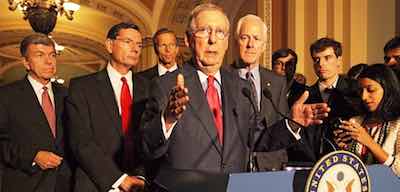 To read the media today, you'd think the only thing noteworthy about the Senate's health care bill is that it was "drafted in secret." Almost every MSM headline on the plan's release emphasizes this Democrat talking point, which leads me to a fairly obvious question:
Isn't everything "secret" up until the point it's made known?
The real news, of course, is what's in the bill - and obviously, its prospects of passage. For a supposedly secret bill, we sure know a lot about it now.
The Wall Street Journal has some excellent summations:
To read the media today, you'd think the only thing noteworthy about the Senate's health care bill is that it was "drafted in secret." Almost every MSM headline on the plan's release emphasizes this Democrat talking point, which leads me to a fairly obvious question:
Isn't everything "secret" up until the point it's made known?
The real news, of course, is what's in the bill - and obviously, its prospects of passage. For a supposedly secret bill, we sure know a lot about it now.
The Wall Street Journal has some excellent summations:The tax cuts in the Senate bill look largely similar to those in the House bill. That includes repealing a 3.8% tax on investment income retroactively to January 2017 and delaying the repeal of a 0.9% payroll tax until 2023. Both of those taxes only apply to individuals making more than $200,000 and married couples making more than $250,000. The bill would also remove taxes on some health industries. . . . Some more quick lines from the bill:
- Bill would end ACA penalties for people who don't have insurance
- The bill seeks funding for insurers through 2021
- The bill provides tax credits, lowers income eligibility
- Tax cuts on high-income households largely unchanged from House plan
- Bill suspends 'Cadillac Tax' on employer health plans through 2025
- Bill strips federal funding from Planned Parenthood Federation of America for one year
Here's a deeper look at what the Senate plan would do: Medicaid: The plan would roll back the Affordable Care Act’s Medicaid expansion more gradually than the House version would, but would ultimately make deeper cuts to the program. While states' funding from Washington would be capped for the first time in the history of the Medicaid program, states would be given a choice of the formula used -- 'block grants' or 'per capita caps' -- to curb it under the bill. Penalties: The bill would end the ACA’s much-debated requirement that most Americans pay a penalty if they don’t have insurance. The bill also suspends the so-called Cadillac tax on generous employer health benefits through 2025. Subsidies: The bill would keep Obamacare's current tax credits to provide subsidies to people who don’t get health insurance on the job, but the bill would lower income eligibility for the assistance, meaning fewer people would be able to get the subsidies. The credits would also be less robust than under the ACA. Planned Parenthood: The bill would strip federal funding from Planned Parenthood Federation of America for one year. It also prohibits tax credits from being used to purchase plans that offer abortion coverage. ACA Taxes: Like the House bill, the Senate bill would repeal a 3.8% tax on investment income retroactively to January 2017 and delay the repeal of a 0.9% payroll tax until 2023. Both of those taxes only apply to individuals making more than $200,000 and married couples making more than $250,000.
Planned Parenthood being defunded for one year only
Excuse me while I groan at the prospect of Planned Parenthood being defunded for one year only. I guess that's to give Republican senators something to go tell pro-life voters they did, even though it's almost completely meaningless. Maybe they thought it would be too difficult politically to defend letting Planned Parenthood completely off the hook, so they threw in this lame provision to save themselves from having to do so. Ah well. On to the real substance of the bill: As with the House bill, we see the end of the Medicaid expansion, as well as a new provision that limits Medicaid spending overall. That has never been done before. It rolls back the expansion more slowly than the House version, but the spending limit makes it a good tradeoff in my view. The individual mandate is gone. That's huge. If you don't want to buy health insurance, it's your choice and the government will do nothing to pressuree you to buy it against your will. The part of the bill dealing with subsidies is disappointing. The government would still subsidize the purchase of health insurance for people in certain income groups. They tighten eligibility and make the subsidies a little less generous, but they leave the basic subsidy stucture in place. It would be easy for a future Democrat president and Congress to put them right back where they were under ObamaCare.If states want to subsidize people's health care premiums, let them
That especially becomes tricky when paired with the repeal of most ObamaCare taxes. Now, these taxes absolutely need to be repealed (and the repeal of the payroll tax increase should happen right away, not in six years), but when you eliminate taxes but don't eliminate the subsidies you were paying for with the tax revenue, how do you make that work? I'm not turning Keynesian on you here. I understand that tax rate cuts don't result in exact commensurate revenue reductions, and it's quite possible the elimination of the taxes could spur enough economic growth to make them revenue-neutral. But the taxes and the spending were put in place together. It would be best to eliminate them together. If states want to subsidize people's health care premiums, let them decide to do so on a state-by-state basis and leave Washington out of it. To me, the most important elements are the end of the mandate, the repeal of the taxes and the rollback of the Medicaid expansion. For the most part I'm happy with the Senate's approach to all three.Now, will it pass?
Now, will it pass? Ted Cruz was complaining last night that he hasn't even seen the bill yet, but that's probably just rhetorical bluster. He was involved with the process of drafting it, so I can't imagine he's shocked by anything in it. The bottom line is that there are 52 Republicans in the Senate, and no Democrats are going to vote for this. So you can only lose two Republicans while still getting to 50 and allowing Vice President Pence to break the tie. The six Republicans reportedly wavering are Lisa Murkowski, Susan Collins and Rob Portman (because it might be too conservative for them); Cruz and Mike Lee (because it might be too centrist for them) and Rand Paul (because he's actually a libertarian who opposes everything). You can't get to 50 unless you've got at least one from each camp. McConnell must think he can get it, or he wouldn't have scheduled the vote for next week. It's going to be close.View Comments
Dan Calabrese——Bio and Archives
Dan Calabrese’s column is distributed by HermanCain.com, which can be found at HermanCain
Follow all of Dan’s work, including his series of Christian spiritual warfare novels, by liking his page on Facebook.