Standing Firm on the Rock
We live in a time of sand storms and contrary winds. Unless we have a rock underneath us, we will be driven and tossed

Joseph J. Bucci , Bio and Archives--August 10, 2024
HeartlandLifestyles | Comments | Reader Friendly | Subscribe | Email Us
Several years’ ago a friend notified me that his wife had been diagnosed with a rare form of leukemia. She received the best care available, and while the situation did not improve, everything had trended towards health maintenance. Tonight we received word that the family has prayed and discussed the future; and they are calling in hospice care.
She has fought the good fight for five years; but the end of the fight is upon us. The family has five beautiful married daughters who have all relocated to be closer to their mom during what they believe are her final hours.
My friend wrote and asked for prayer, but the family also wanted everyone to know that they have placed their faith in the Bible being true and trustworthy; and “in the God of the Bible being All-Powerful, All-Knowing, and All-Loving.” They wrote that, because of their faith in God, “nothing happens to us or those about whom we care that wasn’t either allowed by or caused by God for our benefit and ultimately for His Glory. Soli Deo Gloria.”
I don’t know if I have ever seen or known of anyone who was able to endure significant pain or loss or tragedy with peace and dignity apart from a person having an unshakeable faith in God. It could be true that there are people who are capable of such incredible resolve, based on their own strength and determination. But I don’t know that I have ever seen this kind of inner strength outside of someone who has committed their life and destiny to Jesus Christ: someone who knows that God is good all the time (see James 1:17) because He is in control all the time (see Colossians 1:17).
It could be argued that Olympic athletes or professional sports superstars like Tom Brady or Lebron James exhibit such characteristics in their field of play. But these are sports. These are games. These are not real-life circumstances where a loved one is suddenly snatched from your side or the horror of a brutal murder.
You could say that someone facing an extremely dangerous situation with insurmountable odds, like a soldier or fire fighter or police officer, who is able to compose themselves and focus their energies on overcoming these odds, would exhibit similar resolve and goal-orientation. Strength in the midst of agony is not something that a normal human being can do. It is unnatural. It is other-worldly.
Stephen Covey tells a famous story called “The Man on the Subway” about a paradigm shift in his book, The Seven Habits of Highly Effective People (Covey, 1989). The man is overwhelmed due to the sudden loss of his wife; but those around him only notice his unruly children. Covey uses the story to challenge us that, “things are not always as they seem.” But the power of the story is revealed in the complete insensibility of the man to the circumstances around him. His loss creates a fissure with his present reality. Current circumstances were not important anymore. He had lost touch with reality and faced his own anguish. But for those who know Jesus Christ, this experience is different.
While much of our evangelism and outreach focuses on reaching people who are hopelessly lost in their sins and saving them from a horrific eternal destiny (see Ephesians 2:12); there are amazing resources unleashed in the lives of Christ’s disciples as they press in and give total control of their lives to Him. There is a trust and assurance that God is with us and is leading us forward (Hebrews 13:5-6 ESV). There are many amazing blessings and answers to prayer beyond our understanding (Ephesians 3:20-21).
People who do not know Christ in a personal way will certainly miss out on significant eternal blessings in heaven, such as enjoying God’s infinite presence forever (John 17:3). Meanwhile, here on earth, the God of Love (1 John 4:8) hears our hearts’ cry for mercy and answers prayer, giving us a firm place to stand (Psalm 40:1-2) and guiding us forward (Proverbs 3:5-6). God also gives to His disciples an incredible inner strength and peace in the midst of a storm; with a confidence and authority over the darkness that would attempt to strangle us in despair (Ephesians 6:10-14).
Jesus tells His followers that we must be willing to take up our cross daily in order to truly follow after Him (Luke 9:23 ESV). This is symbolic of his own willingness to endure scorn and criticism for speaking and living the truth. The writer of the letter to the Hebrew says that Jesus took up His cross, despising the shame of a public wretched death, for not being on everyone’s most popular list (Hebrews 12:2).
Jesus lived with a resolute confidence in God’s perfect plan (John 4:34) despite the criticism and ridicule He endured, not only from those who should have known better (the religious leaders) but He also suffered the abandonment of His own disciples.
Christ’s example of self-denial and quiet obedience (Philippians 2:5-11) prepares us for moments of total loss. Part of taking up your cross is realizing that you must be willing to lay other things down. It could be the loss of a spouse, or a job; or the loss of a particular presidential candidate, if I can sneak that in. This life of losing everything but gaining eternity (Mark 8:36) is hard for those of us who love deeply and idealistically believe that things can be better. We pray for God to do ‘God-things;’ but we submit our own interest and intentions to His sovereign plan (Psalm 40:8).
A young man and his wife faced the fetal loss of a preborn child at 20 weeks. There was abnormal bloodwork, then an ultrasound confirming that the baby had died. While they prayed for a miracle, they ultimately delivered an early stillborn child. They held a funeral for this child, and determined in that service that they would give honor and praise to the God “who gives, and who takes away” (Job 1:21). This is beyond winning or losing a Super Bowl or avoiding catastrophe. This is spirit-empowered trust in something that cannot be seen – because the things that we see are only temporary (2 Corinthians 4:18).
When Jesus first appeared to all of His disciples after His death and resurrection, Thomas (called appropriately “doubting Thomas”) was not with the group. He said he would not believe in the resurrected Christ without proof. One week later, Thomas saw the risen Lord and believed. Jesus said to him, “Have you believed because you have seen me? Blessed are those who have not seen and yet have believed” (John 20:29). We choose to hold onto the unseen Christ and believe, not having seen Him, but with a great cloud of witnesses encouraging us forward (Hebrews 12:1).
The songwriter wrote, ‘My hope is built on nothing less, than Jesus’ blood and righteousness. I dare not trust the sweetest frame, but wholly lean on Jesus’ Name. On Christ the Solid Rock I stand, all other ground is sinking sand’ (Mote, 1834). That last chorus is taken from the gospel of Matthew and the Sermon on the Mount (Matthew 7:24-27). There is a contrast between a man who built his house on sand as compared to someone building their house on ‘the rock.’ That Rock is Jesus!
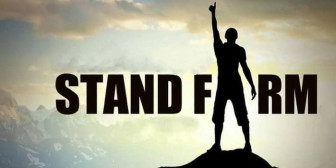
We live in a time of sand storms and contrary winds. Unless we have a rock underneath us, we will be driven and tossed, as James writes (James 1:6), by every wind of change and promise of prosperity, and anyone clamoring for our attention. We need to build our house on the Rock, in order to weather the storms of this life. While most of us will never stand on a podium accepting a gold medal, we can be certain that “in the day of evil” with Christ’s help we will be able to “stand firm” (Ephesians 6:13).
Sources:
Covey, S. (1989). The Seven Habits of Highly Effective People. New York: Free Press.
Mote, E. (1834). My Hope is Built on Nothing Less (to the tune of Solid Rock). Public Domain.
View Comments
Joseph J. Bucci has served as a Pastor, Author, HR Director, Director of Training, Professor and Consultant. He teaches in the College of Arts and Sciences at Regent University in Virginia Beach. He has written two books and numerous articles on the theme of integrating faith with life and our work. You can contact Dr. Bucci at: Joseph J Bucci