Start With Simplicity
Survival in Tough Times: Start simple. Find some buckets

Dr. Bruce Smith , Bio and Archives--December 15, 2024
HeartlandLifestyles | Comments | Reader Friendly | Subscribe | Email Us
We lead complex lives in increasingly complex times. That doesn’t mean that everything we do has to be complicated or intricate. We build walls one rock or one brick at a time. The wall itself is complex and made of many parts, but each part can be rather simple.
In these days of a wanton throwaway culture there are useful castoffs in many places
On a lark I picked up the October 16-22 edition of the Epoch Times a while back. On the front page was a story that can illustrate this point. Once again in these columns, it’s actually about survival in tough times, while preserving a bit of civilization. Here are the first two paragraphs of the story.
- Local Heroes Hailed as North Carolina Recovers
- Residents say it could take years to rebuild after Hurricane Helene
- By Allan Stein, BLACK MOUNTAIN, N.C. –
- Robert Chessick knows about nature’s power, having survived his fair share of tropical downpours and winter ice storms.
- He said that prayer, buckets to collect rainwater, and a borrowed generator helped him get through Hurricane Helene in late September.
There are levels of preparation for a disaster or even for just a storm or a power outage. It makes sense to prepare as well as we can, but we don’t start with the sophisticated stuff.
In these days of a wanton throwaway culture there are useful castoffs in many places. One of the most useful castoffs is containers. They’re everywhere. At the supermarket some jams and jellies are put in proper canning jars. There is spaghetti sauce canned in real canning jars. If you never do any canning, there are always people around who do here in the Heartland.
One of the most useful things Chessick had on hand when disaster struck was buckets
Of course, you can store your dry beans and lentils and pasta in them, too. The plastic containers we buy filled with fresh mushrooms? I keep some of these for transporting garbage to the compost pile because I can’t put all that stuff down the disposal into a septic tank. I use one of these every day for coffee grounds before tossing them into the garden. These are better than tapping a bowl from the Dresden china on the fence post. Small yogurt containers are great for holding leftover grease or trimmings that will spoil in the indoor trash can.
Take these to the outside trash or dispose of them (in leftover plastic bags) in a proper trash can at a place like a discount store. Those receptacles say trash on them, so contribute your part! Cottage cheese cartons? Potato salad tubs? Margarine tubs? Water bottles? Whatever it might be, there is always recycling, after keeping a few back for your own use.
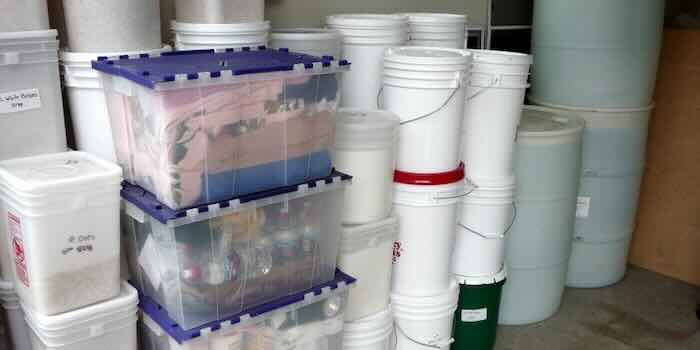
The lead-up, of course, is to buckets. One of the most useful things Chessick had on hand when disaster struck was buckets. This is because when disaster visits us, one of the first thoughts is always to the supply of water. Water for drinking is essential, and this is something that can rather easily be stored ahead of time in bottles or gallon jugs on in dispenser containers with those handy little spout thingies on them. If you buy gallons of spring water for making tea and coffee like I do, then you always have plenty of clean water jugs on hand. Like they say in the grocery business, Rotate Your Stock.
We think of the immediate need for drinking water, but these days a life worth living depends heavily on sanitation
Looking further down the road, there are low-cost ways to purify water also. The oldest one is to simply boil it for one minute before drinking. There are tablets and drops to add to containers of water. Camping supply houses carry a wide variety of equipment to filter and purify water to make it safe for drinking. They have filter straws that can be carried in a backpack or glove box. They have filter bottles. There are gravity purification systems in which one simply pours water in the holding tank, then waits for the filtered water to seep into the dispenser tank below. There are well and cistern filtration systems, and more. Do some research on this topic some evening when your hydration is good and there is no storm on the horizon.
We think of the immediate need for drinking water, but these days a life worth living depends heavily on sanitation. Here on the water planet, that means water for other things besides drinking. Whether you are blessed with municipal sewers or a home sewage plant called a septic tank with drain field, water is the key ingredient. If you have water supplied by a utility company, urban or rural, your faucet, shower, and toilet will still work when the power goes off. The hot water will only last a day or so, but you will still have water. That’s a blessing right there.
If you have a well which uses a pump to deliver your water to the house, a power outage means there is only what the pressure remaining in the tank will deliver plus the water you can drain out of the water heater after turning the breaker off. Especially in rural areas, buckets are essential. When the power fails and you can’t pull water out of the well, civilization will continue along very nicely by filling the toilet tank with water from buckets then going about your business.
Always store water correctly
Going back in time to the 1880s is far better than going back to the Stone Age, seems to me. Count your blessings every day, especially on the days that suck.
Plastic buckets are everywhere if one knows where to look. Purchasing buckets at a home center or hardware store is an option, but not always economical. There are lots of sandwich shops around these days. They all use pickles, peppers, and other condiments which often come in buckets of different sizes. Bakeries and delicatessens go through dozens of buckets in a month’s time. A big supermarket will have a large bakery area and a large deli, too. All of these containers are food grade, of course. Painters and especially drywall crews use lots of buckets which often end up in the dumpster on the site or back at the shop. Use these for storing water for multiple uses. Ask around to discover places that will save buckets for you or will let you remove them when it’s time to discard them. Some places give them away, and some charge. Suit yourself.
Just remember. Your toilet tank does not have an electrical plug. It’s a wonderful machine that works by gravity using the weight and cleansing power of water. Thank you, Thomas Crapper.
Always store water correctly. Every container must be covered or sealed to prevent mosquitoes and the diseases they carry. It must be secured with tight covers or other ways to keep children and pets out. Even a few buckets stored empty and upside down in the shed or basement can be lifesavers when disaster or a storm strikes.
We can go overboard, of course, and that means heading down the road of hoarding, but hoarding means excess. We might find cottage cheese cartons useful, but we don’t need 400 of them, and we don’t need 400 lids, either.
Living on a real farm for a while is an education in itself
When you have trouble opening the door to the shed because the empty gallon jugs are in the way, you probably have too many.
Frugality doesn’t mean going nuts. It means using one’s head so as to avoid panic buying for trivial reasons. Every time we need something we should not have to make a trip to town to get it. If we’re baking and we need a cup of sugar, we don’t go buy a one cup package. We also don’t tear the lid off the barrel where we keep all the purloined sugar packs we’ve picked up at restaurants and fast food places over the past eleven years so we can tear open a couple hundred and fill the cup measure. That would be excessive and goofy, and a little creepy, too. We purchase a bag and keep it in a canister so we have some when we need it. Getting low? Don’t make a special trip today, but put it on the list for the next grocery run.
Living on a real farm for a while is an education in itself. Farmers have a reputation for being able to improvise, adapt, and overcome. A proper farmer always has certain things on hand like scrap lumber, scrap metal, spare parts, extra fuel, nuts and bolts and screws, extra v-belts, tubs, and buckets. This is because the farmer often does not have the time or the ability to make a trip to town for a single grade 5 bolt and nut when the flywheel on the baler snaps the old one. He’ll have some in a toolbox on the tractor or on the baler itself, or curse himself for his foolish neglect. Is that thunder I hear off to the west?
So do what Robert Chessick did. Start simple. Find some buckets.
View Comments
Dr. Bruce Smith (Inkwell, Hearth and Plow) is a retired professor of history and a lifelong observer of politics and world events. He holds degrees from Indiana University and the University of Notre Dame. In addition to writing, he works as a caretaker and handyman. His non-fiction book The War Comes to Plum Street, about daily life in the 1930s and during World War II, may be ordered from Indiana University Press.