Successful Seed Raising
Like it or not, GM has come to the rescue of several important crops when they fell foul of disease. Weed control has been more controversial

Wes Porter , Bio and Archives--January 17, 2025
Lifestyles | Comments | Reader Friendly | Subscribe | Email Us
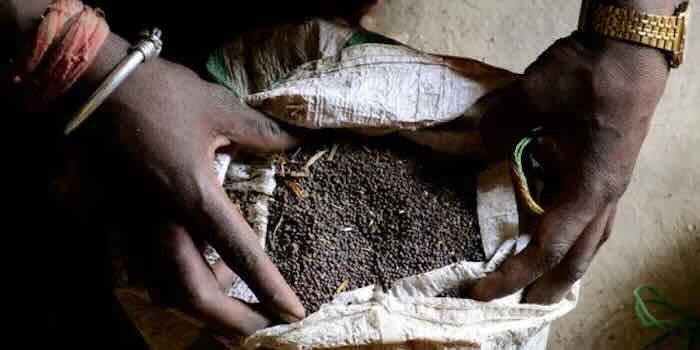
Described with elegant words of Larousse, Grand dictionnaire du XIX siècle: “Dormant organs resulting from the fertilization of the seeds in flowering plants (phanerogams), which, after germination, is capable of producing a new individual.”
Indeed, centuries earlier, English poet Thoms Tusser in 1555 had declared:
In March and April from morning to night,
In sowing and setting, good housewives delight.
Then again, the Nepalese proverb advises Jasto topyo testa falcha – As you sow so you reap.
Seeds kick-started civilization
Seeds kick-started civilization. From the discovery that grains grew from seeds gave rise to early agriculture. Civilizations rose and fell but farming continued. Seeds could not only sown but could be stored. They could also travel distances. But here lay an enduing mystery: how could such an apparently inert object turn into a plant? It was an all too often for many still is, a matter of life and death. Even the most sophisticated were forced to keep an eye on the skies. John Evelyn wrote in his famous diary on 24th October 1696: “Unseasonable stormy weather, and an ill seed-time.”
That ‘seed-time’ may not be when the seed is produced by its parent. In fact, in vegetables, fruit and many ornamentals it rarely is. It will require a dormant period, often exposed to cold, dry conditions. Moistening, removing retardants in the seed coat and rising temperatures may then induce germination. But not with all seeds. Some require unusual treatment such as endozoochory: seeds that have adapted to pass through the digestive tracts of animals: for example, native raspberries and blackberries need to be abraded in a bird’s gizzard. Other may be dispersed when they fasten to a passing animal’s hair – for example sunflower and tomato. Devil’s claw, the grapple (Harpagophytum procumens) has evolved the peculiarity of clamping itself to the feet of ostriches, which ensures the dispersal of it seeds, writes Adam Leith Gollner (2009).
The principle spreaders of seeds, however, are humans
The principle spreaders of seeds, however, are humans. At all times, all places people have sought seeds. The 17th century English diarist John Evelyn wrote a letter to his nephew George Evelyn then on his travels in Italy, dated 30th March 1664, requesting seeds of ilex, phyllire, myrtle, and jessamine, which he says are rare in England. That was the easy part, having obtained came the successful raising and care of the tender seedlings. Suitable soil, moist but not wet, moderate light ut not direct burning sun, warm but not baking hot, lightly moving air and more all are necessary. Still disaster struck. The seedlings, newly emerged, were discovered one morning toppled over, shrivelled at their base. Collar rot, for that is what is was, is ubiquitous. A simple protection is for the seed to be sown under or through finely chopped sphagnum moss.
Gardeners, farmers, botanist alike saved seeds, grew them on themselves or exchanged them with others. By the early years of the nineteenth century, commercial seed suppliers arose. They issued catalogs often inaccurate if not downright imaginative. Usually little more than lists of the kind still seen today, they merged into the colourful catalogs available today, often accompanied by accurate descriptions and cultural suggestions. Online availability has vastly enlarged these since seeds can usually pass internationally free of restrictions.
However the dream of big business has always been rendering home gardener or farmer saved-seed rendered ineffective, not coming “true” to the parent stock. As Michael Pollan has written (2002):
Then came the “modern miracle” or genetic engineering
The dream of controlling the seed, and through the seed the farmer, is older than genetic engineering. It goes back to at last the development, in a handful of crops, of modern hybrids, high-yielding varieties that don’t “come true” from replanted seed, thereby forcing farmers to buy new seeds every spring.
Today the production of hybrids, strong, disease and pest resistant with astoundingly high productions, are in the hands of an alarming few companies.
Then came the “modern miracle” or genetic engineering and the emergence genetically modified seed (GM). Like it or not, GM has come to the rescue of several important crops when they fell foul of disease. Weed control has been more controversial. Jennifer Clapp observed that by 2013, “Monsanto alone accounted for 90 percent of the global genetically engineered seed market.”
Others have disagreed, often vehemently Mark Bittman wrote (2021): “Hybrid seeds were worth anything only if you could afford the pesticides that protected them.”
Fabulous beliefs in seeds is nothing new, however. Zahn, in his Speculæ Physico-Mathematico-Historicæ (1696) recorded many vegetable marvels. Amont them was the case of a reed growing in the belly of an elephant, an ear of wheat in the nose of an Italian woman, oats in the stomach of a soldier and various grains found in wounds and ulcers, in different parts of the human body – proof positive that some people will believe anything.
View Comments
Wes Porter is a horticultural consultant and writer based in Toronto. Wes has over 40 years of experience in both temperate and tropical horticulture from three continents.