The Air is Getting Cleaner: But the Media are Nowhere to be Seen
It's tough for the American people to lean to the truth about air quality when the media does not report the good news

Institute for Energy Research , Bio and Archives--March 13, 2010
Global Warming-Energy-Environment | Comments | Reader Friendly | Subscribe | Email Us
On Wednesday, the Environmental Protection Agency (EPA) quietly released their annual report on air quality trends.  You would never know it from picking up a newspaper or reading news websites, but the report contains great news. Air quality in the United States has dramatically improved and, according to all indicators, it will continue to improve.
The Good News--the Air is Getting Cleaner
The report can be summed up with this graphic below from EPA: GDP, vehicle miles traveled, population, and energy consumption have all increased since 1990. But despite the fact that more people are using more energy to produce more goods and services, air pollution emissions have decreased.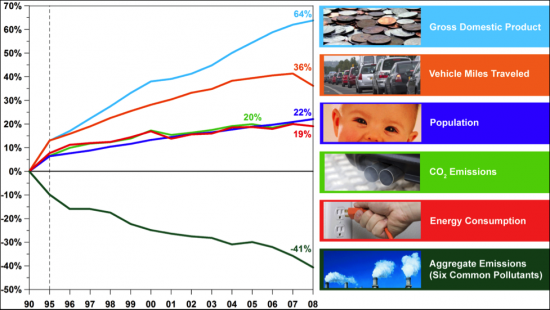 EPA reports that air quality has improved for the six main air pollutants:
Since 1990, nationwide air quality has improved significantly for the six common air pollutants. These six pollutants are ground-level ozone, particle pollution (PM2.5 and PM10), lead, nitrogen dioxide (NO2), carbon monoxide (CO), and sulfur dioxide (SO2). Nationally, air pollution was lower in 2008 than in 1990 for:
EPA reports that air quality has improved for the six main air pollutants:
Since 1990, nationwide air quality has improved significantly for the six common air pollutants. These six pollutants are ground-level ozone, particle pollution (PM2.5 and PM10), lead, nitrogen dioxide (NO2), carbon monoxide (CO), and sulfur dioxide (SO2). Nationally, air pollution was lower in 2008 than in 1990 for:
- 8-hour ozone, by 14 percent
- annual PM2.5 (since 2000), by 19 percent
- PM10 , by 31 percent
- Lead, by 78 percent
- NO2 , by 35 percent
- 8-hour CO, by 68 percent
- annual SO2 , by 59 percent

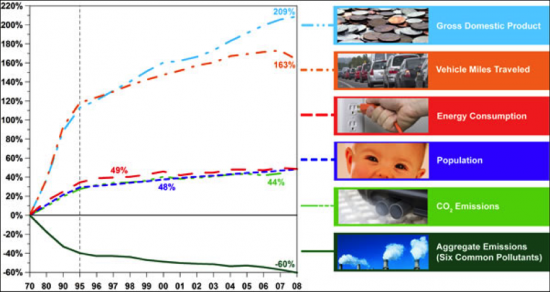 The Bad News: the Press Does Not Seem Interested in Telling the American People Our Air Quality has Dramatically Increased
This is good news that air quality continues to improve and even more so because the American people do not know it. According to a 2004 poll from the Foundation for Clean Air Progress, only 29 percent of people thought that "America's air quality is better than . . . it was in 1970."
One reason that the American people do not know this is because the press does not report on it.  So far not one major newspaper has written a story about the good news in this air trends report--there's nothing from the Washington Post, New York Times, Los Angeles Times, or any of the other major news outlets. The only story we could find is from E&E News (a subscription-based environment and energy news service) and even then it was the 12th story in their afternoon publication.
It's tough for the American people to lean to the truth about air quality when the media does not report the good news.
The Bad News: the Press Does Not Seem Interested in Telling the American People Our Air Quality has Dramatically Increased
This is good news that air quality continues to improve and even more so because the American people do not know it. According to a 2004 poll from the Foundation for Clean Air Progress, only 29 percent of people thought that "America's air quality is better than . . . it was in 1970."
One reason that the American people do not know this is because the press does not report on it.  So far not one major newspaper has written a story about the good news in this air trends report--there's nothing from the Washington Post, New York Times, Los Angeles Times, or any of the other major news outlets. The only story we could find is from E&E News (a subscription-based environment and energy news service) and even then it was the 12th story in their afternoon publication.
It's tough for the American people to lean to the truth about air quality when the media does not report the good news.
Our Air is Getting Cleaner
Today we can breathe easier knowing that our air is much cleaner than in the past. Even though the media is not reporting this good news to the American people, our air quality has substantially improved and will continue to improve. The data shows the truth.View Comments
Institute for Energy Research——Bio and Archives
The Institute for Energy Research (IER) is a not-for-profit organization that conducts intensive research and analysis on the functions, operations, and government regulation of global energy markets. IER maintains that freely-functioning energy markets provide the most efficient and effective solutions to today’s global energy and environmental challenges and, as such, are critical to the well-being of individuals and society.