The BC “Land Back” movement is now in overdrive
Majorities have also expressed concern that private property rights are being subordinated to vague collective ones rooted in indigenous storytelling;

Hymie Rubenstein , Bio and Archives--August 20, 2026
Canadian News, Opinion | Comments | Reader Friendly | Subscribe | Email Us

The Epoch Times has revealed that more than 135,000 hectares--1,350 square kilometres--of British Columbia Crown land has been identified or committed for transfer to Indian Bands through modern treaties and other agreements, according to provincial documents released on August 10. The area is roughly 12 times the 114-square-kilometre size of Vancouver.
The province is also negotiating five separate treaties with the Te’mexw Treaty Association (TTA) that include approximately 1,565 hectares of Crown land in proposed treaty settlement areas.
The lands include several prominent public properties in the Greater Victoria area and dozens of waterfront parcels in downtown Victoria, as mentioned below.
The settlement lands are detailed in five distinct modern treaties currently being negotiated together. The overall settlement is between the provincial government, the federal government, and the TTA, comprising the Songhees, Malahat, T’Sou-ke (Sooke), Beecher Bay (Scia’new), and Snaw-naw-as (Nanoose) Indian Bands.
The five treaties still require: (1) consultation with other Indian Bands who are claiming possession of parts of these same territories; (2) conclusion of negotiations, and ratification by the five Indian Bands, the B.C. government, and the federal government; and (3) treaty implementation in the final part of a six-stage process.
Overlapping territorial rights, a direct result of the wandering lifestyle of hunting, gathering, and fishing peoples around the world, should raise questions about the operation of loose and shifting land occupation before the European colonial era, ways of utilizing natural resources without owning territory in fee-simple terms.
But this contentious issue has not been made public in any detail.
Treaty Negotiations
Negotiations on the wider treaty with the TTA have been ongoing since the mid-1990s, with specific parcels of land, such as the Royal Roads University Campus, mentioned since 2023. TTA negotiations have been in Stage 5 since an agreement-in-principle was signed in 2015 at the end of Stage 4.
The province launched the most recent round of public engagement on May 29, 2026, noting that the agreements still require ratification before advancing to Stage 6, when specific long-term implementation plans will be made with each of the five groups. The province said it has engaged with affected municipalities, neighbouring property owners, businesses, and other Indian Bands that the treaty transfers could impact.
The province has not detailed what this “engagement” has consisted of.
In June 2026, the B.C. government released the full detailed maps of designated lands for transfer once the treaties are ratified. It also held a series of public open houses on the treaties. The maps show proposed treaty territory to be transferred throughout Greater Victoria, Sooke, and up to Nanoose Bay and Parksville on Vancouver Island.
According to the Epoch Times, the B.C. government said that if these transfers are completed, public access and recreational opportunities for the provincial parks would still be safeguarded under the terms of the treaties.
Land Rights Transfers
The B.C. NDP government has said the proposed treaties don’t include any privately owned fee-simple land, “except lands already owned by the respective TTA Member Nations.”
Once transferred, treaty lands would not be subject to external zoning rules. Their transfer would also bring along legislative power over land and resources, health and social services, and other areas such as education and further treaty rights.
As always, provincial and federal governments will require non-Indigenous taxpayers to fund these efforts.
The Cowichan Decision
The potential transfer of lands under TTA treaties comes amid broader questions over land rights in B.C. in the wake of last summer’s landmark Cowichan decision.
In the Aug. 7, 2025, ruling, the B.C. Supreme Court recognized aboriginal title over approximately 800 acres in Richmond, including Crown and municipal land, and some areas containing privately owned land. Justice Barbara Young said aboriginal title is “a prior and senior right to land,” while also finding that it can coexist with fee simple ownership, a controversial ruling if there ever was one.
The province and federal government have appealed the decision. At the same time, the Cowichan Tribes notes that it did not ask the court to invalidate fee simple titles currently held by private landowners and that it has no plan to do so, a decision many landowners fear it could always reverse.
DRIPA Effects
Uncertainty over indigenous land and resource rights intensified in December 2025 when the B.C. Court of Appeal ruled that the province’s mineral-claims regime was inconsistent with the Declaration on the Rights of Indigenous Peoples Act (DRIPA), which incorporates the United Nations Declaration on the Rights of Indigenous Peoples into B.C. law.
B.C. Premier David Eby said on April 1 that he planned to pause or change parts of DRIPA as it raised “serious legal liabilities.” However, he quickly reversed course on April 20 after pushback from Indian Bands, saying that B.C. would continue to negotiate with them in private instead.
In June, the province extended a freeze on new mineral claims across broad swathes of northern B.C. until January 31, 2027, as negotiations on mineral rights continued with several Indian Bands who never used these resources before the colonial era and would never use them today had they not been colonized by technologically advanced outsiders.
BC Conservative Opposition
The figures released by the province this week have drawn criticism from the BC Conservatives, and the party’s leader, Kerry-Lynne Findlay, is calling on the NDP-led provincial government to cease all further land transfers immediately.
“Handing over public assets at this vast scale in secret deals is a direct betrayal of our democracy that treats British Columbians, who own this province, as non-existent,” Findlay said in a statement. “And what is worse, this is only the beginning. There are still over 150 Indigenous bands in B.C. to be dealt with. There will be nothing left of B.C. by the time they are finished.”
She also urged Eby to recall the legislature to repeal “these unfounded agreements, and start the process over this time with full transparency instead of these backroom handovers.”
Eby has yet to respond adequately to these comments or other claims and negotiations about the land-back process his government has strongly promoted.
NDP Secrecy
As if these issues were not enough, the Western Standard, in a comprehensive piece titled Is the NDP secretly giving away 24 million acres?, has pointed out that the Conservative Party of BC is claiming nearly 24 million acres and over a trillion dollars in mineral wealth are at stake under a “secretive” land “handover” process.
As expected, all the other parties call this claim “misinformation.”
On August 10, the Public Accounts listed 334,643 acres of provincial Crown land as treaty obligations. The largest slices were clear: 113,147 acres for Kitsumkalum, 87,203 acres for Kitselas, 34,461 acres for Wuikinuxv, and 23,411 acres for another indigenous group.
The Conservatives did not stop there with their criticisms.
They also added the Tahltan Indian Band’s asserted traditional territory--95,933 square kilometres, or about 11% of British Columbia. That works out to roughly 23.7 million acres, an area larger than Portugal.
Inside that territory sits a large share of the Golden Triangle, where the B.C. Geological Survey has estimated $1.28 trillion in contained metal value.
Is 24 Million Acres Up For Grabs?
Put together, the Conservatives said, that is “up to 24 million acres” that could be up for grabs.
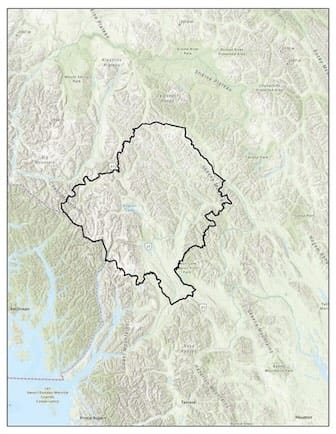
Map of Tahltan Territory showing the area covered under the 2022 Maps Declaration Act Consent Decision-Making Agreement between the Province of British Columbia and the Tahltan Band.
The black outline and hatched area above represent Tahltan’s asserted traditional territory in northwestern British Columbia, including the Telegraph Creek, Iskut, and Dease Lake regions.
The Conservatives also pointed to the Te’mexw treaty process.
Roughly 30 Crown parcels are on the table here, including two downtown Victoria parking lots across from the legislature, Hatley Castle and the Royal Roads grounds, Discovery Island, and Sooke Mountain provincial park.
The Conservatives described the deals as “secret,” said the NDP was preparing to “hand over” vast areas of Crown land, and argued the public was being shut out of decisions that will reshape the province.
The Public Accounts figure of 334,643 acres mentioned above is accurate. The hectare totals published by the province convert cleanly to the acre figures the Conservatives cited for Kitsumkalum, Kitselas, Wuikinuxv and one other.
Those lands are listed as contingent liabilities--commitments that take effect if the relevant treaties are finalized--not land already transferred. On the arithmetic and the source document, the Conservatives are correct.
The Tahltan territorial size is also correct.
The Indian Band itself, and provincial references, consistently use 95,933 square kilometres, or about 11% of British Columbia. The conversion to roughly 23.7 million acres is standard. The $1.28 trillion mineral estimate comes from a British Columbia Geological Survey valuation of contained metal in the Golden Triangle. Both figures check out.
The Te’mexw parcels are real, too.
What Do These Numbers Mean?
The real fight is over what those numbers actually mean.
Within hours of the Conservatives going public, the Tahltan Central Government fired back.
On August 14, it released a statement calling the claim false. Kerry Carlick, president of the Tahltan Central Government, said British Columbians “deserve facts, not fear.”
He accused both the Conservative Party of BC and the OneBC Party of repeating unsupported claims that create unnecessary fear about inherent indigenous rights.
According to the Tahltan, the work under the 2020 Shared Prosperity Agreement has been public--land-use planning, environmental stewardship, economic development, and a stronger government-to-government relationship.
A negotiated foundation agreement was always identified as the next step. “There is nothing secret about this work,” the Tahltan say.
The province has taken the same position.
Ministry officials say there is no mandate to transfer the entire traditional territory. The Shared Prosperity Agreement, they argue, is a framework for shared decision-making and the transfer of specific, agreed-to lands in community areas--not a plan to convey all 95,933 square kilometres.
In fairness to the government’s position, the “secret” part of the Conservatives’ claim is exaggerated.
The Shared Prosperity Agreement itself has been a public document since 2020. Both the province and the Tahltan Central Government point to ongoing public processes around land-use planning and stewardship. Calling the entire effort secret is difficult to sustain once those records are examined.
On this narrower point, the “misinformation” label seems reasonable.
From No Misinformation to No Transparency
Not so for the issue of “transparency.”
In May, the Public Land Use Society released findings from Freedom of Information records. Those records showed years of negotiations on a Foundation Agreement that contemplated land and governance changes, title recognition, and authority across roughly 11% of the province. But more than 400 pages were withheld.
This fits a recurring pattern. The shíshálh Nation agreement was signed weeks before the 2024 election and kept from public view until after the vote. Non-disclosure agreements were heavily used during consultations on proposed DRIPA amendments. FOI requests on aboriginal title and governance files routinely return large volumes of redacted material.
At the same time, no published mandate or agreement transfers fee-simple title to the full 23.7 million acres.
The Conservatives treat the recognition principle as evidence of an imminent full handover; the Tahltan Central Government and the province unequivocally reject that reading.
Before turning to the Victoria parcels, here is a clear accounting of what holds up on the Tahltan claims and what does not, according to the Western Standard.
The territorial size checks out. The Tahltan Nation and provincial references consistently put the traditional territory at 95,933 square kilometres, or about 11% of British Columbia--roughly 23.7 million acres.
The $1.28 trillion mineral estimate for the Golden Triangle is also accurate, drawn from a British Columbia Geological Survey valuation.
The 2020 Shared Prosperity Agreement states that foundation-agreement negotiations will be based on recognition of Tahltan aboriginal title and rights in the territory. And significant portions of the detailed negotiation record have been withheld from public view, as the Public Land Use Society’s Freedom of Information work showed.
What does not fully hold up is the claim that the NDP is executing a “secret plan” to transfer the entire 23.7 million acres.
The core Shared Prosperity Agreement has been public for more than five years. Some planning work has been public. Both the province and the Tahltan Central Government deny any mandate to convey the whole territory.
The strongest version of the “secret deals” framing therefore overreaches.
Opacity exists here, certainly, but the process is not entirely hidden or secretive.
The Te’mexw file offers a miniaturized version of the same issue.
Roughly 30 Crown parcels are listed as proposed treaty settlement lands in Stage 5 negotiations with the Te’mexw Treaty Association. These include two downtown Victoria parking lots across from the legislature, Hatley Castle and the Royal Roads grounds, Discovery Island, and Sooke Mountain Provincial Park. The parcels appear in the Public Accounts. They have not yet been transferred either.
They remain Crown land until the Bands, the province, and Canada ratify a final treaty and formally transfer the land.
What is being hidden from the public in this process are overlapping claims by other groups.
The Songhees and Esquimalt Nations both assert rights in the Victoria area, and they are currently adverse parties in ongoing litigation over aboriginal title. Court records show the Esquimalt have filed a title claim covering land in Victoria in which the Songhees appear as a defendant.
Whether the province could seamlessly transfer the proposed Te’mexw parcels, even if it wanted to, remains unclear.
What the Public Says
Still, public opinion is relatively clear on the entire land-back issue.
A Research Co. survey conducted in early August found 61% of British Columbians want all negotiations involving aboriginal title agreements paused until the Cowichan Tribes case is resolved.
Earlier Angus Reid polling showed nearly half of respondents supporting the repeal of DRIPA, including a notable share of past NDP voters. Majorities have also expressed concern that private property rights are being subordinated to vague collective ones rooted in indigenous storytelling.
Finally, there are the issues of the Crown ownership, on behalf of the citizenry, of the entire Canadian land, river, and inland sea mass, on the one hand, and adverse possession (so-called squatters’ rights) and fee-simple ownership by non-aboriginals who have legally lived on, possessed, and transmitted their properties for generations.
View Comments
Hymie Rubenstein, a retired professor of anthropology at the University of Manitoba, is editor of —REAL Indigenous Report.