The Cost of Voting
The cost and consequences of not voting are too grave to contemplate. Vote, no matter what;
Dr. Sam Clovis , Bio and Archives--October 14, 2026
Cover Story | Comments | Reader Friendly | Subscribe | Email Us
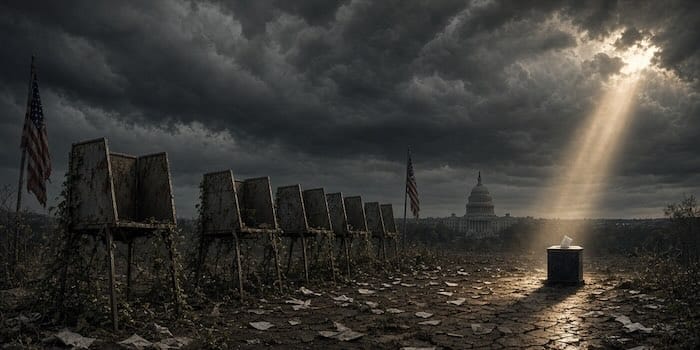
The 2026 mid-term election is barely two weeks away. Turn-out is always a big issue during any election, but the mid-terms generally draw far fewer voters than those elections where the president is at the top of each party ticket.
There was a time in our history when over 80% of eligible voters cast their ballots. As the country dealt with a civil war and the acceleration of the industrial age, voters turned out in droves.
Sadly, as the nation had to deal with the Great Depression, voter turn-out diminished precipitously, down from the historic 80+% turn-out to barely 60% during presidential election cycles. Mid-term turn-out lagged the general election turn-out by 20% or more. Thus, the party that could whip the most voters to cast their ballots, the more likely that party would be successful in advancing its electoral agenda. In the many races of consequence in the country this time around, control of the House and Senate are very much in play. If the Democrats tip both houses in their favor, the last two years of President Trump’s administration will be filled with disorder and revenge. Perhaps the fall-out of this election may be the bottoming out of politics in this country, the likes of which the nation has never experienced.
So, what is the cost of your vote? In economic terms, we look at opportunity cost and transaction cost. Opportunity cost is very simple to understand. If you go to vote, either by absentee or walk-in, what are you giving up to do so? In that hour it takes you to go to your polling place and going through the process of voting, what have you given up? Did you give up an hour with your family? Did you give up having a beer with the gang after work? Did you have to wait an hour to go to the grocery store? Did you have to get someone to pick up your kids from school so you could vote? As one can see, the opportunity cost of voting is relatively low, so there is little excuse for not voting as what you might give up is inconsequential.
So, what about transaction cost? This is the actual cost of going to vote as it measures the time it takes to vote, the gasoline it takes to drive to the polls, the time you take in line and in actually voting, and then the time and energy it takes to go on about your business of the day. Again, the transaction costs are relatively low for such an important act.
Voting is one of the great privileges of living in a constitutional republic. Every single person who has reached voting age (and a citizen and not a convicted felon) has the right to participate in free and open elections where the people, collectively, make a statement about what kind of government administration will operate for the next two to four years. Each vote brings the weight of decision on those who seek office. Those that win a political race then have the responsibility to do the bidding of the people (at least, that is how it is supposed to work).
As all citizens have the right and privilege to vote, those same citizens have an obligation to vote. Our founding fathers were adamant about building into our political institutions and processes the fact that citizens would be active participants in our governing and governmental processes. Voting, then, is a singular obligation that must be met every election cycle. Remember, the party that whips the most votes gets a stronger voice in how we govern ourselves. Staying at home or away from the polling places indicates you will be happy with whatever government shakes out after all the votes are counted. The cost and consequences of not voting are too grave to contemplate. Vote, no matter what.
View Comments
Samuel H. Clovis, Jr., Doctor of Public Administration
Liston to Sam on LATalkRadio, Sundays: 1:00 to 3:00 PM (PST)
(Impact With Sam Clovis)
Sam Clovis was raised in Kansas and attended the United States Air Force Academy, serving for 25 years on active duty as a fighter pilot. He retired as a Colonel and the Inspector General of NORAD and the United States Space Command.
Sam served as a Fellow at the Homeland Security Institute, contributing in national preparedness and immigration policy. He recently served as a tenured full professor of economics at Morningside College.
Sam has a BS from the Academy, an MBA from Golden Gate University and a doctorate from the University of Alabama. He served as national co-chair and chief policy advisor for the Trump for President Campaign, was a policy director during the transition period and served as the Senior White House Advisor to the US Department of Agriculture. He currently lives in rural Iowa.