The final arbiters of the Constitution is us
Constitutional Executive Authority

Douglas V. Gibbs , Bio and Archives--October 2, 2025
American Politics, News | Comments | Reader Friendly | Subscribe | Email Us
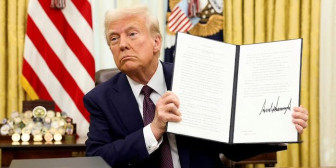
Article II of the United States Constitution establishes the Executive Branch. The Constitution establishes the President of the United States with executive power, which means he is the head of the Executive Branch. That makes the President of the United States the one in charge of everything attached to the Executive Branch. This power is established by the following language: “The executive Power shall be vested in a President of the United States of America.”
“Executive Power” means the authority to execute the laws of the United States. The departments and agencies that exist within the Executive Branch exist for the purpose of serving as tools for the President to execute the laws; a constitutional duty spelled out at the end of Article II, Section 3. “…he shall take Care that the Laws be faithfully executed…”
The word “vested” means that the President exclusively possesses executive power. The word “vested,” which exists in the first sentence of each of the first three articles of the Constitution, is the basis for the constitutional doctrine of a separation of powers. That means the President may operate as head of the Executive Branch: reorganizing, changing pay, firing employees and using those agencies to execute the law as he pleases.
While there is an unconstitutional political and judicial construct that states the Constitution is living and breathing so it may be interpreted based on current language or practices, the idea of “interpretation” as is modernly applied exists nowhere within the text of the Constitution. Despite the claims of the federal court system, past Presidents, the media, historians and the ramblings of the political class the duties of the different branches of government do not include constitutional interpretation. The job of the judges is to apply the law as written, despite their judicial opinion regarding the constitutionality of such laws based on their review. If they have a problem with a law, they may issue a judicial opinion of which the Congress may consider, but they are not required to follow it. The President also does not possess the power to interpret the law. The Constitution instructs that he execute the laws of the United States, regardless of his opinion regarding their constitutionality.
This is not to say that there are no final arbiters of the Constitution. If the President cannot refuse to execute a law based on his interpretation of its constitutionality, and federal judges have no authority to strike down a law due to their opinion of its constitutionality, then how do we stop unconstitutional laws from being created and executed?
Since the word vested appears in each of the first three articles of the Constitution that means that only the legislative branch possesses legislative authority, only the President possesses executive authority, and only the courts possess the authority to apply the law and the Constitution to the cases they hear. That means that not only does the executive branch and judicial branch fail to possess the authority interpret the law or the Constitution, but also they do not possess the authority to legislate. That means the judges may not legislate from the bench, which includes striking down law. And, the President of the United States may not establish, modify or repeal law with an executive order. Executive Orders exist only for the purpose of providing a proclamation that is not legally binding, like George Washington’s Thanksgiving Proclamation, Abraham Lincoln’s Emancipation Proclamation, and Ronald Reagan’s proclamation calling for a National Day of Prayer; or to serve as a means of communicating to the different parts of the Executive Branch on how to execute the laws of the United States.
If a law is unconstitutional, and neither the President nor the federal court system may do anything about it, then how do we deal with unconstitutional legislation?
Legislative Powers belong to Congress, the Legislative Branch. According to Article I, Section 1: “All legislative Powers herein granted shall be vested in a Congress of the United States, which shall consist of a Senate and House of Representatives.”
Legislative Powers are the ability to create, modify and repeal law. “Herein granted” means that the Congress may only make legislation authorized by the Constitution, which requires that the power is expressly enumerated in the text of the U.S. Constitution. So, the power to interpret a law as being unconstitutional and then repealing it in response belongs to the law-givers.
But, what if Congress is compromised, and they are purposely passing unconstitutional laws and are unwilling to carry out their constitutional duty of eliminating any laws that exist without any constitutional authority?
We seem to often forget that the Constitution begins with the words, “We the People,” and that as a constitutional republic there are mechanisms in place that allows us, and the States (the powers of the latter nearly eroded over the last two centuries) to check the federal government and even change it and the office-holders through various means that may include voting, nullification, or even an Article V. Convention. In short, the final arbiters of the Constitution is us.
In 2024, the American People took action to put into the Office of the President a man they believed would operate in their interest, and move America back toward the Constitution. The result has been a Donald J. Trump presidency that has taken energetic actions to achieve a long list of constitutional goals from an accurate execution of the Fourteenth Amendment’s Citizenship Clause and the Civil Rights Act of 1866, which support the concept that Birthright Citizenship does not apply to those subject to a foreign power to laws that allow the President to operate in the field of foreign relations without congressional oversight to the ability to use the militia (National Guard) to execute the laws of the United States as laid out in Article I, Section 8 of the Constitution.
In response, those who oppose the Constitution and President Trump have conjured every lawfare tool they can imagine into existence to stop President Trump’s agenda. The federal inferior courts have been using universal injunctions (of which the United States Supreme Court has ruled against) and other tools to micromanage the actions of the President of the United States. Their claims? His actions violate the Constitution.
Judges have no constitutional authority to micromanage the President. Such a move violates the doctrine of a Separation of Powers, and they also have no enforcement arm to carry out such orders. The enforcement arm of the federal government is the executive branch, and if the President of the United States believes the courts are out of line he has every constitutional authority to tell them to take a hike. That’s what Thomas Jefferson did when the Supreme Court ordered him to give William Marbury his judicial commission, and that is what Andrew Jackson told the courts regarding their ruling in Worcester v. Georgia with the famous quotation, “John Marshall [Chief Justice] has made his decision, now let him enforce it.”
When examining the constitutionality of President Trump’s executive orders, one must only ask if a law is in place that supports it. And in each of the cases which the courts and the media claims Trump is operating outside his constitutional authority, the reality is that President Trump is operating within constitutional limits.
Immigration law, for example, is a federal authority, and any state law contrary to federal immigration law (as per Article VI.), including sanctuary laws, are unconstitutional. So, despite a state governor’s or state legislature’s protests, President Trump may use ICE and Border Patrol to operate within the states to execute immigration law. The President may also use the National Guard as a means of support because of Article I, Section 8.
As per the Alien Enemies Act of 1798 the President has the authority to restrain or remove nationals of a hostile nation, and it does not require the existence of a declared war or invasion despite the presence of such arguments. The Alien Enemies law was passed, signed by President John Adams, and used during the final years of his presidency during a time when there was no war being engaged.
That precedent alone reveals that there does not have to be a war or invasion in progress for the law to be triggered. As a result, if the President believes the presence of these persons poses a threat to public safety or national security, the law may be activated.
While the power to tax is given to Congress in Article I, Section 8, the International Emergency Economic Powers Act was passed based on the realization that sometimes the use of tariff powers need the quick and decisive actions that only the President is capable of. So, the law allows the President to regulate imports and set tariffs during times of unusual threats to national interests.
Those are only a few examples of current issues that the courts have been overstepping their limits regarding while attempting to limit the powers of the President. The executive power is not subject to approval from Congress nor any micromanaging by the courts. And if the President is operating outside the Constitution the constitutional checks are not possessed by the courts. Those powers belong to Congress. If a President is operating in a manner that Congress believes is beyond his constitutional authorities, they may defund the operations, pass laws (which they can do without his signature if they have two-thirds support from each House of Congress), or impeach. Beyond that, the powers to take action belongs to the states (who can nullify laws they believe to be unconstitutional, at risk of backlash from the public if their citizens disagree with them) or to the people who through their voting power, their free speech power, their assembly power, or their power to petition the government for a redress of grievances.
In short, the powers taken by politicians, judges and other political enemies of the Constitution actually belong in the hands of the people and the states – but those powers only matter if we are willing to wield them.
View Comments
Douglas V. Gibbs of Political Pistachio Conservative News and Commentary, has been featured on “Hannity” and “Fox and Friends” on Fox News Channel, and other television shows and networks. Doug is a Radio Host on KMET 1490-AM on Saturdays with his Constitution Radio program, as well as a longtime podcaster, conservative political activist, writer and commentator. Doug can be reached at douglasvgibbs [at] yahoo.com or constitutionspeaker [at] yahoo.com.