Far Better Than DrudgeUnfiltered News • Daily Headlines

The Gift of an Unfinished Story

You don’t have to finish everything to have lived well. You have to trust the One who will;


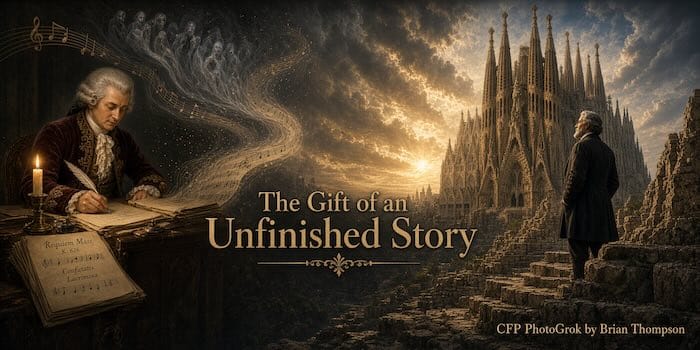
On February 20, 2026, a crane lifted the last arm of a cross to the top of a tower in Barcelona. With it, the Sagrada Família became the tallest church on earth (Guinness World Records, 2026). The man who designed that tower never saw it. Antoni Gaudí was struck by a tram and died in 1926 (Aleteia, 2026), forty-four years into a project that would outlive him by a century (Sagrada Família, 2026). On the anniversary of his death this June, the church gathered for a Mass at the foot of the tower he imagined.


And still the building is not done. One of its great façades awaits completion (Serratore, 2026). Generations of architects and masons have laid stone for a design they inherited and will pass along unfinished.

We admire that, and then we quietly resent it. We want our own stories to have clean endings: the business launched and profitable, the diagnosis resolved, the book finished. When the ending doesn’t arrive, we suspect something failed, whether our faith, our will, or our planning.

I want to suggest another reading. The inability to finish everything we start is not a verdict on our faith. It is a part of our journey here on earth, and Scripture treats it as an invitation: the story was never ours to finish. We are given a chapter, and the One who wrote it is the One who will complete it.

Nearly a century before Gaudí set his first stone, another artist ran out of time. In the summer of 1791, an anonymous messenger commissioned Mozart to write a Requiem Mass. Mozart died that December at thirty-five, with the work unfinished. The manuscript breaks off in the Lacrimosa, a movement about weeping on the day of judgment, after only eight bars (Swafford, 2020). His widow, Constanze, needed the commission fee, and she eventually handed the score to his student, Franz Xaver Süssmayr, who completed it (May, 2023).

Today the Requiem fills concert halls around the world, finished by another hand. The music did not die with the composer. It passed on. Scripture knows this pattern well.


The Pattern in Scripture

Consider Moses. He spent forty years leading a complaining people through the wilderness, and on the last day of his life the LORD walked him to the top of Mount Nebo and showed him the whole land. “I have let you see it with your eyes,” God said, “but you shall not go over there” (Deut. 34:4 ESV). Moses was a hundred and twenty years old, and his eye was undimmed (Deut. 34:7). It was not a failure of stamina or of faith. His part of the story was finished, and the next part was not his.

What happens next is easy to miss. Scripture does not linger on Moses’ disappointment. It records that the LORD himself buried him, and then the book of Joshua opens with a sentence of striking calm: “Moses my servant is dead. Now therefore arise, go over this Jordan” (Josh. 1:2). The work did not die with the worker. God handed it to Joshua and carried it on.

Paul knew the same ground. He wrote to the Romans of his hope to reach Spain (Rom. 15:24), and Scripture never tells us he did. He begged three times for his thorn to be removed, and the answer he received was not a cure but a promise: “My grace is sufficient for you, for my power is made perfect in weakness” (2 Cor. 12:9). Paul’s life ended with the map only partly filled in. Yet from a Roman prison he could write with confidence about the work of God that would outlast him.


The writer of Hebrews gathers all of these lives into a single verse that every entrepreneur, parent, and pastor should memorize. After a long catalog of faithful servants, the author says that all of them “did not receive what was promised, since God had provided something better for us, that apart from us they should not be made perfect” (Heb. 11:39–40). Abraham, Moses, Rahab, and the unnamed martyrs are not waiting on us out of frustration. The completion of their story and the completion of ours are the same event, and it belongs to God.

That changes how we hold our own unfinished chapters. Gaudí did not need to see the tower for the tower to be real. Mozart did not need to write the last bar for the Requiem to be sung. And we do not need to see the last page of the business, the family, or the calling to know that God is in the ‘Finishing Business.’

Which raises the harder question. It is one thing to admire this from a concert hall or a cathedral. It is another to live it when the sea is rough.


Peace in the Boat

The disciples knew what a rough sea feels like. In Mark 4, a furious windstorm swamps their boat, with Jesus asleep on a cushion in the stern. “Teacher, do you not care that we are perishing?” (Mark 4:38). He wakes, speaks to the wind and the waves, and says, “Peace! Be still!” (Mark 4:39).

In Matthew 14, the storm comes again, and this time He is not in the boat. The disciples are far from land, beaten by the waves, with the wind against them. Jesus comes to them in the dark, walking on the very water that frightens them. “Take heart; it is I. Do not be afraid” (Matt. 14:27).

Notice what He does not do. He does not first quiet the sea and then ask for their trust. He arrives in the middle of the storm, and the storm is still raging while He is saying “take heart.”

John the Baptist understood this better than anyone. From Herod’s prison he sent the question that unfinished stories provoke: “Are you the one who is to come, or shall we look for another?” (Matt. 11:3). Jesus did not open the prison door. He sent word of what was happening, the blind seeing and the lame walking, and added a gentle line: “Blessed is the one who is not offended by me” (Matt. 11:6). Then He turned to the crowds and declared that no one greater than John had been born (Matt. 11:11). John had said, “He must increase, but I must decrease” (John 3:30). His chapter ended in a cell, in the same chapter of Matthew that carries the storm (Matt. 14:1–12), and the One he served did not leave the story unfinished.

This is the peace of which Isaiah wrote: “You keep him in perfect peace whose mind is stayed on you, because he trusts in you” (Isa. 26:3). It is the peace of the Prince of Peace (Isa. 9:6), who said, “In the world you will have tribulation. But take heart; I have overcome the world” (John 16:33).

Horatio Spafford learned this lesson in the worst season of his life. The Chicago lawyer saw most of his real-estate investments destroyed in the great fire of 1871, and then lost all four of his daughters when their ship sank in the Atlantic in 1873 (Library of Congress, 2005). By long tradition, he wrote his hymn as his own ship passed near the place where they were lost. “It Is Well with My Soul” has been sung ever since, and its first image is a river of peace running alongside the rolling billows of sorrow.


Living Faithfully Forward

So how do we live between the laying of the cornerstone and the final placement of the cross on the building’s steeple?

We faithfully do today’s work, and leave tomorrow’s to Him. We plant what we may not harvest and build what others will finish (Ecclesiastes 11:6). Joshua took up Moses’ work, and Süssmayr took up Mozart’s, and someone will take up yours. For an entrepreneur this may be the hardest lesson and the most freeing: the business, the ministry, and the family are not yours to complete, only to steward well.

Gaudí understood this. He planned a church that generations of other hands would build. Today a cross crowns the tower he never saw, and the cranes are still at work. Paul wrote to the Philippians with the same confidence: “I am sure of this, that he who began a good work in you will bring it to completion at the day of Jesus Christ” (Phil. 1:6).

You don’t have to finish everything to have lived well. You have to trust the One who will.

Sources:

Aleteia. (2026, February 21). Spain’s Sagrada Familia reaches its full height.

Guinness World Records. (2026). Tallest church/cathedral spire

Library of Congress. (2005, March 4). The American Colony in Jerusalem: Family tragedy. 

May, T. (2023, June/July). Wolfgang Amadeus Mozart: Requiem, K. 626. Nashville Symphony. [Program notes]. .

Sagrada Família. (2026, June 11). Pope Leo XIV blessed Sagrada Família’s Tower of Jesus Christ on centenary of Antoni Gaudí’s death [Press release]. PR Newswire. .

Serratore, A. (2026, March 12). Watch exclusive drone footage of the crowning of the Sagrada Família, the world’s tallest church. National Geographic. 

Swafford, J. (2020). Mozart: Requiem. Boston Symphony Orchestra. 


Read next: Ontario Squatters At The Canadian Embassy In Washington Not Telling The Whole Story

Email Us | Reader Friendly | Comments

Joseph J. Bucci—— Joseph J. Bucci has served as a Pastor, Author, HR Director, Director of Training, Professor and Consultant. He teaches in the College of Arts and Sciences at Regent University in Virginia Beach. He has written two books and numerous articles on the theme of integrating faith with life and our work. You can contact Dr. Bucci at: Joseph J Bucci