The Left Must Acknowledge The Crisis Of Our Plummeting Birthrate And Help Turn It Around
We need to get back to the Godfearing and fruitful childbearing nation that made us exceptional

Col. Bill Connor , Bio and Archives--April 25, 2025
American Politics, News | Comments | Reader Friendly | Subscribe | Email Us
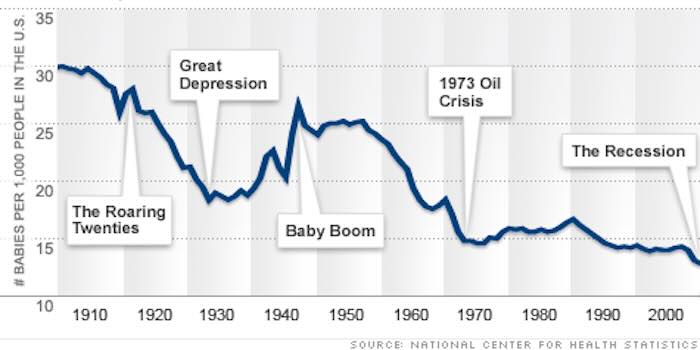
This past week, the issue of our nation’s birthrate crisis broke through all the other news stories taking center stage. On Wednesday, the CDC released the data about the critically low birthrate, confirming the problem remains acute: “Overall, the number of births declined by 2% per year, on average, from 2015 through 2020 and fluctuated in the years since.” (Source)
In perspective, until the mid 2000s, the US birthrate was at the maintenance level of 2.1 average children per woman but then fell to 1.6 after the 2008 economic crash. Also last week, the Trump administration announced a proposal to provide $5000 for newborns to mothers and fathers. Trump stated he believes that was “a good idea” to help foster childbirth to come out of the crisis. As has come to be expected, the left slammed Trump’s proposal with the usual attacks. The women of “The View” went so far as to insinuate the plan was racist, despite the $5000 going to all mothers regardless of race. CNN’s reporting on the Trump proposal and birthrate crisis stigmatized those concerned about the falling birthrate as “Pronatalists” while hammering Trump’s plan (Source)
Other mainstream news outlets were similarly dismissive of the problem and critical of Trump. It’s past time Americans demand the left at least acknowledge the danger of the catastrophically low birthrate and support plans to turn it around.
First, despite the data, the left appears to be fighting to keep the low birthrate. In recent years, a number of Liberal female celebrities have publicized their alleged joy of being middle aged and childless seeking to encourage this lifestyle choice for younger women. (Source)
Whenever data evidences the plummeting birthrate, left-leaning media sources will inevitably attack the “pronatalist” movement and praise the wonders of feminism associated with low birthrates.
The birthrate crisis cuts across society and culture. In 2021, Pew Research Center published a survey showing that “a rising number of childless adults claim they are unlikely to have children. Of the nonparents aged eighteen to forty-nine who were surveyed, forty-four percent said it is ‘not too likely’ or ‘not at all likely’ that they would procreate, an increase of seven percent from 2018. And seventy-four percent of polled adults under fifty said they were unlikely to have more children after having one or two.”(Source)
In correlation with the plummeting birthrate is the disintegration of the American family. Well under half of American seventeen-year-olds have spent their life with the same (intact) father and mother. Those children of broken families have lower GPAs and educational attainment and a lower chance at marriage and having their own children in a stable environment. Children of broken families are not only educationally hindered but have poorer mental health and future employment. Critically in relation to childlessness, they are less likely to be married themselves, and live shorter lives. (Source)
Noted expert on families and society, Carle Zimmerman, wrote of the connection of a high birth to the strength of families: “we see [ever] more clearly the role of proles or childbearing as the main stem of the family” and that childbearing itself “creates resistances to the breaking-up of the marriage.” Zimmerman concluded that “the basis of (strong, enduring families) is the birth rate. Societies that have numerous children have to have (it). Other societies (those with few children) do not have it.” (Source)
Famed Historian Will Durant wrote of the importance of family to cultures throughout history. He described the role of the breakdown of the family to the fall of the Roman Empire: "A large number of native-stock Romans avoided wedlock altogether, preferring prostitutes or concubines even to a varied succession of wives. Of those who married, a majority appear to have limited their families by abortion, infanticide . . . and contraception" (Source)
The national economic impact from childlessness and broken families goes beyond the fewer workers producing and paying taxes. Married men with children are 27% more productive (with corresponding higher income) than single men. In terms of productivity, single men work the least, then divorced men, then cohabitating men, and then finally married men with children. Being married and father of multiple children brings men and women to their full, God-given potential.(Source)
Turning this existential childlessness problem around will not be easy. It will require a great deal of time and patience. The blessing for America is that we can turn it around, unlike a number of other Western and Asian nations which have come to such a low birthrate history shows they cannot recover. The first step is for all Americans, including those on the left, to acknowledge the problem and support “pronatalist” proposals. Beyond financial incentives, history tells us low birthrates correlate directly to declining levels of religious faith. As de Tocqueville said of exploding America of the 1830s with twice the birthrate of today “There is no other country on Earth in which the Christian religion retains greater sway over the souls of men than in America”. We need to get back to the Godfearing and fruitful childbearing nation that made us exceptional.
View Comments