The Long and Whining Road
How Canada’s Liberals Mastered Giving Quebec Separatists Something to Complain About--and Added Alberta to the Mix

Mark Macneill , Bio and Archives--October 8, 2026
Canadian News, Opinion | Comments | Reader Friendly | Subscribe | Email Us
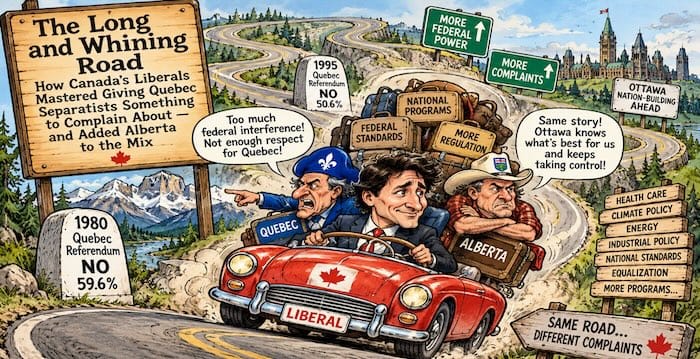
There are certain rituals in Canadian politics as dependable as February snow, April taxes, and Ottawa discovering that whatever problem confronts the country can be cured by another federal program. One of them is Quebec separatism.
Canada possesses a peculiar genius for recreating the circumstances of its previous constitutional crises
It is Canada’s long and whining road--a constitutional journey we have travelled for more than half a century while demonstrating the peculiar Canadian talent of covering enormous political distances only to arrive back at precisely the same argument. Consider the milestones. In 1980, René Lévesque’s Parti Québécois asked Quebecers to begin the journey toward sovereignty-association. In Ottawa sat Pierre Elliott Trudeau, newly restored to office, defending a Canada whose federalism bore his intellectual fingerprints unmistakably. Quebec said No.
Fifteen years later, Canada returned for the sequel. Jacques Parizeau’s Parti Québécois governed Quebec. Jean Chrétien’s Liberals governed Canada. Once again, Quebecers were invited to consider leaving. This time Canada survived by 50.58 per cent. In most democracies, winning by half a percentage point constitutes a victory. In Canada, it constitutes an invitation to spend the next thirty years discussing what the question really meant.
The historical symmetry is difficult to miss. On both occasions when Quebec actually went to the polls to decide its constitutional future, a Parti Québécois government occupied Quebec City and a Liberal government occupied Ottawa. Twice is not destiny. Correlation is not causation. History is under no obligation to rhyme merely because political columnists enjoy pointing out that it does. Still, Canada possesses a peculiar genius for recreating the circumstances of its previous constitutional crises.
The Liberals and the PQ are, in one sense, magnificent political antagonists. Each supplies something useful to the other. Quebec separatism allows federal Liberals to present themselves as the indispensable custodians of national unity. Federal Liberalism, in turn, has often carried an instinct toward centralization--the conviction that Ottawa should set national standards, attach national conditions and increasingly occupy fields that provinces regard as their constitutional preserve.
Increasingly, Alberta has entered that conversation
And therein lies the Canadian paradox. The more Ottawa reaches into the provinces in the name of building a stronger Canada, the more ammunition it can hand those Quebec nationalists who insist Confederation leaves Quebec too little room to breathe. Federalism intended to bind the country together can, when pulled too tightly, become the very thing against which separatism defines itself.
The PQ does not therefore have to invent Ottawa as an adversary. Ottawa, particularly when seized by the missionary enthusiasm of centralized Liberalism, can be remarkably obliging in auditioning for the part. Every new federal initiative can consequently have two lives. In Ottawa it is announced as nation-building. In Quebec City it may be received as intrusion. One government’s national standard becomes another government’s jurisdictional grievance. Ottawa announces that it is helping. Quebec replies that it wasn’t asked. Then everyone holds a press conference. But there is a new passenger on Canada’s long and whining road. We now know as Alberta, and it’s pending a referendum.
For decades, Quebec supplied the great Canadian argument over federalism: how much power belongs in Ottawa, how much belongs to the provinces, and how far a national government may reach before national unity begins to suffer from the cure prescribed for it. Increasingly, Alberta has entered that conversation. The grievances are not identical. Quebec nationalism grew from a distinctive language, culture and conception of nationhood.
Alberta’s alienation has been driven much more heavily by economics, natural resources, energy policy, equalization and the province’s relationship with the federal government. But beneath those considerable differences lies a remarkably familiar complaint: Who gets to decide?
As the country once again argues over who should decide what, who should pay for it, and who should be left alone
When decisions affecting the economic lifeblood of a province appear increasingly to be made hundreds or thousands of kilometres away, federalism ceases to be an abstract constitutional arrangement. It becomes intensely political. And here lies an irony worthy of Canada. A federal government determined to strengthen the country through national programs, national standards and national policies can discover that the more vigorously it pulls authority toward the centre, the more vigorously some provinces pull in the opposite direction. Quebec demonstrated where that road can lead. Twice.
The tragedy, or perhaps the comedy, is that Canadians already know the scenery. We know the speeches. We know the flags. We know the grievances. We know the solemn declarations that this time the future of Confederation hangs in the balance. Yet beneath all that constitutional theatre lies a lesson Canada periodically seems determined to forget. A federation does not survive because its central government possesses enough authority to make its constituent parts alike. It survives because those constituent parts retain enough autonomy to make remaining together preferable to leaving. Canada was not constructed despite its regional differences. It was constructed because of them. Forget that, and the road begins winding again.
Perhaps the Beatles had the title almost right. For Canada, it has never merely been The Long and Winding Road. It is the Long and Whining Road; stretching from Trudeau and Lévesque through Chrétien and Parizeau, and now westward toward Alberta, as the country once again argues over who should decide what, who should pay for it, and who should be left alone.
After all those miles, perhaps Canada has not discovered a new road at all. We have simply added another lane.
View Comments
C. Mark MacNeill is a lifelong student of legal history, political philosophy, and public affairs. He writes on issues ranging from constitutional and administrative law to public finance, governance, and Canadian political culture. His professional experience includes legal consulting, strategic advisory work, corporate governance, and public policy analysis.
He lives on Cape Breton Island, Nova Scotia