The Pacific Link Pipeline is not Going to Happen
Why not the alternative--America’s Bridger Pipeline

Colin Alexander , Bio and Archives--October 9, 2026
Cover Story | Comments | Reader Friendly | Subscribe | Email Us
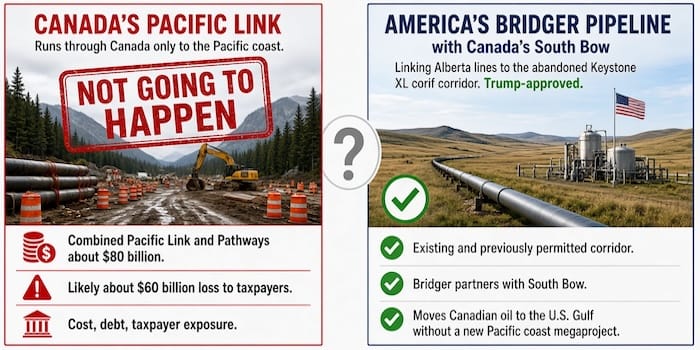
Any reasonable assessment of its economic viability finds the much-vaunted Pacific Link pipeline dead before starting. Its announcement may let the federalists win Alberta’s pre-referendum on independence on October 29. Then the sovereigntists’ movement could gather momentum when Albertans see they’ve been bamboozled.
The Trans Mountain pipeline is the place to start an evaluation, with its cost for taxpayers’ ownership of some $35 billion Canadian. Earnings are coming in around $600 million annually, after interest, taxes, depreciation, and amortization. However, Thomas Gunton says: “The only reason Trans Mountain looks like it’s making a profit is that most of the debt has been moved off their books.” He’s a professor and director in resource and environmental planning at Simon Fraser University
TMP Finance holds billions of the pipeline’s debts on its books. The problem is that interest is a real cost of doing business. Instead of that $600 million profit, the real annual return on taxpayers’ $35 billion is about 1.7 percent. Given the government’s borrowing cost of about 4.5 percent, taxpayers could really be losing $600 million annually. Unsurprisingly, however, Mark Maki, Trans Mountain’s Chief Executive Officer speaks of the declared profit as delivering “direct, measurable benefits for Canada.”
Worse yet, Trans Mountain’s toll, at some $11.50 per barrel, is double what Enbridge charges for transporting oil to the US. Apart from what they’ve already contracted for, oil producers would go for a lower cost option, if available. According to the Parliamentary Budget Office, taxpayers face a huge write-down. Reality now is that Trans Mountain has a market value of the order of $18 to 22 billion—say, $20 billion. Assuming, therefore, a successful sale around that price, the unrealized capital loss to taxpayers is some $15 billon.
The estimated cost of the Pacific Link pipeline is said to be $35.2 billion if finished in 2032, or $43.7 billion if finished in 2034 without accelerated approval. These numbers do not include inflation and financing costs during construction. The later finishing date is more likely given such obstacles as negotiation with Indigenous peoples. The probabilities favour the later forecast completion date.
We’re already getting on for two years since Prime Minister Mark Carney took office saying he’d get things done. For comparison, with a third of our current population in the 1950s, construction of the Trans Canada gas pipeline, over 3,500 kilometers from the Alberta–Saskatchewan border to Toronto and Montreal, took three years (1956–1958). That’s about three times the length of Pacific Link,
With inclusion of inflation and capital costs during construction that’s likely to face obstacles and delays, an optimistic ballpark cost may be around $50 billion.
Pacific Link is specifically tied to the Pathways Alliance project that the industry is expected to pay for, and then reclaim the cost with tax credits--ultimately its own loss to taxpayers. It’s to link production sites across northern Alberta, compress carbon dioxide and then transport it via pipelines to sites where it can be injected and stored underground. Pacific Link and Pathways are mutually dependent on each other. So it’s disingenuous to account for the two projects separately.
Given the problems with the technology for capturing and storing CO₂, these projects have been troubled with chronic underperformance, ballooning costs and technical failures. For example, in May 2024, Edmonton-based Capital Power cancelled a $2.4-billion project because it proved not to be “economically feasible.” Cenovus CEO Jon McKenzie has put cost of the Pathways project as high as $30 billion. For a reality check, that’s equivalent to $6,000 for every man, woman and child in Alberta.
The combined and likely optimistic cost of Pacific Link and Pathways comes in then at some $80 billion. Given that the pipeline’s capacity would be in the same general range as Trans Mountain’s, logically the two pipelines would have about the same market value for prospective arms’ length investors. That means a combined $60 billion loss to taxpayers.
Ironically, there’s another option for exporting oil, and President Donald Trump has already approved it. America’s Bridger Pipeline has partnered with Canada’s South Bow to link existing pipelines in Alberta with the abandoned Keystone XL system that President Biden killed. South Bow was created in 2024, when former Keystone XL proponent TC Energy spun it off.
Bridger would initially transport 550,000 barrels of oil daily in a 36-inch pipe across 1,040 kilometres to central Wyoming. It could be completed by early 2029, and capacity over a million barrels daily is foreseen. The route follows existing pipeline corridors, and avoids Indigenous tribal lands so that the cost is estimated to be of the order of $3 billion Canadian. That’s a rounding error relative to the Pacific Link’s potential for gigantic cost overruns on my combined estimate of $80 billion.
According to The New York Times, Canada’s position in trade negotiations has been silent about Bridger. Is that because it conflicts with the perceived national interest and the prospective result for the pre-referendum?
There’s’ another wild card for Pacific Link. What happens to the price of oil when Pacific Link comes on stream? The oilsands’ full-cycle mining cost is of the order of US$55 per barrel and the in situ cost is of the order of US$35. Over time there have been considerable reductions in the cost of production but there are limits to how far that can go. A price below about $40 per barrel leaves no room for filling the Pacific Link pipeline at any toll level.
Specifically, what happens to the price of oil with a recovery in production from any combination of Venezuela, Iran, Iraq, Russia and elsewhere? Older Albertans will remember the surge in price in 1980 after years prolonged low prices restricted production. And then, soon after Prime Minister Brian Mulroney rescinded the Liberals’ National Energy Program, the oil price collapsed down to $13. The NEP had capped the price of Canadian oil for the benefit of central Canada. But when producers needed it, the corresponding floor price was no longer there. Both ways, heads central Canada won and tails Alberta lost.
It’s weird that nobody calls Carney out for saying: “The Canadian taxpayer is going to make a lot of money on this pipeline.” With its potentially infinite cost, delayed construction, and a questionable price of oil, it’s not going to happen.
View Comments
Colin Alexander’s degrees include Politics, Philosophy, and Economics from Oxford. His latest book is Justice on Trial, Jordan Peterson’s book and others show we need to fix the broken justice system.