The Race Between Culture and Biology
Survival in Tough Times: As we begin to understand the destructive forces better, perhaps we can begin to prepare for the trials that lie ahead. Will there be any remnant of the old Republic left when those who have led its destruction claim their v

Dr. Bruce Smith , Bio and Archives--July 19, 2022
HeartlandLifestyles | Comments | Reader Friendly | Subscribe | Email Us
 Lots of things took me many years to finally understand. The list is very long, and there are many questions that remain unanswered. From the time one particular dilemma struck me, about 1966, until an answer dawned on me was probably 30 or more years later. My head is still spinning from it all.
It was the teen years, and I could not understand why young people had all these crazy feelings and hormones and urges, but we weren’t supposed to indulge any of them.
Lots of things took me many years to finally understand. The list is very long, and there are many questions that remain unanswered. From the time one particular dilemma struck me, about 1966, until an answer dawned on me was probably 30 or more years later. My head is still spinning from it all.
It was the teen years, and I could not understand why young people had all these crazy feelings and hormones and urges, but we weren’t supposed to indulge any of them. There were many sermons cautioning us about the temptations of avarice and covetousness
Every week in church I heard about restraint and license and temptation and hellfire. There, even playing poker and dancing was just a short downhill skip to the edge of hell. Drinking was worse, I was assured on many occasions. One of my dad’s cousins told me that I had the drinking gene, just like others in my family who had died before I ever had a look at them. “Just one drink,” he told me somberly one day “and you’ll be a drunk forever.” I was a little skeptical, even then, but there was never any liquor or beer in our house. I was genuinely frightened a couple of years later when, at this same cousin’s house, my dad was offered a glass of wine on New Year’s Eve. My dad took it, then put the glass down when he had finished it. I watched him carefully for the next couple of weeks for the inevitable decline into sloth and degradation, but it never happened. That was a close one. There were many sermons cautioning us about the temptations of avarice and covetousness. Those were easier to resist, covetousness especially. I knew that if I coveted somebody’s bicycle down the road, or their color TV set, and I got to the point where I coveted it enough to swipe it, that I wouldn’t be able to enjoy it for long. The person I stole it from would find out, and then there’d be some hell to pay right here on earth. If they didn’t find out, the folks certainly would. It’s not like I even had a job that paid the minimum wage, which was $1.60 per hour at the time. If I suddenly had a color TV in my room, or a bicycle stashed beside my brothers’ Schwinn Corvettes, nobody in my house was blind enough to miss it for long. Then, not only would the victims of the theft be located, but the folks would be fully aware of what I had done. I would become the mouse captured by the cat and used as a plaything as long as the cat found me amusing, which wouldn’t be for long, either. Avarice was easy to pass up, too. With no job in the labor market of those days, I was grateful to get new pants and a shirt when the dreaded back-to-school sales began way too early in the summer. There was another disincentive in those days, applicable to all kinds of temptation. I’m thinking of Reform School. Somehow I never actually heard where any of these dreaded institutions were located in our state. Additional pressure came from Santa keeping track of who was naughty and nice. “He knows…He always knows.” Ralphie’s dad used that line in A Christmas Story, to great effect. With Reform School, no one dared ask where it was, because that would be taken as a prime example of smart mouth, and smart mouth was one of the most frequent methods of admission to Reform School. I didn’t know a dad anywhere who wouldn’t have responded to that question with anything but a call to the sheriff’s department, or the FBI, or any source of muscle and badges. To be sent to reform school meant you were already a goner, lost forever to a miserable life beside the devil in hell. I never risked asking the question. No, thanks.The struggle was between culture and biology
Then there was that other temptation, the one our hormones and caveman urges were shouting in our heads every minute of every day. You know what I mean. That’s right, the one that was never mentioned in our house. The same one was all over the movie screens and on quite a few television sets. Then James Bond came along. Of course, nothing probably happened there because his tie was never askew and he never had a wrinkly shirt after coming out of the grass hut or the penthouse apartment following a visit with the latest Bond girl. Wow. How did he manage that? And in a matter of minutes! Must be no-iron shirts. And vitamins! I’ll bet he took lots of vitamins and maybe had all his sandwiches made with Wonder Bread. That would explain it. Just my luck, I thought. I didn’t have any no-iron shirts, and we never had Wonder Bread. I decided I probably wasn’t quite as good looking as Connery, either. Have to work on that. So for years, during all the teen years, and even beyond, I just couldn’t figure out why we were supposed to be plagued with, but at the same time resist the many heinous activities our hormones and animal urges told us it was time to indulge. It seemed that the more the yelling in my head increased, the more insistent were the demands from people and certain institutions in my world to resist at all costs. I could see the benefits of delay, especially in those days of making $1.60 per hour. It’s hard to carry on a glamorous lifestyle on that kind of wage, especially after taxes. At the rate I was earning money by the time I was sixteen and began to drive the delivery truck for the dry cleaners, I could see that it would take about sixty years to save up enough money to buy a used car with a six-banger and bad tires. By that time the only girls who would be interested in my car or in me would be, well, let’s face it, there wouldn’t be any girls interested in either one. It made the whole thing ridiculous. Still, we had to go ahead with our lives, knowing that the future was likely pretty bleak. But why did we have to exist in this daily struggle between what we were capable of and what we were told we ought to do? We didn’t ask for this fight, we just showed up when the folks thought it was a good idea and found ourselves in the mud hole. How to get out? Why was it like that? Why this constant battle between want and don’t? The answer, it turns out, was not of our making, but it was to our benefit, sort of. The struggle was between culture and biology. We were just third-stringers sitting on the sidelines, hoping to get a chance to play.Our bodies are the result of biology. Our societies are the result of culture
Our bodies are the result of biology. Our societies are the result of culture. For a very long time, biology and culture slogged along side by side, eating berries and an occasional roast beast. We drank water wherever it could be found. We usually died pretty young. Culture provided us with the ability to capture and control fire, and that allowed us to regulate our warmth. Pick a year well before the first civilizations came along, say 5000 BC. Your biology and your culture are pals, moving at the same speed, which was very slowly. One didn’t get ahead of the other much, and then not for long. The life expectancy was in the low to middle 30s. The grizzled old timers made it to 40 or 45, but they were pretty much used up by then. I never believed the Methuselah story. By the time that dude hit 125, he would have had to haul his own butt around in a sling, or have someone haul it for him. That’s my opinion. No offense intended. If the life expectancy was 35, and life was nasty, brutish, and short, then merely to propagate the species and raise enough kids who could go out berry picking on their own, it was necessary to start pretty early. Pretty early in those days meant around age 13-14. Better than 90% of all people were engaged in agriculture, and agriculture needs lots of labor, so families were large. Until the era of my grandparents, born between 1893 and 1906, the age of 14 was still considered to be old enough to think about it. By that time the basic education ended with eighth grade, around age 13-14. With education complete and bodies capable of…you know… and with youthful vigor permitting plenty of work, then why wait around until all the good marriage partners are snatched up? There are plenty of fish in the sea, you say, but not so many in the old neighborhood. My maternal grandmother married when she was 14. My paternal grandmother married a month after she turned 17. Think of it. The people I knew as grandparents still followed the old system of partnership and propagation, ongoing for thousands of years. The same subsistence work was available that had served previous generations. There were jobs, small plots of land, and family members nearby. One might grow tobacco, work in a nearby town, at a sawmill, feed cattle, or work in the coal mines. By age 15 or 16, those basic needs and wants were being met. My grandmother had four children by age 21. In the meantime, the pace of societal change, that is, of cultural change, took off slowly until the mid eighteenth century, then really began to accelerate. Industrialization began about then, with the leading Western societies becoming thoroughly industrialized by 1850. By 1900 those societies had become juggernauts with exploding populations, material transformations, and growing complexity beyond anyone’s expectations. Within the industrialized countries such as Britain, Germany, the United States, and others there were pockets and areas of slower growth and simpler times, lagging behind the urban areas and centers of commerce. My family came out of one of those backward pockets. Pre-industrial family sizes and educational expectations were the norm. Who needs more than an eighth-grade education if it’s done right? My grandparents didn’t. My paternal grandfather was the first in either family to attend high school. He thought he’d like to be a doctor, but high school was enough at that time. It worked for their generation.In a single generation, just in a year, really, both sides of my family left the preindustrial subsistence life and moved into a 20th Century
Those rural pockets shrank, however. Some are still there, of course, but our families moved out of them, into the industrial Midwest. In a single generation, just in a year, really, both sides of my family left the preindustrial subsistence life and moved into a 20th Century industrial town populated with people from their former county. They made a leap into the cultural future.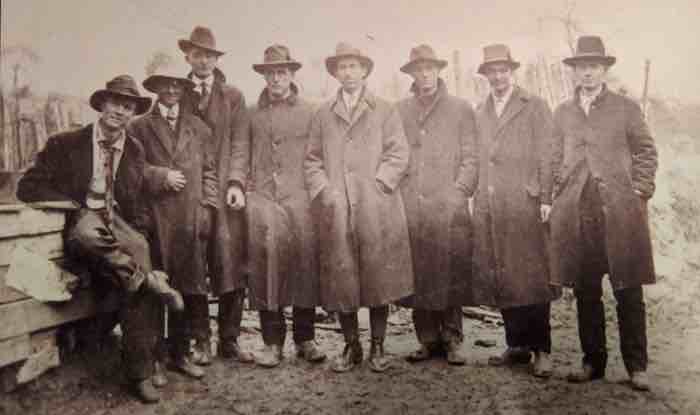
Sixteen million Americans went into service and came back very different people
Then the war came. As was typical with major conflicts, everything changed. The industrial prosperity of the previous 100 years continued, boosting nearly everyone into better incomes, better housing, and better diets. There was a pause in all this during the war while the industrial base produced the goods needed to win the war, and while an entire generation of men aged 18-25 went into uniform. That experience changed everything, too. Sixteen million Americans went into service and came back very different people. Their children, the kids of the baby boom of 1942-1962 lived in a world no one had ever seen before. They were both numerous, more visible, and more indulged than any generation before them. The expectations were different, too, and the preparation for a new, modern era extended far into their futures. For many of the boomers, high school became a minimum requirement, and a very large percentage felt the pressure and expectation to attend a college or learn a trade. Millions of them did, and this pushed the age of courtship and marriage further down the road. In a very short period of time, the requirements for entry into a life of work and family ballooned, and with that came a growing conflict between societal culture and biology. I don’t remember seeing any guidebooks explaining how we were to manage all this newfangled stuff. So by the time my brothers and I came along, the entire world had changed completely and continued to change at an accelerating pace. My oldest brother was born in 1944, just 24 years after my grandparents had been married, and two months after D-Day. My middle brother was born in 1947, and I came along later, but that just meant that the societal changes had accelerated even more. In my world of the 1950s and 1960s, the last generation of the preindustrial mindset was still very much among us. They were our grandparents. They were part of the world we knew. We expected that we would grow up and live lives much like our grandparents and parents, but I, at least, had no idea that everything had changed. People born in the 19th Century were still running the country. The elders in our lives were born in that century or just into the next one. It was a new and exciting time, or so we were told on the new television sets some families had by the later 1950s. Of course, the kid years are always pretty exciting.We were born in a world that had changed far beyond the capacity of our bodies to change with it
My point is that we were born in a world that had changed far beyond the capacity of our bodies to change with it. Then it began to change even more rapidly. We expected to find spouses, buy a house, have good silverware and dishes like our parents had had, and raise families as they had on the wages of the father figure. By the time we had reached age 25, the old system had collapsed, producing an entirely new world and set of rules, many of which were still forming and poorly understood. The political system, the economic system, the culture, all had been transformed, and not for the better, in my opinion. Biology never had a chance. In the end, culture left biology behind in the dust in the race of life. Those of us who wanted to play by the old rules saw some bumps along the way, to put it mildly. Nothing is the way it was for our grandparents’ or even our parents’ generation. What worked for them didn’t work for us. We had to find a new approach, but first we had to figure out that we needed a new approach. That took some time. I’m still working on that one. So here we are, again…in a time we’re not prepared for. As we begin to understand the destructive forces better, perhaps we can begin to prepare for the trials that lie ahead. Will there be any remnant of the old Republic left when those who have led its destruction claim their victory? I don’t have an answer to this question, but I remember the old ways, and especially the old days, even the ones before my own time. I’ll preserve those precious memories and traditions in every way possible, trying very hard to pass them along to anyone who will listen or notice.View Comments
Dr. Bruce Smith (Inkwell, Hearth and Plow) is a retired professor of history and a lifelong observer of politics and world events. He holds degrees from Indiana University and the University of Notre Dame. In addition to writing, he works as a caretaker and handyman. His non-fiction book The War Comes to Plum Street, about daily life in the 1930s and during World War II, may be ordered from Indiana University Press.