The Rats Are Jumping Ship, Two Major Newspapers Ignore Harris
The silence of these two major liberal outlets is deafening. Let’s hope All Americans are listening

Milt Harris , Bio and Archives--October 28, 2024
American Politics, News | Comments | Reader Friendly | Subscribe | Email Us
In the play Henry IV Part 1, William Shakespeare introduced the world to the idiom, “The better part of valor is discretion.” They won't say it, of course, but the
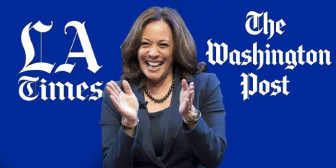
The Washington Post and LA Times have both decided not to endorse Harris because, I believe, they don’t want that stain on their records.
Both newspapers are consistently liberal and back the Democratic party
Both newspapers are consistently liberal and back the Democratic party. In fact, The Post has endorsed every Democratic candidate for president since 1976, a period of 48 years. So, even though both papers downplay its significance, it is obviously meaningful.
In the case of the LA Times, Mariel Garza, the recently resigned editorials editor, shared that she had prepared an outline for an editorial endorsing Kamala Harris when she learned that the paper would not be endorsing anyone. In an interview, Garza mentioned that this decision took her by surprise.
However, the paper's owner disagrees. Soon-Shiong, a billionaire who bought the struggling newspaper in 2018, stated last week that the editorial board failed to follow a directive to maintain fairness and balance.
"The Editorial Board was provided the opportunity to draft a factual analysis of all the Positive and Negative policies by each candidate during their tenures at the White House and how these policies affected the nation. In addition, the Board was asked to provide their understanding of the policies and plans enunciated by the candidates during this campaign and its potential effect on the nation in the next four years. In this way, with this clear and non-partisan information side-by-side, our readers could decide who would be worthy of being President for the next four years. Instead of adopting this path as suggested, the Editorial Board chose to remain silent and I accepted their decision," Soon-Shiong stated.
The truth is Harris has no virtues or viable policies that the American public can relate to
Consider that decision for a moment. Rather than fulfill the owner's wishes to compare the candidates' past records in the White House and their policies and plans for the future, as well as their effects on the nation, the editorial board chose to remain silent. The question is, why? Why would an extremely liberal paper not want to espouse their candidate's virtues? If Donald Trump’s record and policy plans are so bad compared to your candidate’s, wouldn’t you want to point that out in a side-by-side comparison?
The truth is Harris has no virtues or viable policies that the American public can relate to. Any comparison, especially a written comparison in black and white, would expose Harris as the fraudulent candidate that she is. Rather than print that embarrassment for the world to see, The Times took the cowardly way out and left their readers in the dark.
The Post made the same decision. While they had no plans to compare the candidates, they waved their tradition of offering a straightforward endorsement when they believed in the candidate.
William Lewis, the publisher and chief executive officer of The Washington Post, wrote a long-winded explanation for the non-endorsement. (Washington Post, Oct. 25, 2024)
- “The Washington Post will not be making an endorsement of a presidential candidate in this election. Nor in any future presidential election. We are returning to our roots of not endorsing presidential candidates. (Washington Post)
- "As our Editorial Board wrote in 1960:
- "The Washington Post has not ‘endorsed’ either candidate in the presidential campaign. That is in our tradition and accords with our action in five of the last six elections. The unusual circumstances of the 1952 election led us to make an exception when we endorsed General Eisenhower prior to the nominating conventions and reiterated our endorsement during the campaign. In the light of hindsight, we retain the view that the arguments for his nomination and election were compelling. But hindsight also has convinced us that it might have been wiser for an independent newspaper in the Nation’s Capital to have avoided formal endorsement.’
- "The Editorial Board made two other points — ahead of an election that John F. Kennedy won — that will resonate with readers today:
- "The election of 1960 is certainly as important as any held in this century. This newspaper is in no sense noncommittal about the challenges that face the country. As our readers will be aware, we have attempted to make clear in editorials our conviction that most of the time one of the two candidates has shown a deeper understanding of the issues and a larger capacity for leadership.’
- "However, it concluded: (Washington Post)
- "We nevertheless adhere to our tradition of non-endorsement in this presidential election. We have said and will continue to say, as reasonably and candidly as we know how what we believe about the emerging issues of the campaign. We have sought to arrive at our opinions as fairly as possible, with the guidance of our own principles of independence but free of commitment to any party or candidate.’
- "And again in 1972, the Editorial Board posed and then answered this critical question ahead of an election which President Richard M. Nixon won: In talking about the choice of a President of the United States, what is a newspaper’s proper role? … Our own answer is that we are, as our masthead proclaims, an independent newspaper and that with one exception (our support of President Eisenhower in 1952), it has not been our tradition to bestow formal endorsement upon presidential candidates. We can think of no reason to depart from that tradition this year.’
- "That was strong reasoning, but in 1976 for understandable reasons at the time, we changed this long-standing policy and endorsed Jimmy Carter as president. But we had it right before that, and this is what we are going back to.
In today's climate of political activism, the non-endorsement of Harris is significant
- "We recognize that this will be read in a range of ways, including as a tacit endorsement of one candidate, or as a condemnation of another, or as an abdication of responsibility. That is inevitable. We don’t see it that way. We see it as consistent with the values The Post has always stood for and what we hope for in a leader: character and courage in service to the American ethic, veneration for the rule of law, and respect for human freedom in all its aspects. We also see it as a statement in support of our readers’ ability to make up their own minds on this, the most consequential of American decisions — whom to vote for as the next president. (Washington Post)
- "Our job at The Washington Post is to provide through the newsroom nonpartisan news for all Americans, and thought-provoking, reported views from our opinion team to help our readers make up their own minds.
- "Most of all, our job as the newspaper of the capital city of the most important country in the world is to be independent.
- "And that is what we are and will be.”
Lewis wants the American public to believe they are taking a noble stance by not endorsing Harris. However, he doesn’t clarify that since the 1976 election, the Post has endorsed a candidate in every election except 1988. In today's climate of political activism, the non-endorsement of Harris is significant.
Both of the newspapers are extremely liberal, and their tone often reflects the presence of Trump Derangement Syndrome (TDS). The fact that they are avoiding Harris like the plague is a strong indication that they don’t believe in her candidacy.
The silence of these two major liberal outlets is deafening. Let’s hope All Americans are listening.
View Comments
Milt spent thirty years as a sales and operations manager for an international manufacturing company. He is also a four-time published author on a variety of subjects. Now, he spends most of his time researching and writing about conservative politics and liberal folly.