The September To October Change
Survival in Tough Times: Soon the dull duns and browns and grays of November will settle over us. I must remember to savor every day until then because glorious October is always a fleeting time

Dr. Bruce Smith , Bio and Archives--October 7, 2024
HeartlandLifestyles | Comments | Reader Friendly | Subscribe | Email Us
It's a late September Friday that seems like a Saturday but isn't.
So yesterday the remnants of Hurricane Helene approached us here in the heartland, marching through Georgia, up across Knoxville, and then into Kentucky. Rain was promised by the forecasters and also by the wind swinging around to the northeast. The glass fell rapidly through the night.
The preparations began. There was a bag of yellow eye beans that I bought in New Hampshire a while back that I rinsed two or three times last evening then put to soak overnight, just in case. Soup or chili when a storm’s coming is always a good thing. If the storm doesn’t show, oh, well.
The low pressure center came up rapidly from the southeast as we waited here in the Heartland along the old National Road. The remnants of tropical storms don’t always give us rain, then sometimes they wash us away. At a different spot along the National Road in 1980 I had 14 inches of rain in a week. All the creeks and rivers came out of their banks, including the one I backed up against. On a foggy morning, I went there to tend to chores and came very close to driving in to a river that was sixty feet out of its banks on both sides. In its normal state it was only twenty feed wide most places. That time I saw the muddy water just before I drove into it, backing up the hill to safety, shaking the whole time.
Over the past two months the dust built up here, gritty and white upon everything. It coated the windowsills and made lines along the windshield wipers on the spotted car. I have watered for weeks, draining the rain barrels to keep the tomatoes and morning glories alive in the deck garden and to try to get the rows of late season spinach started.
Overnight there arrived a pleasant, gentle rain starting by 3 or 4 AM, continuing throughout the morning. It was never heavy, never making the creeks and ditches gush with overflow. It was so dry and the rain so gentle that there was not even a little creeklet running along the driveway on the steep hillside. I went out in it without getting drenched, just pleasantly dampened. Now and then it seemed like it stopped altogether.
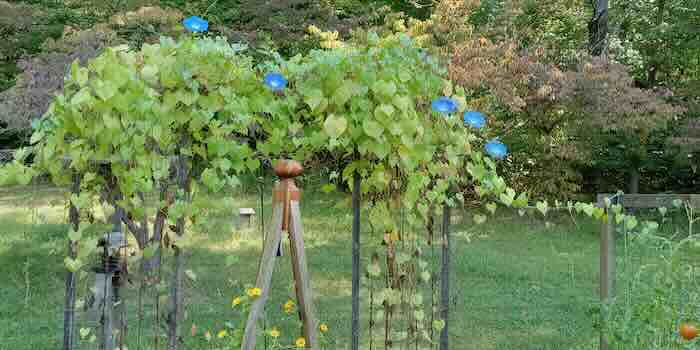
Saturday morning’s first light brought the payoff. Shockingly blue morning glories looked upward to the showers and dull skies, grateful as we were for some relief. Bright green spinach showed much better against the dark dirt than it did in the dust before the showers turned the soil a rich, dark brown. Tiny weeds in their thousands showed for the first time, determined to make the most of the moisture. Nearly all day Saturday it continued, soothing and quieting the dusty ground. That morning the beans soaking in the small pan had nearly breached the sides of the pan in their thirst. They seemed eager to find a purpose after sitting in wait for a year. They more than doubled in size, splitting their thin skins. I rinsed them again and put them on to simmer with water and broth. They made a fine soup later that day with diced ham added, and crumbled crackers on top. It lasted nearly a week.
It was cool, in the upper 60s, with some wind out of the northeast, unusual for us, and the misty air felt like standing beside the Atlantic along the southern Maine coast on an overcast morning early in the summer.
The rain is so welcome. It continued on and off for nearly three days, but when it had ended, the total was only about 1¾ inches. It fell all across the region, but raised the White River only slightly and didn’t muddy it at all.
An extended spell of cool and moist air followed on the heels of a frontal boundary that stretched from James Bay all the way to Texas, bringing the first opportunity to consider flannel shirts and layering, and flannel sheets. Our thanks to Canada for sending the cool air we’ve been craving. I began to look forward to the chance to put a fleecy throw over my lap in the mornings at teatime. It reminds me I must get the chimney and stovepipe brushed out soon.
Stories began to filter in about the apocalyptic flooding in the southern Appalachians. I’ve been to many of those places that were so traumatized. A week later, they still haven’t been able to assess all the damage or find many of the missing.
We remind ourselves of our good fortune and give thanks for having been spared this time. I think about how far it is to our own little creek, and how far above it we are. Our drainage basin is tiny, but these things warrant vigilance and frequent observation. We should be okay, I think, trying not to deceive myself. Better look again in different light to be sure.
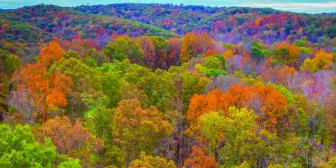
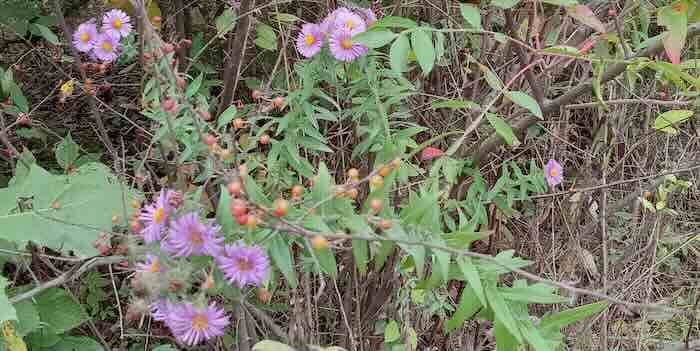
The weather followed its usual pattern. By the time October arrived, we were into chilly mornings in the upper 40s and low 50s with highs only in the 70s. Later this past week it warmed up as it usually does, but the top temperature only reached the middle 70s before beginning another decline. It’s classic seasonal lag combined with the transition from late September to early October. In the coming week lows may get down to the mid 40s, and there are days coming soon with highs only in the 60s. The best time of year is on its way. The fall asters have bloomed proudly. Soon there will be more than dogwoods showing red. The poplars and hickories will go over to brown and yellow, then the sugar maples and red maples will begin to show their gold and scarlet.
Soon the dull duns and browns and grays of November will settle over us. I must remember to savor every day until then because glorious October is always a fleeting time.
View Comments
Dr. Bruce Smith (Inkwell, Hearth and Plow) is a retired professor of history and a lifelong observer of politics and world events. He holds degrees from Indiana University and the University of Notre Dame. In addition to writing, he works as a caretaker and handyman. His non-fiction book The War Comes to Plum Street, about daily life in the 1930s and during World War II, may be ordered from Indiana University Press.