The Three Branches of Government—We’re in Trouble!
Those who have enjoyed the pleasures of aristocracy at our expense are screaming and scheming to maintain their privileges. Will we allow their tantrums to succeed, or will we treat them like the infants they are?

David Robb , Bio and Archives--March 25, 2025
American Politics, News | Comments | Reader Friendly | Subscribe | Email Us
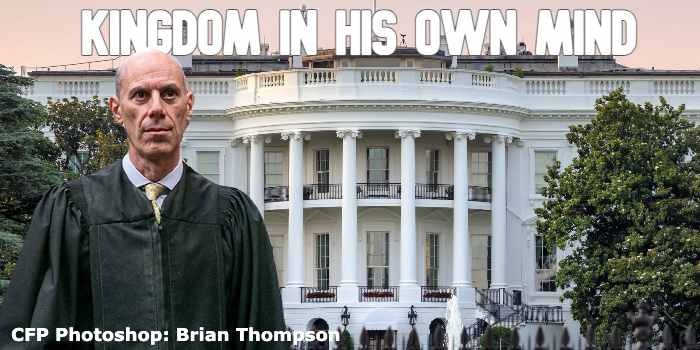
Although it may come as a surprise to many people, there are actually three equal branches to the government of the United States. In what remains of civics classes today, some are taught that there is a system of checks and balances that exists and that there is the Judicial, the Legislative, and the Executive branches, but there is often little or no clarity about what that all means.
Constitutional Separation of Powers
For too many, the Executive branch is the President who sits in the White House and signs unpopular orders. The Legislative branch passes massive obtuse bills drafted by special interests, spends money, and campaigns for reelection. The Judicial branch is the Supreme Court that decides what is Constitutional and decides cases according to partisan desires of whichever party is in power.
We are in trouble!
Today there is great conflict over who should have ultimate authority. Decisions by the executive branch headed by Donald Trump are being challenged in court under the belief that courts have ultimate authority to determine if an action is permissible or not. Many believe that the Supreme Court should have final say over what the other branches can do.
This idea of judicial supremacy has even been extended to allow courts to dictate policy and actions that the other two branches must follow. This out-of-balance system makes courts both legislators and enforcers, resulting in a judicial dictatorship--a danger the founders recognized and took pains to prevent.
It is, as a result of this circumstance, time to review the particular functions, authorities, powers, and limitations set forth in our Constitution to restore essential balances.
First and foremost is the idea that our government is established to serve the citizens, not to rule them. The people give government certain powers to perform necessary tasks, to ensure laws are fairly applied, that we can defend against those who might seek our harm, and generally ensure that things run smoothly to maximize and protect individual rights, liberties, and opportunities. These principles were evident to the Founders at the time our Constitution was devised, and have persisted as the cornerstones of our system of government for nearly 250 years.
Many have objected to those principles over the years, generally on the basis that they are too restrictive, and prevent government from doing whatever the critics feel need to be done at the time. Fortunately, the Constitution has stood firm against these attacks, largely as a result of a general recognition of the wisdom embodied in the Constitutional separation of powers.
This limitation of the power of the Judiciary is deliberate
The ultimate descriptions of the three powers will be found in the text of the Constitution, but we can summarize the duties of the divisions he
- Legislative--Legislature creates and defines the law
- Executive--Executive enforces the law
- Judicial--Judges interpret the law and assign guilt or innocence
This is the same order in which the branches are defined in the Constitution, illustrating the proper relationship between the three branches. Note that the Judiciary is listed last, and is the most limited in power. The Judiciary cannot make laws, has no power to enforce laws, and cannot decide which laws are permissible, nor which actions are allowed. It can only offer opinions about the actions of the other two branches. It cannot decide for other branches if a law or an enforcement action is allowed by the Constitution.
It can judge if laws or actions are consistent with the Constitution or with other laws enacted by legislature, but it cannot say what those laws should be or what actions must be taken.
If a law is unclear, it can so rule and suggest that the Legislative branch revise and clarify a law, or even repeal it if necessary, but cannot declare a law passed by Legislature to be invalid, or rule according to what it believes a law should be. When it declares something to be unconstitutional, it is ruling that there is an inconsistency or contradiction that exists between the law, action, or rule and the provisions of the Constitution. That is a signal to the Legislative or Executive branches that something should be addressed, but otherwise cannot force a change.
This limitation of the power of the Judiciary is deliberate. The Judiciary is the weakest branch for good reason. It was recognized that if the Judiciary had the power to enforce its judgments on the other branches, it would put an unelected group in the position of absolute power and divorce them from the ability of the citizens to remove them. By making judges appointments by the two other branches, the power of the electorate would be preserved.
As a matter of fact, the Constitution explicitly states that judges, including Supreme Court justices shall only hold their offices subject to good behavior. While not explicitly stated, it can be assumed that good behavior includes not trying to assume the powers granted to the other branches. No activist judges need apply.
This is not to say that the opinion of appointed judges should be taken lightly, or ignored. Only that a judgment rendered against another branch should be seriously considered or reconsidered as it may indicate a problem that should be addressed in a different way, or something that encroaches on the rights of the citizens that the Constitution guarantees. It does not have the authority that a judgment that applies to a different entity would have.
Of the three branches, it is probably the Legislative that has been most lax in its duties
The function of the Executive branch is to enforce the laws enumerated in the Constitution or enacted by the Legislative branch. It can be advised and informed by opinions of the Judicial branch, and its actions may be directed or constrained by the Legislative branch, but can also recommend legislation for consideration by Legislature. The Executive is specifically charged with ensuring the laws of the land be faithfully executed. He is expected to use discretion in the enforcement of laws, but is not limited in the time, manner, or place of enforcement.
As but one example, congress has passed multiple laws regarding the presence of citizens of other countries in these United States. They also require that such aliens be removed should they violate our laws. It is a gross attempt at infringement of Executive power for representatives of the Judicial branch to block the ability of the Executive to enforce the laws as he has been elected to do.
Enforcement of laws enacted by Legislature is not dictatorial or authoritarian, as some would have us believe. Rather it is carrying out the duties of his service. Those who don't like the situation are welcome to try to persuade legislature to change the laws, recognizing that there might be many other citizens who prefer those laws.
The Legislative branch is responsible for originating new laws, removing old ones that do not serve the country well, and for managing the financial affairs of the country through budget approvals, tax, duty, and tariff policies, and spending authorizations. It has final approval over Executive appointments, declarations of war, and other matters of general concern. It also holds power of impeachment of both Executive officials and Justices--a further check provision
Of the three branches, it is probably the Legislative that has been most lax in its duties. It was originally intended that the members of the Legislature would prepare legislative drafts themselves, or at most, with the assistance of staff. The Legislators would then debate the pros and cons of the proposal, making corrections or revisions as appropriate, and would then vote on the final version. In this way it would be ensured that laws would be understandable, and all reasonable consequences foreseen, prior to enactment.
Recently, laws have been drafted by outside agents, including special interests, and the texts have grown to thousands of pages, most of which are never read by legislators, are written in obscure and complicated language, and are often full of provisions that favor particular groups at the expense of the general populace. Discussion and debate of the provisions is often superficial, and votes on passage are frequently taken before the provisions have been fully evaluated, or even read.
This is a fundamental violation of the principles of good governance that have been recognized for thousands of years. People should not be held accountable for obedience to laws that they cannot know and understand, and these massive legislations are neither knowable nor understandable. Even those in government whose job it is to keep track of laws, rules, and regulations acknowledge that they do not know how many rules there are, much less what their content might be. This situation is a moral failure of government that can be laid directly at the feet of the Legislative branch.
A further failing of the Legislative branch is in its lazy and improper delegation of authority. This delegation has not only permitted, but actually abetted the growth of the Administrative State that forms such a great current threat to individual liberty. Not only has it encouraged formation of new, unaccountable agencies, but has not exercised its obligations to check the growth of Executive offices and agencies.
Today, the situation has developed to the point where the general ignorance of the populace coupled with the duplicity of many politicians has led the country to stray far from the principles of good governance. Activist courts are but one symptom. The massive abuse of public funds being uncovered by the DOGE team is indicative of the poor stewardship of Legislature. The fact that a President who is doing no more than what he promised to do in his campaign is receiving such violent opposition is yet another indication of the sorry state of our government. When did public fraud, abuse of public funds, dishonest politicians and unaccountable administrators who actually run things become an acceptable norm?
No, this is not a good situation. We have come close to the brink of losing our country, but have not yet stepped over the edge. There are many who would be happy to push, and who are working hard to ensure we fall.
There is much that is broken, and much to repair in order to regain distance from that precipice.
The work must begin with we, the people. Donald Trump, Elon Musk, and many other good people have made much progress, but they alone cannot undo the damage that has been many decades in the making. We must look in our own mirror and ask what we did to allow this situation to arise, and then fix what we alone can fix.
It is said that people get the government they deserve. Perhaps what we have now is no more than what our inattention and low expectations have gained us. If we want better results, we must expect more integrity, more accountability, more prudence, more wisdom, and more restraint of those we choose to be our representatives.
The first obligation of a representative is to listen to those they represent and then to act in accordance with what they have heard. The first obligation of a ruler is to establish authority and then to command. Too many of the people we have elected believe they were chosen to rule, not to represent. We have tolerated that, and have thus been complicit in our own enslavement.
It is time to remind those in government that they govern with the consent of the governed, and not with the submission of the serfs. We start by understanding the powerful foundation our Constitution provides with it separation of powers and the tools in the Bill of Rights. We start by understanding how we gave up our own power and allowed the current situation.
I am not taking about taking to the streets in demonstrations and protests, but by understanding that a good civilization requires good citizenship. A good citizenship requires courage and good understanding and vigilance. It doesn't just happen. We must not ask of a government what we should be doing for ourselves, nor should we be seduced by those who offer shiny promises if only we surrender our power, but just for a little while or a little bit.
We are seeing today what happens when we ask too much of government and give them too much power. Those who have enjoyed the pleasures of aristocracy at our expense are screaming and scheming to maintain their privileges. Will we allow their tantrums to succeed, or will we treat them like the infants they are?
View Comments
David Robb is a practicing scientist and CTO of a small firm developing new security technologies for detection of drugs and other contraband. Dave has published extensively in TheBlueStateConservative, and occasionally in American Thinker.