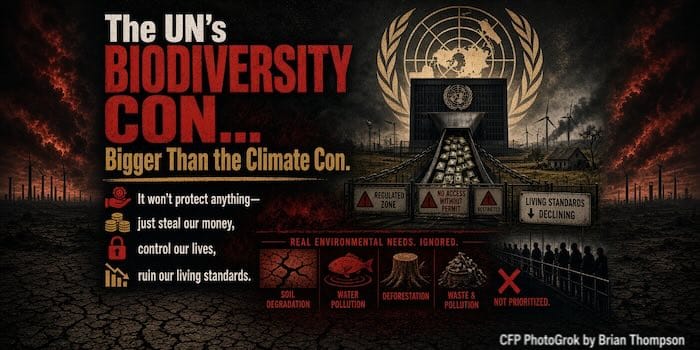
The UN agenda echoes the 1976 Vancouver Declaration: “Land cannot be treated as an ordinary asset controlled by individuals. Private land ownership is … a principal instrument of accumulation and concentration of wealth,” which “therefore contributes to social injustice,” making public control of land use “indispensable.” Frederic Bastiat and many others would call this legalized theft.
As with the Paris climate “agreement,” the US Senate never ratified the 2022 Framework. However, national, state, and local governments and regulators, as well as banks, corporations, and courts can and do work to implement climate and Framework targets and impose UN agendas.
President Biden’s Executive Order 14008 directed federal agencies to develop strategies to “conserve” 30 percent of US lands and waters by 2030. President Trump terminated the EO, but under Gov. Gavin Newsom, California enshrined the target into state law.
COP17’s biodiversity forums centered on closing a supposed $700 billion annual finance gap. Of course, even this will never be enough. In addition, Target 18 demands that governments identify, eliminate, phase out or reform “incentives” and “subsidies”--for metal, mineral, fossil fuel and other extraction and use activities--that activists and UN officials identify as “harmful to biodiversity,” while maintaining them for “clean, renewable” energy, “ecological agriculture” and other favored enterprises.
As COP17 President and Armenia Environment Minister Hambardzum Matevosyan explained, global biodiversity policy can and should “influence how natural resources are used, how goods are produced and consumed, and where public and private financial resources are directed.”
The process is devious but effective. Worse, as global demand rises for vital raw materials, while acreage and mineral deposits are made off-limits, it will result in massively reduced availability and shockingly higher prices for electricity, fuels, petrochemical feedstocks, metals and minerals; fertilizers, food and nutrition; and thus healthcare, living standards and life spans.