The Vanishing Male--The Numbers Don't Lie
Testosterone is collapsing. Birth rates are collapsing. The mice saw it coming;

Chet Nagle , Bio and Archives--October 19, 2026
Cover Story | Comments | Reader Friendly | Subscribe | Email Us

Start with the numbers, because the numbers are the story. In 2020, researchers pulled serum testosterone samples from 4,045 American men aged 15 to 39, spanning 1999 to 2016, and found that average total testosterone had fallen more than 25 percent — from 605.39 ng/dL down to 451.22. Even among young men with normal body weight, it fell 20 percent, from 664.8 to 529.2. The researchers adjusted for age, race, illness, drinking, drugs, and exercise. The trend didn't budge.
The Body Keeps the Score
One honest caveat, because the authors flagged it themselves: the survey changed its testosterone assay methods across those years, so some fraction of the trend could be measurement. Some fraction. Not 25 percent.
And it's not one study. A meta-analysis of 1,257 studies covering more than a million men found testosterone declining 0.56 percent per year, independent of age and independent of assay method. This July, at the European Society of Human Reproduction meeting, new data on roughly 118,600 men showed testosterone down 54 percent between 1972 and 2019. Different groups, different methods, same direction.
Testosterone doesn't fall alone. Sperm concentration has fallen by more than half since the 1970s, and the decline has accelerated since 2000. Young men's grip strength has fallen measurably since the 1980s — in one study, men aged 20 to 24 squeezed 101 and 99 pounds with right and left hands, against 121 and 105 a generation earlier. (The researchers themselves blame the shift from manual work to screens, which is fair as far as it goes.) In Denmark, diagnoses of gynecomastia — breast tissue in males — rose five-fold among teenagers between 1998 and 2017, and more than ten-fold in older groups. Waistlines expanded, driven almost entirely by fat, not muscle.
Fatter, weaker, less fertile. That's not rhetoric. That's the literature.
The Mice Saw It First
Now the analogy — and I'll label it as such, because that's what it is. In July 1968, the researcher John Calhoun built a mouse utopia at the National Institute of Mental Health: unlimited food, water, nesting material, no predators, no disease. He wanted to see what a population does when struggle is removed.
What it did was die. Through four phases Calhoun named Strive, Exploit, Equilibrium, and Die, the colony grew, stalled, and collapsed. Here's the detail that matters: the population peaked around 2,200 against a capacity of 3,000. Growth stopped with room to spare. It wasn't crowding that killed them.
What killed them was withdrawal. Males stopped fighting, stopped competing, stopped mating--Calhoun's "beautiful ones," who did nothing but eat, groom, and sleep. Females stopped raising pups. Calhoun called it the first death, the death of social purpose, preceding the second death, the physical one. He published it in 1973 under the title "Death Squared."

(Calhoun inside Universe 25, 1970. Photo by Yoichi R. Okamoto, public domain.)
The Objections, Answered
The critics deserve their sentence, and then we move on. Two researchers, Ramsden and Adams, argued the mice didn't collapse from density but from unequal social space--dominant males monopolizing the good territory while everyone else got the dregs. Fine. But unequal social space is the defining feature of every human city on earth. If they're right, the experiment is more relevant to us, not less.
The primatologist Frans de Waal noted that primates--and humans--have conflict-resolution and coping mechanisms rodents lack. True, and worth exactly one sentence. Coping mechanisms can be overwhelmed. That's arguably the story of the last decade.
It was never replicated, and no serious person claims mice prove anything about humans. Noted. Now look at the numbers again.
The Empty Cradles
South Korea's fertility rate hit 0.72 in 2023--less than one child for every three women--and ticked up to 0.80 in the preliminary 2025 figures. The rebound is real and it is tiny: the best news in the developed world is eight-tenths of a child. China is around 0.96, with the fewest births since 1949 and its fourth straight year of population decline; the UN projects 1.4 billion Chinese falling to 633 million by century's end. Japan recorded 671,000 births last year, the fewest since records began in 1899, with fertility at 1.14. The United States sits below 1.6. Even the CDC is concerned to judge by its chart below.
Males are withdrawing, cradles are emptying, and Calhoun's mice got there first
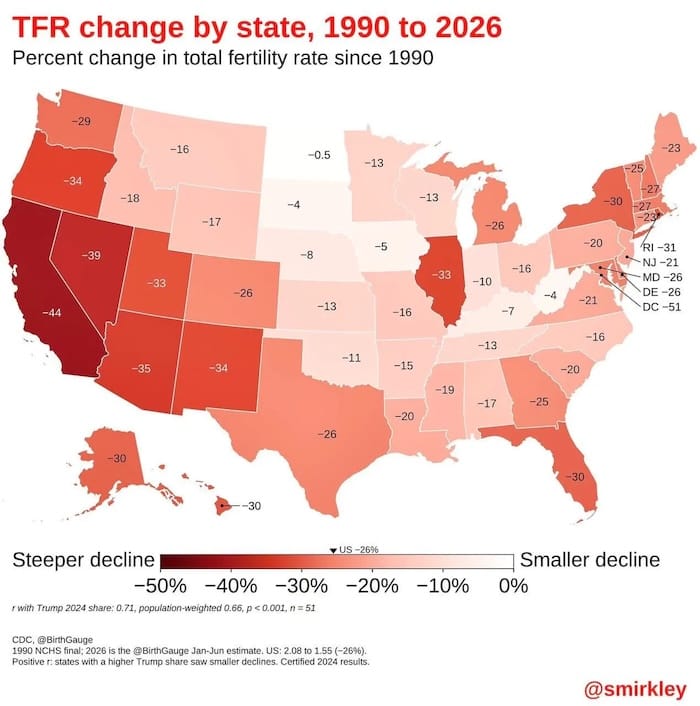
The EU hit a historic low of 1.34. Globally, 63 countries have already passed peak population.
Two different phenomena, and I won't conflate them: the birth-rate collapse is mostly behavioral and economic--people choosing fewer children--while the testosterone collapse is biological--reduced capacity. Different mechanisms. Same direction.
Convergence
So here is where we stand, and I'll give it to you straight. Male testosterone is collapsing across every age group in the published literature. Sperm, strength, and body composition are going with it. A mouse colony with everything provided stopped breeding with room to spare. And the birth rates of the richest societies in human history are cratering.
I am not claiming one caused the other. The honest shape of this is convergence, not causation: three collapses, same direction, no single proven cause. The serious literature points at endocrine-disrupting chemicals, obesity, sleep loss, inactivity--and admits none of them fully explains it.
Eccentrik, whose piece sent me down this road, sees a deliberate cabal behind it all. His claim, not mine. What I can tell you is what's documented.
Males are withdrawing, cradles are emptying, and Calhoun's mice got there first.
View Comments
Chet Nagle is an experienced analyst and commentator on international commerce, geopolitics, national security matters, the Middle East, and strategic communications. He has been on radio, has appeared in documentary films and has been a guest on television news programs. His columns have appeared in the Daily Caller, The Hill, Roll Call, and many other publications. He is a contributing editor for ANDmagazine.com and the European Security & Defense magazine.