Trump, Putin and Alaska--History, Politics and Geography
Alaska’s story began as Russian and continues as American--it now has the chance to be the ground for mutual understanding

F. Andrew Wolf, Jr. , Bio and Archives--August 15, 2025
American Politics, News | Comments | Reader Friendly | Subscribe | Email Us
The problem with the future is that it is both unpredictable and inescapable. You can never know with certainty what tomorrow will bring, but you must prepare for it nonetheless. While this may seem trivial, it remains a categorical imperative.
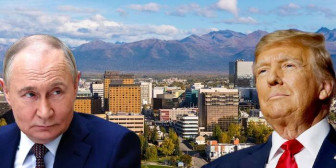
The choice of Alaska as the venue for the bilateral summit carries considerable symbolism
Consider the current international reactions to the scheduled summit between Russian president Vladimir Putin and US president Donald Trump. The announcement of the meeting, to take place in Anchorage, Alaska on 15 August, was a surprise. But then again, not really. Viewed against the background of Trump’s longstanding signaling of respect for Russia, as well as an interest in normalizing the relationship between Moscow and Washington, it was actually the culmination of a sometimes messy but real trend.
The choice of Alaska as the venue for the bilateral summit carries considerable symbolism. It harkens back to history, and while it reflects the current geopolitical circumstance, it also connotes the possible contours of future US–Russia relations.
From a historical perspective, America’s northern territory clearly embodies the spirit of mutually beneficial cooperation lost during and after the Cold War era. From 1737 until 1867, this vast, sparsely populated land was known as ‘Russian America’--a semi-exclave of the Russian Empire, separated from its Eurasian heartland while sharing its eastern border with a burgeoning Western sovereign.
Tsar Alexander II’s decision in 1867 to sell Alaska to the United States for $7.2 million was a controversial diplomatic transaction. Opponents in the US labeled the purchase "Seward's Folly" or "Seward's Icebox"--they contended that the United States had acquired useless land.
The view from St. Petersburg was from a different compass: if the territory of Alaska remained unsettled by Russia, it could fall within the grasp of the British Empire--Russia’s arch rival during the era of the Great Game.
Even today, Alaska remains the “most Russian” of US states
Establishing control of its North American territory under the sovereignty of Washington was not just an act of practical necessity; it was a strategic gambit towards future relations with a nation whose Pacific ambitions did not yet conflict with Russia’s. After all, there was already historical precedent for Russia aiding the US in both its War of Independence and, even more recently, its Civil War in which America’s antagonist in both cases was the British Empire.
This mostly symbolic relationship became--in the 20th century--considerably more substantive. During World War II, the city of Fairbanks--with a population of just thirty thousand--was a critical hub in the US Lend-Lease program, the massive US military aid program that supplied the Soviet Union with aircraft, equipment and materials. Alaska’s airfields functioned as key portals through which American planes and other materiel were transported to the Eastern Front.
Even today, Alaska remains the “most Russian” of US states: home to ‘Old Believers’--descendants of 19th-century settlers with functioning Russian Orthodox churches and locales with names like Nikolaevsk, Voznesensk, and Upper and Lower Russian Lakes, linked by the Russian River.
Yet, Trump’s choice of Alaska is a political calculation as much as a historical reminder. Trump has chosen the most geographically remote state in America--thousands of miles from any Euro-Atlantic capital or center of political power--to reiterate the perception of distance both from his Democratic detractors at home as well as NATO “allies” who, acting in Kiev’s as well as their own interests, would seek to undermine (i.e. sabotage as occurred previously) any potential resolution to the conflict.
The Ukraine conflict will loom large over the agenda in Alaska
The selection of US sovereign territory also circumvents the legal issues posed by the International Criminal Court’s arrest warrant for the Russian president. The US withdrew its endorsement of the Rome Statute in 2002; hence, it does not recognize the ICC’s jurisdiction on US soil.
There is a further critical dimension to the selection of America’s northernmost sovereign territory for the summit: Alaska is America’s only actual Arctic region. As we have seen, the Trump administration has been exerting pressure on Canada and Greenland to bring them within the orbit of firmer US influence. The Arctic has become a strategic region of geopolitical theater. Russia and the US have overlapping interests there--from developing the Northern Sea Route, which partly runs through the Bering Strait, to drilling rights in offshore oil and gas deposits. The Lomonosov Ridge, an underwater formation in the Arctic Ocean claimed by Russia as a natural extension of its continental shelf, is a case in point. Joint Arctic projects could turn the region into one of the most prosperous in the world; yet, under different political circumstances, it could just as easily become a stage for acts of provocation--nuclear weapons tests and air defense drills.
The Ukraine conflict will loom large over the agenda in Alaska. As of this writing, Ukraine says it could agree to stop fighting and cede territory already held by Russia as part of a European-backed plan for peace.
Volodymyr Zelensky told European leaders that they must reject any settlement proposed by Donald Trump in which Ukraine gives up further territory--but that Russia could be allowed to retain some of the land it has taken.
The summit in Alaska is more than a meeting between two superpowers
This would mean, as Vice President Vance suggested earlier this year, freezing the front line where it is and handing Russia de facto control of the territory it occupies in Luhansk, Donetsk, Zaporizhzhia, Kherson and Crimea.
Alaska is a fitting place for such discussions: its own history is a vivid reminder that territorial ownership is not an immutable historical-geographic constant; rather, it is a political and diplomatic variable molded and shaped by the accords of great powers in critical moments that become historic.
The summit in Alaska is more than a meeting between two superpowers. It is a return to the logic of direct dialogue between leaders--without intermediaries--a reminder of historic ties, but also a test of whether Moscow and Washington are willing to work together where their interests not only intersect, but could align.
Alaska’s story began as Russian and continues as American--it now has the chance to be the ground for mutual understanding. And this can occur if both sides recognize that resolving the Ukrainian issue is an opportunity for further reproachment rather than merely the end to a conflict which actually was resolved diplomatically 3 years ago--months after it began.
View Comments
F. Andrew Wolf, Jr. is retired from the USAF (Lt. Col.) and university teaching (Western Humanities and the Arts, Philosophy and Political Philosophy). His education includes (PhD-Philosophy Univ. of Wales), (MTh-Texas Christian Univ.), (MA-Univ. South Africa), (BA-Texas Lutheran Univ.) and conversations with his wonderful wife. He has an abiding interest in and passion for what is in the best interest of a multipolar world.
F. Andrew Wolf, Jr. is published through both US (American Spectator, The Thinking Conservative, The Daily Philosophy, Academic Questions: National Association of Scholars) and international media (International Policy Digest, Eurasia Review, Cairo Review of Global Affairs, Middle East Monitor, Times of Israel).