Trump’s conviction calls Christians to consider: Was Jesus political?
Christians are given agency to remove the pharisaic power permeating the nation’s capital, and, like it or not, it is political

A. Dru Kristenev , Bio and Archives--June 1, 2024
American Politics, News | Comments | Reader Friendly | Subscribe | Email Us
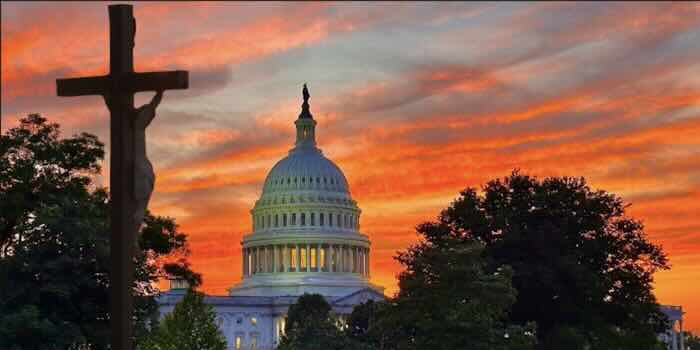
In light of the seriously, some might say demonically, perverted “justice” delivered in a New York courtroom May 30, 2024, it is incumbent on believers to research Scripture to understand the connection between faith and politics.
There are Christians and non-Christians alike who take adamant stands denying that Jesus was a political figure. But is that true?
Jesus was condemned to the cross to bodily remove Him from disrupting the power structure in Judea that was controlled by the Pharisees
In fact, it is not true. Jesus was condemned to the cross to bodily remove Him from disrupting the power structure in Judea that was controlled by the Pharisees. They thought, incorrectly, that once Jesus was branded a criminal and dispatched from the scene, memory of Him would be derailed and the status quo would be undisturbed. It was a political move they expected would cement their dominance, quelling opposition.
Although Donald Trump is not a savior, there is a correlation between the miscarriage of justice 2000 years ago and the repudiation of the law in New York, both carried out to dispatch an adversary. In both instances the legal machinations were wholly political.
Claiming Jesus’ teaching only affected spiritual matters, millions of Christians justify avoiding involvement in cultural affairs that are influenced by politics, and make the decision not to vote because that would draw them into participating in worldly issues. Non-Christians often use the argument to encourage Christians to keep themselves separate from the electoral process that entrenches amoral and immoral policies, policies that are anathema to the Christian, God’s, worldview.
Either stance places Christians in a conundrum, claiming their connection is to a spiritual continuum while atheistic policies irreparably deconstruct the social structure they hope to survive.
The question is whether Jesus Christ expected His followers to be involved in changing culture or to disengage. The answer lies in whether Jesus Himself pulled back from or was outspoken about social practices He viewed as abhorrent to God.
Reading through the four Gospels and the Book of Acts, in particular, paints a picture of a messiah who didn’t shirk a duty to confront cultural attitudes that countered God’s Word. Nor did He shrink from directly calling out the cultural leaders who clung to the tradition of men, valuing it above scripture that they claimed to honor (Matthew 15:1-9). Pharisees, Scribes and the judicial body of the Sanhedrin are recognizable as those Jesus often upbraided for these practices.
Could His interference in the status quo be considered political in nature?
Could His interference in the status quo be considered political in nature? There is good reason to apply that label in a number of instances that Jesus taught in the Temple and elsewhere during His brief ministry on earth.
The most identifiable illustrations range from Jesus overturning the moneychangers’ tables in the Temple court, to denoting how believers participate in the social order by acknowledging the hierarchy of civil power, down to paying taxes.
Judea itself was something of an anomaly within the Roman Empire, being allowed considerably more autonomy than other conquered nations. The Jews were supplied freedom to follow their cultural and religious laws as long as they didn’t conflict with Roman authority. It was a fine line of repression to walk between retaining Jewish social standards without antagonizing the Empire’s representatives. The political power was retained by the religious leaders who readily bowed to Roman control.
This was a contentious time for the messiah to arrive, but it was a pre-ordained time for good reason. Christ ushered in the changing of one age of cyclical blood sacrifice to atone for sin, requiring a physical temple to accommodate animal offerings, to the age where a once-for-all sacrifice dispensed with the necessity for continual blood offerings. (Hebrews 9:12, 28) To place a permanent stamp of change from one age to the next was the utter destruction of the Temple in Jerusalem, leaving just one avenue to find salvation, receiving Jesus’ sacrifice as the ultimate payment for sin.
It was a brutal time in history where radicals could find themselves beaten, publicly humiliated and bound, imprisoned, or crucified for disobedience or questioning authority. And Jesus questioned authority, especially that of the ruling religious class, on a regular basis.
It is time to put this into context with what has occurred in our country in our time
Challenging the outward piety of the Pharisees was necessary to call attention back to the authority of God rather than the multitude of traditions that shackled average citizens. It was a power struggle between one who taught the necessity to follow the truth of Scripture, rather than customs honoring the wealthy religious rulers who had Caesar’s dispensation, in other words, the State.
Jesus, and the apostles who continued His works upon receiving the power of the Holy Spirit, never stopped condemning the evil embedded in worldly culture, taking a stand for social change that acknowledged God. Impervious to whipping and incarceration, they contended for the faith in the face of persecution, which was political because pharisaic power was always about retaining their seats of power. Jesus Himself repudiated the Pharisees and Scribes as two-faced religious tyrants who would do whatever necessary to retain their noble positions by permission of Caesar. Read Matthew 23, appended below.
It is time to put this into context with what has occurred in our country in our time. “They” are the modern incarnation of the Pharisees, Scribes and Sanhedrin who sit in Washington, D.C., lording it over the general populace, denigrating, denying and ignoring the only Law of the Land, the Constitution.
They have instituted their will via policies and customs solely to protect their stations of power, and they have no compunction about maligning, detaining, torturing, and imprisoning any who disagree with them. They have usurped the nation’s God-inspired liberty, replacing it with their self-empowering whims.
Christians have the age-old mandate to challenge injustice and those who twist the law to benefit themselves, just as Jesus confronted the Pharisees and Scribes who deviated from their true purpose to honor God. Hiding behind a façade of piety and leaving the unrighteous to despoil the nation is not what Jesus did, nor should it be the path of the faithful in modern times.
Are Christians willing to step outside the safety of their church buildings and make the difference in changing culture to honor God?
The Great Commission was to spread the Gospel to all the world, so the further question is this: does the Gospel of Christ include taking action to rectify what’s wrong by direct involvement? Or is it limited to going out to teach Christ as salvation, doing no more to free all people from evil, physical subjugation, here and abroad, than to benignly pray it away behind closed doors?
Jesus proclaimed the “gates of hell” cannot prevail against the church (Matthew 16:18) but the church cannot be quiescent. John and Peter were warned to stop preaching the name of Jesus or risk death at the hands of the ruling class, because the power of Christ threatened their control. (Acts 5:26-28) It is the same today. The power of God that is spoken and acted upon by His church is the one power that can topple tyranny, both in the spirit and in the flesh. No evil is immune from God’s justice and Christians are told to “resist the devil and he will flee from you.” (James 4:7) Unrighteous authority is the embodiment of “the devil.”
Are Christians willing to step outside the safety of their church buildings (which may not be safe for much longer) and make the difference in changing culture to honor God? Christians being in the world but not of it (John 17:14-18) doesn’t absolve them from defending His presence in the culture. Because they are destined to live in the world, they are commanded to share Christ’s vision to change it, rather than be paralyzed, refusing to invoke the Power of God to save humanity from itself.
Retiring behind church walls to contemplate the evil of the outside world and respond only by sending up prayers for God to act isn’t an option. Christians are given agency to remove the pharisaic power permeating the nation’s capital, and, like it or not, it is political.
Matthew 23 Then spake Jesus to the multitude, and to his disciples, 2 saying, The scribes and the Pharisees sit in Moses’ seat: 3 all therefore whatsoever they bid you observe, that observe and do; but do not ye after their works: for they say, and do not, 4 For they bind heavy burdens and grievous to be borne, and lay them on men’s shoulders; but they themselves will not move them with one of their fingers. 5 But all their works they do for to be seen of men: they make broad their phylacteries, and enlarge the borders of their garments, 6 and love the uppermost rooms at feasts, and the chief seats in the synagogues, 7 and greetings in the markets, and to be called of men, Rabbi, Rabbi, 8 But be not ye called Rabbi: for one is your Master, even Christ; and all ye are brethren, 9 And call no man your father upon the earth: for one is your Father, which is in heaven, 10 Neither be ye called masters: for one is your Master, even Christ, 11 But he that is greatest among you shall be your servant, 12 And whosoever shall exalt himself shall be abased; and he that shall humble himself shall be exalted.
13 But woe unto you, scribes and Pharisees, hypocrites! for ye shut up the kingdom of heaven against men: for ye neither go in yourselves, neither suffer ye them that are entering to go in, 14 Woe unto you, scribes and Pharisees, hypocrites! for ye devour widows’ houses, and for a pretence make long prayer: therefore ye shall receive the greater damnation. 15 Woe unto you, scribes and Pharisees, hypocrites! for ye compass sea and land to make one proselyte, and when he is made, ye make him twofold more the child of hell than yourselves.
16 Woe unto you, ye blind guides, which say, Whosoever shall swear by the temple, it is nothing; but whosoever shall swear by the gold of the temple, he is a debtor! 17 Ye fools and blind: for whether is greater, the gold, or the temple that sanctifieth the gold? 18 And, Whosoever shall swear by the altar, it is nothing; but whosoever sweareth by the gift that is upon it, he is guilty, 19 Ye fools and blind: for whether is greater, the gift, or the altar that sanctifieth the gift? 20 Whoso therefore shall swear by the altar, sweareth by it, and by all things thereon, 21 And whoso shall swear by the temple, sweareth by it, and by him that dwelleth therein. 22 And he that shall swear by heaven, sweareth by the throne of God, and by him that sitteth thereon.
23 Woe unto you, scribes and Pharisees, hypocrites! for ye pay tithe of mint and anise and cummin, and have omitted the weightier matters of the law, judgment, mercy, and faith: these ought ye to have done, and not to leave the other undone. 24 Ye blind guides, which strain at a gnat, and swallow a camel. 25 Woe unto you, scribes and Pharisees, hypocrites! for ye make clean the outside of the cup and of the platter, but within they are full of extortion and excess. 26 Thou blind Pharisee, cleanse first that which is within the cup and platter, that the outside of them may be clean also. 27 Woe unto you, scribes and Pharisees, hypocrites! for ye are like unto whited sepulchres, which indeed appear beautiful outward, but are within full of dead men’s bones, and of all uncleanness. 28 Even so ye also outwardly appear righteous unto men, but within ye are full of hypocrisy and iniquity.
29 Woe unto you, scribes and Pharisees, hypocrites! because ye build the tombs of the prophets, and garnish the sepulchres of the righteous, 30 and say, If we had been in the days of our fathers, we would not have been partakers with them in the blood of the prophets 31 Wherefore ye be witnesses unto yourselves, that ye are the children of them which killed the prophets. 32 Fill ye up then the measure of your fathers. 33 Ye serpents, ye generation of vipers, how can ye escape the damnation of hell.
34 Wherefore, behold, I send unto you prophets, and wise men, and scribes: and some of them ye shall kill and crucify; and some of them shall ye scourge in your synagogues, and persecute them from city to city: 35 that upon you may come all the righteous blood shed upon the earth, from the blood of righteous Abel unto the blood of Zacharias son of Barachias, whom ye slew between the temple and the altar. 36 Verily I say unto you, All these things shall come upon this generation. 37 O Jerusalem, Jerusalem, thou that killest the prophets, and stonest them which are sent unto thee, how often would I have gathered thy children together, even as a hen gathereth her chickens under her wings, and ye would not! 38 Behold, your house is left unto you desolate. 39 For I say unto you, Ye shall not see me henceforth, till ye shall say, Blessed is he that cometh in the name of the Lord. (KJV)
View Comments
Former newspaper publisher, A. Dru Kristenev, grew up in the publishing industry working every angle of a paper, from ad composition and sales, to personnel management, copy writing, and overseeing all editorial content. During her tenure as a news professional, Kristenev traveled internationally as a representative of the paper and, on separate occasions, non-profit organizations. Since 2007, Kristenev has authored five fact-filled political suspense novels, the Baron Series, and two non-fiction books, all available on Amazon. Carrying an M.S. degree and having taught at premier northwest universities, she is the trustee of Scribes’ College of Journalism, which mission is to train a new generation of journalists in biblical standards of reporting. More information about the college and how to support it can be obtained by contacting Kristenev at cw.o@earthlink.net.
ChangingWind (changingwind.org) is a solutions-centered Christian ministry.