Two Fatal Flaws In Our Elections—Why We Can't Have Honest Elections and How to Fix Them
Part I - The Illusion of Paper Ballots

David Robb , Bio and Archives--March 17, 2026
American Politics, News | Comments | Reader Friendly | Subscribe | Email Us
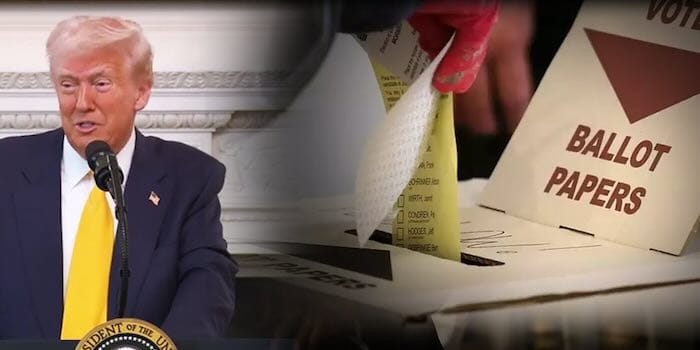
There has been much discussion recently about the SAVE Act and how it will eliminate fraud in our elections by requiring proof of citizenship before being allowed to register to vote. Other legislation would require single day in-person voting, no mail-in ballots except in well defined special circumstances, paper ballots, and a short counting period.
No amount of legitimate votes can outvote fraud
While all these things are good measures and necessary, they would all be useless unless two other problems are fixed. Congress has been very slow to act, and even were it to pass the SAVE act, these fundamental problems would remain and our elections would still not be secure.
I have been asked not to write this article, including by a candidate for a state governor, because they feared that it would reduce confidence in the integrity of our elections, and would discourage people from turning out to vote.
As for the first objection, that ship has already sailed. With almost ninety percent approval of a voter ID requirement, as well as all the reports of massive election fraud in Georgia, Pennsylvania, Michigan, Arizona, and many other states, confidence in the honesty of our elections is at an all time low. The people know there is fraud in our elections and they want it fixed! Anyone who claims that election fraud hasn't been proven, or doesn't happen often enough to matter either hasn't been paying attention, or is deliberately lying.
The second objection is more subtle. Simply put, no amount of legitimate votes can outvote fraud. Given the sort of wholesale ballot manufacturing, vote-by-mail fraud, and other modern methods of massive fraud, our current methods of ensuring election integrity are hopelessly inadequate to prevent introduction of enough fraudulent ballots to determine the outcome of any election. Even if there are huge numbers of legitimate ballots, more fraudulent ballots can be created to ensure any outcome desired, regardless of the will of the voters.
In our current system, all ballots in every State are converted to electronic images
Most people think that if we return to one day voting, paper ballots, ID required to vote, and proof of citizenship to register, we can eliminate most of the fraud potential. These are necessary, but not sufficient. The first fatal flaw explains why.
In our current system, all ballots in every State are converted to electronic images, including those cast in person. All subsequent ballot processing is done using the images in ways that are no longer transparent to the voters and that are highly vulnerable to corruption. Anyone who has used their computer to copy, edit, or delete images knows how easy it is to manipulate images that exist only as electronic records. Ballot images are no different. Ballot images can be edited, can be duplicated by the hundreds of thousands, ballots with "unwanted" selections can be altered, and paper copies can be printed from the edited or created images when it might be necessary to have paper back-up copies to "prove" the legitimacy of the fraudulent counts.
While there are safeguards devised that might reduce the likelihood of fraudulent images being introduced into election counts, few of them are actually used. A FOIA response, as well as live demonstrations proved that, despite being illegal, critical election systems, including tabulators, are internet connected, leaving them vulnerable to hacking. Higher up in the chain of processing, image databases have been altered in a variety of ways, and log files of changes altered or deleted to hide improper accesses.
In every State, the databases of registered voters contain large numbers of registrations for voters who have moved and are no longer legally permitted to vote in a jurisdiction, voter registrations at locations where no legal voter can reside, and even huge numbers of non-citizens who have been added to the rolls.
So long as we use ballot images for determining vote counts, we can never have an honest election
In California alone, it is estimated that over twenty percent of active voters in the rolls are non-citizens who by law cannot vote, yet who will be mailed ballots in each election. An additional five to ten percent are registrations for people who have moved and now reside out of state. Most other states have the same issues in comparable numbers. Every State has dirty voter rolls.
When fraudulent ballots are manufactured, they have to be associated with a voter. This is where dirty voter rolls come into play. All those invalid active registrations can be used to assign a ballot to an active registration. The registration can be used even if that "voter" might be a non-citizen who has been deported, or a voter who has moved away.
Even legitimate registrations can be used in early voting states. When the legal voter later goes to vote in person, they will be told they already voted! This is a form of identity theft used to conduct election fraud rather than for credit card or banking fraud. Generally, the person whose registration was used does not even know that they were used for election fraud.
Risk limiting audits, used to ensure the validity of the vote totals, compare a random sample of results for selected precincts with counts from the paper ballots for those precincts. If the totals match, the election is assumed secure. However, since paper copies of ballots can be printed from manufactured images, it is easy to ensure that paper copies will exist for any selection of precinct totals. Thus, in modern elections, risk limiting audits eliminate no risk and prove nothing.
So long as we use ballot images for determining vote counts, we can never have an honest election.
Part II will discuss why proving fraud never works.. We will also describe what must be done to fix matters.
View Comments
David Robb is a practicing scientist and CTO of a small firm developing new security technologies for detection of drugs and other contraband. Dave has published extensively in TheBlueStateConservative, and occasionally in American Thinker.