What Happened To 400 Million Chinese?
There is a strange silence in China. The crowded streets in Tier One cities are gone. Villages are deserted. How did hundreds of millions of Chinese people disappear?

Chet Nagle , Bio and Archives--October 8, 2025
Videos | Comments | Reader Friendly | Subscribe | Email Us

-Photo by Kai Caemmerer
The mainstream media does not seem to notice, but everyone else is beginning to see that Communist China’s population is collapsing. And it has been collapsing dramatically since 2018, long before the Covid pandemic. So what is causing that depopulation and what does it mean for the world – and for the United States?
The mainstream media does not seem to notice, but everyone else is beginning to see that Communist China’s population is collapsing. And it has been collapsing dramatically since 2018, long before the Covid pandemic. So what is causing that depopulation and what does it mean for the world – and for the United States?
We know that the Chinese government lies about most things except its military, its Belt and Road initiative, and its alliance with Russia and North Korea. It especially lies about its declining population despite the empty roads, empty shopping centers and empty office buildings in Guangzhou and even Beijing.
Shanghai, China’s largest city, also borders on empty. See it by clicking here.
The silence is more oppressive in rural villages, where the population dropped by 12.22 million in 2024 alone, a drop of 78.3% leaving 20 million acres of farmland growing weeds. See them by clicking here. here.
The Truth In China According To Beijing
According to the Beijing government, the number of Chinese was 1.408 billion at the end of 2024. That is number is down 1.39 million from 2023 and there is a similar drop in 2022. China’s National Bureau of Statistics shows a birth rate of 6.77 per 1,000 and a death rate of 7.87 per 1,000, with a total fertility rate at 1.2 children per woman, below the replacement rate of 2.1. That is despite the government paying cash incentives for third children and social pressures on unmarried women.
See another video describing the Chinese catastrophe by clicking here.
Charts can also describe the fall of China’s population -- for demographers.
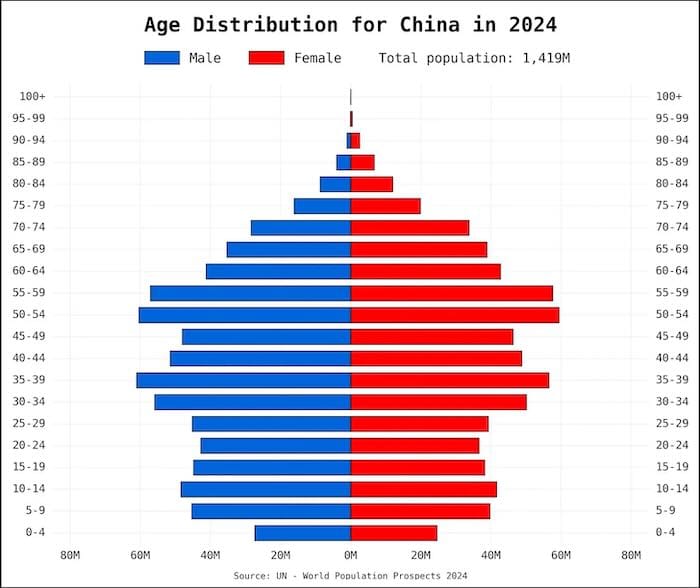
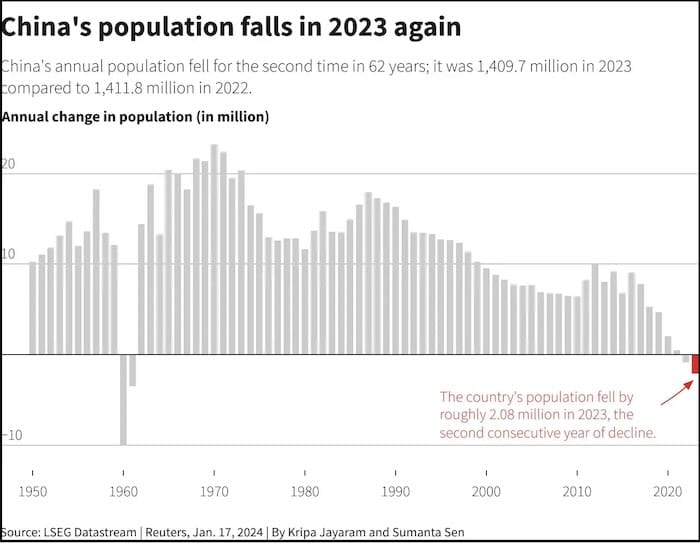
There are other indicators, however, and the facts behind them have a way of leaking out. Even in China. The Chinese Communist Party (CCP), in its effort to change derogatory numbers into something more complimentary to their bosses in Beijing, they sometimes do something that borders on the ludicrous. Like the charts below that are based on facts from Baidu, China’s equivalent of Google.
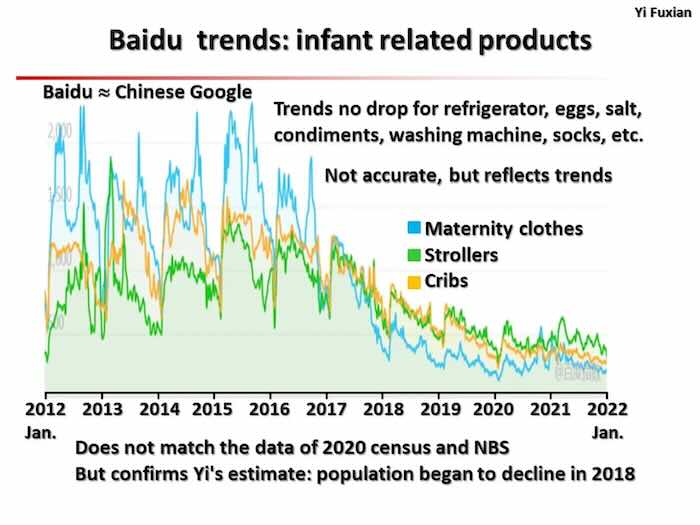
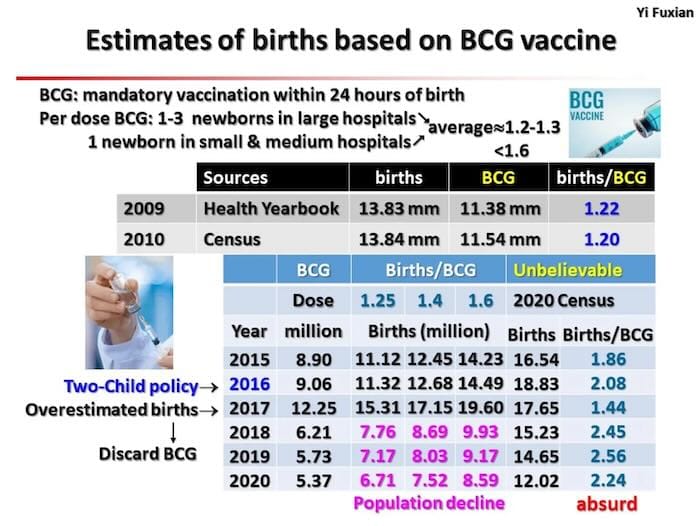
The scale of the sudden depopulation of China means it is global news. Have you heard about it?
The CCP stories of “urbanization in progress” and a “slight birth rate uptick” do not support the real world picture of a disappearing population and abandoned cities, towns and villages. What it does do is put a spotlight on a major glitch in government propaganda.
Shanghai’s Public Security Bureau database actually contains information for only about 1 billion adults, far less than the official number of 1.4 billion. Since personal information files are mandatory for anyone over 16, and 18% of the population is underage, a simple calculation means China’s population is less 1 billion – half a billion people have disappeared from CCP official records!
A hacker who calls himself “Chinadan” managed to obtain the personal data of 970 million Chinese through a data breach at Alibaba cloud. He tried to sell the data online in 2022, and he offered 750,000 random identities to interested parties who could vouch for the authenticity of the data.
After testing the data the Wall Street Journal said, “New evidence compiled by cybersecurity experts points to the database’s authenticity.”
The Epoch Times did a detailed study of Chinadan’s data and also investigated China’s population numbers from a number of angles. Their conclusion was that the “China Dance” database is genuine and that China’s population was indeed around one billion around June 2022. Many more people have died in China since 2022, which indicates that the population is now well below one billion. Well. Below. One. Billion.
The scale of the sudden depopulation of China means it is global news. Have you heard about it?
How Does It End?
What does the amazing shortfall in population mean for China and for the rest of the world?
China is the largest exporter of products in the world. In 2023 Chinese factories exported products worth $3.42 trillion. It will take time for that monstrous export number to drop, and in the interim China can use their older population for skilled and unskilled workers, as has Japan – which also has a demographic problem.
Their military will ultimately have recruiting problems, but none of the populations of eastern nations they want to control are robust – except for India, a nuclear power blocking China’s ambitions. And India now exceeds China’s population by at least 500 million.
China’s strategic alliance with Russia and North Korea is on shaky ground, especially with China’s demographic problems. North Korea’s economy is a shambles, and Russian cheap oil is only a stopgap measure for China’s automotive sector and it’s nuclear and coal power plant infrastructure.
The AI race needs electrical power, and it needs it immediately, one of the reasons China is building more coal and nuclear power plants. In 2023 China gave permits for 106 Gigawatts of new coal capacity, more than the rest of the world combined. China is also the world’s largest coal miner, producing more than 4.6 billion tones in 2023.
Then There Is The Funding For Belt And Road Problem
China’s ability to fund its promises for the Belt and Road initiative and its attendant trade deals is moving toward rocks and shoals. Trade incentives for countries that China asks to diplomatically isolate Taiwan, a major Chinese priority, are not materializing. Since 2016 Taiwan lost diplomatic relations with 10 countries. Only 12 remain, but there is now serious grumbling in their ranks.
For example, in 2023 Honduras broke diplomatic ties with Taiwan in favor of China and got little but grief in return. Educational exchanges with Taiwan were stopped, of course. Worse, imports by China of Honduran goods were a tenth of the imports by Taiwan. Presidential frontrunner, Salvador Nasrallah, says the Honduran shrimp industry as lost tens of thousands of jobs when Taiwan stopped imports of Honduran shrimp. He also said he knows other Central American countries that have never received China’s promised benefits but instead were flooded by Chinese imports Nasralla intends to resume ties with Taiwan.
Losing Honduras, not to mention other Central American countries, will be a huge embarrassment for China for two reasons. It highlights China’s failing efforts to deliver on economic commitments, and it makes superpower China look weak when a smaller country defies it. Which raises the question: despite its nuclear weapons, is Communist China still a superpower?
What China’s Population Collapse Tells America
What China means to America today is a glimpse into our own future. A massive decline in any nation’s population means economic decline – and there’s just no way around that. China today shows all the symptoms: a housing market collapse, a devastated healthcare system, a contracting tax base, and a crippling disparity between the numbers of working-age citizens and their dependents.
Will we suffer the same tortuous decline? Perhaps President Trump will be able to bring about investment in domestic infrastructure, train a generation of skilled workers, and bring manufacturing back to our shores. That will reward the workers, bring back their family stability, and motivate domestic growth. In such an America, wives will have babies again. If it does not succeed, we will inevitably inherit China’s silent cities, towns and hamlets.
To paraphrase Hemingway, “How did the world end? Two ways. Gradually, then suddenly.”
View Comments
Chet Nagle is an experienced analyst and commentator on international commerce, geopolitics, national security matters, the Middle East, and strategic communications. He has been on radio, has appeared in documentary films and has been a guest on television news programs. His columns have appeared in the Daily Caller, The Hill, Roll Call, and many other publications. He is a contributing editor for ANDmagazine.com and the European Security & Defense magazine.