What Were the People of Canada Thinking or Were They?
It seems to this writer it would have been much simpler for Canada to just elect Justin Trudeau again – the result will likely be the same

F. Andrew Wolf, Jr. , Bio and Archives--April 29, 2025
Canadian News, Opinion | Comments | Reader Friendly | Subscribe | Email Us
The 49th Parallel is the longest undefended border in the world – 5,525 miles. And I have lived just below that for my entire life of more than a few decades.
Throughout that time, I have watched Canada (an absolutely wonderful country filled with some of the finest people on Earth) slowly lose a semblance of direction.
Canada’s rather puerile political status-quo
Since the second world war, Canada has developed unprecedented order and stability in a country of hugely expansive territory and immensely difficult and varied terrain.
Over the last several decades, it has become a country struggling to resolve critical issues. Instead, a type of thinking one can only describe as wish fulfillment has taken hold of Canada’s political establishment.
Canada’s rather puerile political status-quo denotes a type of wishful thinking that has been substituted for critical thought.
Here's a classic example: To combat climate change, my friends to the North have unilaterally declared that global energy use should be radically restricted, despite the fact that billions of people depend on cheap and abundant energy, which renewables are nowhere near being able to provide.
Nature is unaffected by what we want to be true. The laws of physics are indifferent to our purposes, our wants and desires.
When we accept as truth what we want to be true, rather than what actually is, we become irrational, absent of sound reasoning.
We thrust nations like Germany into crisis because of short sightedness (a TikTok approach to reasoning) and give Russia the brush-off because of its invasion of Ukraine (without fully comprehending why that happened).
In Canada former Prime Minister Justin Trudeau, while supplying Ukraine with basic armaments, has chosen to punish Russia and its oligarchs with various sanctions – as if seizing a Russian billionaire's yacht would be some sort of crippling action that would impede Russia’s military action.
You can plant a field of corn and nurture its growth, but pulling on its ears won't make them grow larger or mature faster
Other western nations (essentially those in NATO) have also, like Canada, followed the US-led initiative and toyed with poking the “Russian Bear” in the eye, risking retaliation. But this would be retaliation from a country that in Putin's own words cannot prevail in a conventional war against NATO and would not dare risk a nuclear excursion for fear of a devastating counter response in which no one wins (i.e. survives).
Canada's approach to its foreign policy, in lockstep with the US, is obviously not working, as Russia continues to prevail on the battlefield and in the past two years managed to grow its economy beyond that of all major Western nations in the G-7
What Canada should have (and could have) done is to pay attention to its domestic economic affairs, maximize GDP growth and use a measure of the capital produced to invest in discovering new technologies that could help solve the problem so many Canadians seemed so exercised about – climate change.
This domestic approach has never failed Canada. In fact, it is precisely the reason why, despite extraordinary population growth since the second world war, Canada continues to be able to feed itself.
But this approach will not satisfy those of a modern liberal persuasion who want immediate results with initiatives which have no hope of resolving the perceived climate change issues.
You can plant a field of corn and nurture its growth, but pulling on its ears won't make them grow larger or mature faster.
“We were dead and buried in December”
Monday's election was Canada's opportunity to begin to set it right, but it was squandered on emotion in response to the rhetoric of someone who poses no real threat to Canada and its people.
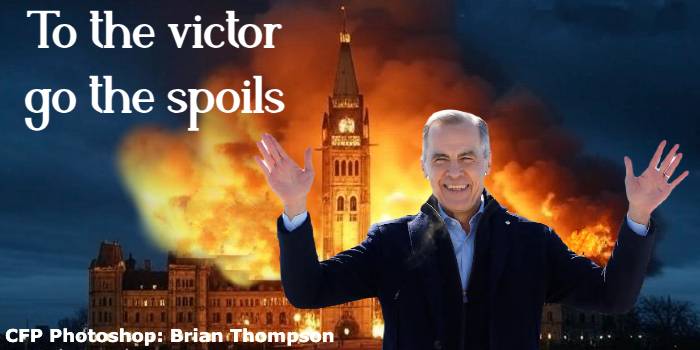
Prime Minister Mark Carney’s Liberal Party has won Canada’s federal election, manifesting an extraordinary reversal fuelled by Donald Trump’s threats to Canada’s economy and sovereignty.
After polls closed Monday night, the Liberals were projected to win more of Parliament’s 343 seats than the Conservative Party, though it wasn’t immediately clear if they would win an outright majority.
Throughout much of Justin Trudeau's last 18 months in office, the Liberals looked headed for a crushing defeat. But then – enter Donald J. Trump. The American president began his verbal assault on Canada’s economy and the issue of running trade deficits with the US. And this was then followed by vacuous threats to Canada's sovereignty, suggesting it should become America's 51st state.
Clearly by design, Trump’s actions infuriated Canadians and stoked a surge in nationalism that enabled Liberals to overturn the election narrative and win a fourth-straight term in power.
“We were dead and buried in December,” said former Liberal Justice Minister David Lametti. But now thanks to the rhetoric of Donald Trump, “...We are going to form a government.”
Canadians on both the left and the right, young and old, allowed their emotive response to an outsider to control the destiny of their country and continue policies that before Donald Trump were anathema to their consciousness.
Carney: “The Americans want to break us so they can own us”
Unfortunately, now those policies will likely continue, since in their haste to “show Trump” what they thought of him, they elected a globalist clone reiterating much of what Trudeau was advocating.
The Conservative Party's leader, Pierre Poilievre, hoped to make the election a referendum on former Prime Minister Justin Trudeau, whose popularity collapsed toward the end of his decade in power as food and housing prices escalated.
But Trump attacked, Trudeau resigned and Carney, a two-time central banker and thoroughgoing globalist, became the Liberal Party’s leader and prime minister.
Even with Canadians grappling with the fallout from a deadly weekend attack at a Vancouver street festival, Trump was trolling them on election day, suggesting on social media that he was on their ballot and repeating that Canada should become the 51st state.
Trump’s truculence infuriated many Canadians on both sides of the political divide, leading many to react foolishly: cancelling U.S. vacations, refusing to buy American goods and possibly even voting early. Trump likely precipitated a record turnout: 7.3 million Canadians cast ballots before election day.
The ensuing rhetoric by the Liberals was predictable:
“The Americans want to break us so they can own us,” Carney said in the run-up to election day. “Those aren't just words. That's what's at risk.”
Donald Trump's rhetoric caused them to lose their minds
After running a Trump-like campaign for months, Poilievre’s similarities to the bombastic conservative American leader might have cost him the election. But not because he was like Trump; rather, because the Canadian electorate reacted in a puerile manner and let their emotions get the best of them and their country, which they say means so much to them.
Reid Warren, a Toronto resident, said he voted Liberal because Poilievre “sounds like mini-Trump to me.”
There appeared to be too much similarity between Poilievre and Trump, and that is ultimately what cost him with voters. They looked at Poilievre but saw Trump instead.
Carney and the Liberals may have prevailed, but the challenges before them are daunting.
In addition to the trade war with the U.S. and dicey relationship with Trump, Canada is dealing with a cost-of-living crisis. Moreover, roughly 75.9% of its exports go to the U.S., so Trump's tariffs threat and his desire to get North American automakers to move Canada's production south could severely damage the Canadian economy.
But voting for a government that is antithetical to what the majority of Canadians said they wanted before Donald Trump's rhetoric caused them to lose their minds is irrational. It seems to this writer it would have been much simpler for Canada to just elect Justin Trudeau again – the result will likely be the same.
View Comments
F. Andrew Wolf, Jr. is retired from the USAF (Lt. Col.) and university teaching (Western Humanities and the Arts, Philosophy and Political Philosophy). His education includes (PhD-Philosophy Univ. of Wales), (MTh-Texas Christian Univ.), (MA-Univ. South Africa), (BA-Texas Lutheran Univ.) and conversations with his wonderful wife. He has an abiding interest in and passion for what is in the best interest of a multipolar world.
F. Andrew Wolf, Jr. is published through both US (American Spectator, The Thinking Conservative, The Daily Philosophy, Academic Questions: National Association of Scholars) and international media (International Policy Digest, Eurasia Review, Cairo Review of Global Affairs, Middle East Monitor, Times of Israel).