MAID Live Organ Donation: The Quiet Commerce of the Human Body
The names have changed. The science has changed. The law has changed. But the hare still runs, reminding us that progress is measured not only by what we discover, but by the wisdom with which we choose to use it;

Mark Macneill , Bio and Archives--July 31, 2026
Canadian News, Opinion | Comments | Reader Friendly | Subscribe | Email Us
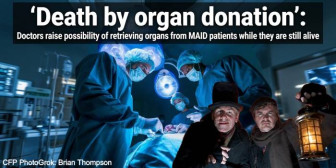
There was a time when a whispered phrase, "The rabbit died," meant a child was coming. Few knew that the tested rabbit always died; whether the woman was pregnant or not made no difference. Science demanded certainty, and certainty came at a price. History remembered the saying, but forgot the lesson.
History has another Hare. His name was William. He walked the streets of Edinburgh at a time when medical schools needed cadavers and society supplied too few. Burke and Hare discovered that the human body possessed value beyond life itself. Their victims became commodities for anatomy, not because medicine was corrupt, but because science had outpaced the legal and ethical boundaries that were meant to govern it. Parliament recoiled. The Anatomy Act followed. Society convinced itself that the lesson had been learned.
Perhaps every generation believes that.
Today medicine performs miracles unimaginable in Burke's Edinburgh. Hearts are transplanted. Kidneys restore decades of life. Organ donation has become one of humanity's greatest acts of generosity, transforming loss into hope for families who would otherwise know only grief. Yet every medical advance brings with it an older question—not whether something can be done, but whether every possibility should become a practice.
Recent public debate has returned us, in a different setting and for different reasons, to the ancient boundary between life and death. Physicians, lawyers, ethicists, and legislators continue to wrestle with questions of autonomy, dignity, consent, and organ donation. The circumstances are profoundly different from those of nineteenth-century Edinburgh. The question, however, is strikingly familiar.
When does a person become a body?
The rabbit marked the beginning of life. Burke and Hare forced society to confront its end. Between those two moments lies a line that every civilization must draw for itself. The law exists to define it. Medicine exists to respect it. Society is ultimately judged not only by the lives it saves, but by the principles it refuses to surrender while saving them.
History rarely repeats itself in the way we imagine. More often, it returns quietly, asking whether we still recognize the questions that challenged those who came before us. The names have changed. The science has changed. The law has changed. But the hare still runs, reminding us that progress is measured not only by what we discover, but by the wisdom with which we choose to use it.
View Comments
C. Mark MacNeill is a lifelong student of legal history, political philosophy, and public affairs. He writes on issues ranging from constitutional and administrative law to public finance, governance, and Canadian political culture. His professional experience includes legal consulting, strategic advisory work, corporate governance, and public policy analysis.
He lives on Cape Breton Island, Nova Scotia