With Thomas At Chickamauga
There is much to discover on a stroll in a cemetery around Memorial Day

Dr. Bruce Smith , Bio and Archives--May 27, 2024
HeartlandLifestyles | Comments | Reader Friendly | Subscribe | Email Us
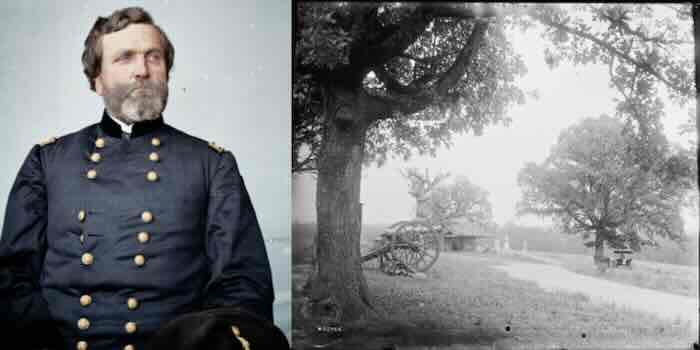
For many years it has been an interest of mine to visit cemeteries. There was a tradition of visiting cemeteries on my dad’s side of the family, particularly. My grandfather’s father was a stone carver who inscribed several family stones. I was shown these markers before I was a teen. It was very clear to me that they were part of our family’s history but more importantly, part of the country’s history. They are part of us, and they remind us of those who came before.
After my grandmother passed away I made many visits to the Mt. Summit cemetery where she rested. I began to look around there, discovering a marker for Flossie Flannery, a WAC who lost her life in a plane crash off the coast of Africa in 1945. The rest of her story appeared in my bookThe War Comes To Plum Street, along with many others that began with visits to cemeteries.
Not long afterward, when I learned to drive, I began to stop at cemeteries here and there to explore and investigate. Using James E. Smith’s stone carving legacy, I later began to write academic papers on cemeteries and funerary art for American culture journals. That meant more visits to more cemeteries. I visited the American military cemetery at Hamm, Luxembourg, where Patton is buried with many of his troops. I went to the Allied D-Day cemetery at Colleville-sur-Mer, in Normandy, and to many markers in the little villages scattered across France and England. I made several trips to Oakwood Cemetery in Troy, New York. That’s where you’ll find Civil War notables John A. Griswold and George Thomas. Every cemetery has something to teach us if we will make the effort to seek them out and read their messages to the future.
Just a few weeks back I stopped at a cemetery in Spencer, in Owen County, Indiana as part of a research project. On a prominent knoll above the flood plain of the White River there were a series of markers that seemed different from the rest. I walked over to try to understand why. It turned out they were memorials to some of the town’s early founders and prominent citizens of the past. Several had some biographical information on them. There the usual memorials to children and their spouses. One had a bronze plaque with raised letters. When I read one of the sentences, chills ran down my back.
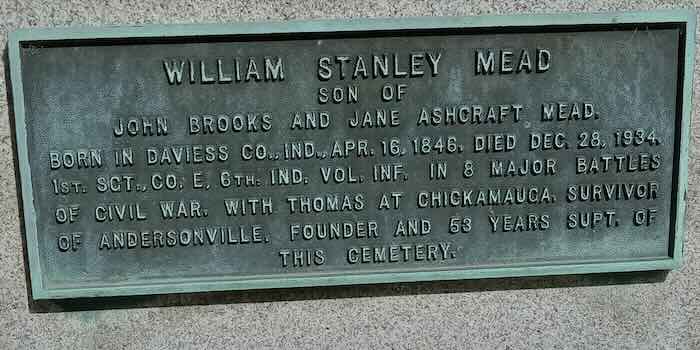
I was five feet from a veteran sergeant of the 6th Indiana Infantry. The 6th was under Gen. George Thomas’ command on that terrible September day in 1863.
For years after starting with Bruce Catton’s masterful Army of the Potomac trilogy I had studied and read about the Civil War. I knew the woes and the difficulties the Union army had faced over the long years 1861-1865. They were watershed years for the country.
Between the battles of Waterloo in 1815 and First Manassas in 1861, just 46 years, infantry weapons changed dramatically but infantry tactics did not. Over these few years the development of rifled muskets and conical bullets extended the killing zone in front of a dug-in defensive force to as much as 400 yards, compared to the 30-yard killing zone for smoothbore muskets of the eighteenth century and Napoleonic era.
The problem in the Civil War was the use of Napoleonic tactics in the face of updated weapons. Napoleon and earlier commanders could march forces just 40 yards in front of an enemy with little danger from the opposing infantry. We’ve seen the paintings of scarlet-clad British forces marching forward in tight formations to concentrate fire on their enemies, including Continental forces in our Revolutionary War. Every regular army fought that way for 200 years while trying to steer clear of massed artillery. It was possible because the range of infantry weapons was so limited. By 1861 this drama of straight lines and colorful uniforms could only be indulged at great price. And yet on they marched as if on parade on the rolling ground outside Brussels.
The new firepower made strong defensive positions superior in most every case. Because Confederate commanders often chose to fight defensive battles, and because the Union side had to go on the offensive for most every battle, the war was a series of costly ordeals for Union troops. Defense was superior in those years and Union forces were usually on offense, paying a heavy price for every gain.
In the late summer of 1863, just a couple of months after the carnage at Gettysburg, and exactly a year after the terrible battle of Antietam, in Maryland, the Union Army of the Cumberland had orders to begin moving south into Georgia from its base in Chattanooga. Part of that movement involved Union forces operating near Chickamauga Creek, just south of Chattanooga. Commanded by Gen. Rosecrans, the Union forces came under attack by determined Confederate forces. When the Union line began to falter and part of it broke, Rosecrans gave orders to all units to give up the field and withdraw toward Chattanooga.
Everyone got the order to withdraw except the units under General Thomas. Without knowing that forces on both his flanks had been withdrawn, Thomas ordered that the ground they occupied be held. With only a single stronghold point left on the battlefield, Confederate forces concentrated on the curved line on the high ground in front of them. There stood Thomas and his command, which on that day included the 6th Indiana Infantry. Gen. Thomas was in a unusual position for a Union general. He had a sizeable well-supplied force on the high ground and he was under heavy attack by Confederate forces. Defense was superior on that day, too, and Thomas taught a textbook lesson.
All that day Union forces stood in their positions on the high ground, delivering devastating fire on the Confederates attacking up the steep slopes. The blue line held. Late in the day word finally came to Thomas that he was to withdraw and so he did, in good order, after dark when the threat against him was gone.
But on that day the perilous position held. Thomas gained the nickname ‘Rock of Chickamauga.’ That moniker had been made possible by the determined veteran troops Thomas commanded. One of those was William Stanley Mead, whom we now remember. Note his age in September, 1863.
By his own account Mead was in eight major battles of the Civil War and survived a notorious Confederate prison camp, but he was proudest of one of those battles, when he was -- With Thomas at Chickamauga.
View Comments
Dr. Bruce Smith (Inkwell, Hearth and Plow) is a retired professor of history and a lifelong observer of politics and world events. He holds degrees from Indiana University and the University of Notre Dame. In addition to writing, he works as a caretaker and handyman. His non-fiction book The War Comes to Plum Street, about daily life in the 1930s and during World War II, may be ordered from Indiana University Press.