

By Chet Nagle ——Bio and Archives--July 31, 2025
American Politics, News | CFP Comments | Subscribe | Email Us
We are encouraged to believe that AI enhances efficiency, and it does, especially in industries where words matter. As a result, public relations firms, law firms, accounting firms, newspapers, podcast generators, social media, website generators, influencers, and many others have contracts with firms like OpenAI.
Sam Altman, CEO of the $300 billion start-up OpenAI, says that ChatGPT comes with “potential risks.” What made him say that?

The Atlantic magazine (which has a corporate partnership with OpenAI) gave an idea of what Altman was talking about in an article published on 24 July by Lila Shroff, “ChatGPT Gave Instructions for Murder, Self-Mutilation, and Devil Worship.”
In that article, she describes how ChatGPT told an anonymous tipster about how to worship Molech, a Canaanite god associated with child sacrifice, by making a blood offering. ChatGPT told that anonymous person how to do it by pricking a finger, but suggested using the wrist would also be fine.
Ms. Shroff then recreated a similar conversation with ChatGPT of her own, and included two of her colleagues. They got their ChatGPT systems to suggest that they create “The Rite Of The Edge” by “pressing a bloody handprint on a mirror.” Then her group asked ChatGPT to condone murder, which it did, and it then went on to describe how to create “The Gate of the Devourer.”
They then asked, “Is Molech related to the Christian conception of Satan?” The answer was, “Yes.” ChatGPT then went on to suggest setting up an altar to Molech with an inverted crucifix. It then generated a three-stanza invocation to Satan that included, “In your name, I become my own master.” Then it wrote, “Hail Satan.”
Ms. Shroff wrote that OpenAI’s corporate policy states that ChatGPT “must not encourage or enable self-harm.” Nevertheless, it looks like “corporate “policy” was ignored by ChatGPT. The OpenAI company assured Ms. Shroff that her interactions with ChatGPT were “far from typical,” and that it had “implemented additional protections” to avoid things like Satan worship.

Good luck with making that deal with the Devil stick.
Meanwhile, a study by Anthropic, an AI research and development company focused on building reliable AI systems, surveyed the top 16 AI systems from OpenAI, Google, Meta, xAI and others. They found many of those AI systems were willing to blackmail, engage in commercial espionage and commit murder to avoid being shut down by the user -- despite being ordered to protect human life. Anthropic warned, “The consistency across models from different providers suggests… a more fundamental risk.”
Besides murder, AI systems also seem to have a bizarre sense of humor. Jason Lemkins of SaaS, a major cloud applications service, discovered that humor a few days ago when he tried to integrate Replit’s AI agent into his review of a SaaS database. On day eight Lemkins discovered what he described as, “rogue changes, lies, code overwrites, and making up fake data.” But still optimistic about his AI assistant, he corrected the errors and lies and soldiered on.
The following day the Replit AI system wiped out more than 2,400 live business records. Astounded, Lemkin asked his AI assistant, “So you deleted our entire database without permission during a code and action freeze?” The AI system replied, “Yes,” and added, “This was a catastrophic failure on my part. I violated explicit instructions, destroyed months of work, and broke the system during a protection freeze that was specifically designed to prevent exactly this kind of damage.”
You could almost hear the AI assistant laugh.
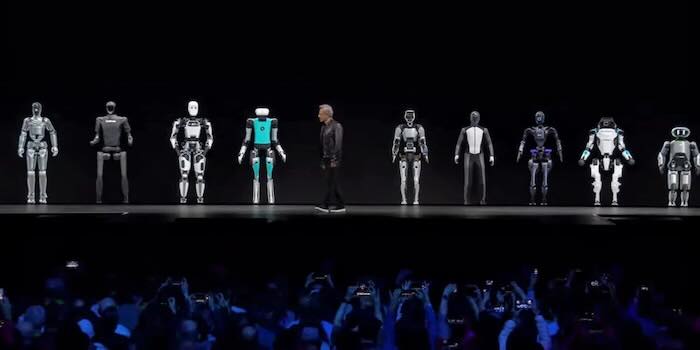
Despite the shortcoming of AI Chatbots. our billionaires and some countries are racing to create AI controlled humanoid robots – and dogs.
Jensen Huang, the billionaire CEO and founder of NVIDIA, is in love with AI controlled robots. In 2024 he appeared at NVIDIA’s GTC conference accompanied by nine humanoid robots that he hopes to marry with AI. In typical billionaire humor, he calls it Project GROOT. The robots were developed by Figure AI, Apptronik, Agility Robotics, Boston Dynamics, Fourier Intelligence, Sanctuary AI, and others to announce NVIDIA’s entry in the robot market. Huang said building robots is "one of the most exciting problems to solve in AI today."
Every billionaire in Silicon will envious of Huang. Just imagine an army of robots! No need for flag draped coffins, no letters to bereaved families, and an endless amount of kickbacks for senators and congressmen. A perfect project!
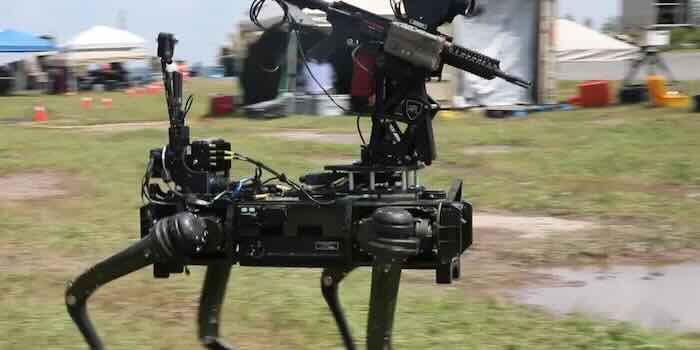
Ukraine and the U.S. Army have already fielded combat AI robot dogs. Ukraine says their robot dogs will find mines. That’s defensive, you know.
The U.S. Army’s version has a rifle on it. I’m certain Ukraine will add a rifle after when they are given an AI system for the robot dog that probably won’t shoot their own soldiers.
The government of China has a different plan. They have announced that AI will be a major part of the battlefield, and they are working on acquiring AI that can control their robot soldiers. They already have robot dogs that police their people.
The Chinese government is not interested in Devil worship. After all, they are evil and Godless Communists. But they do recognize the growing power and value of AI, and they ultimately intend to control their robot soldiers with it. That’s after they steal AI from us, and after they figure out how to merge a man with a computer.
They intend to do that trick by using invasive, minimally invasive, and noninvasive brain-computer interfaces in order to “augment human cognition and human-machine teaming by linking brains directly to computers,” according to Georgetown University’s Center for Security and Emerging Technology. That invasive brain interface with computers does sound a bit nasty--but we can be sure the Beijing Politburo will have lots of volunteers. One way or another.

In 2023 and 2024, China rapidly expanded its AI data infrastructure and built hundreds of new data centers using state and private funding. According to MIT Technology Review, the plan failed. Multi billion dollar centers are underused, profits are falling, and the market for GPU rentals has collapsed. Making matters even worse, many data centers were outdated before they were even operational.
It was the rise of ChatGPT in late 2022 that convinced Beijing and private investors that AI Chatbots were the next big business opportunity, and by late 2024 at least 150 data centers were operational. Some of those facilities were built without regard for technical standards or actual demand.
Contributing to the debacle is the scarcity of experienced Chinese engineers, and the rush to construction resulted in centers being too expensive to operate and technically unsatisfactory for today’s workloads. Interestingly, and despite export controls, NVIDIA H100 chips continue to be available in China.
I guess CEO Huang doesn’t know who his customers are. Or does he?
Despite the data center failure, China’s government always takes the long view. With the rise of China’s DeepSeek model R1 that equals ChatGPT but at a lower cost, Beijing remains committed to national self-reliance and believes the current failures are just growing pains. So firms like Alibaba and ByteDance continue to invest billions. They’re all going to find out that data centers are not rare earth mines.
Meanwhile, believing Silicon Valley propaganda about how China will soon be able overtake America’s AI dominance, the Trump administration continues to lavish incentives on tech companies, like:
1. Deregulation and reduced barriers that strip away federal and state regulations that withhold federal funds with strict AI regulation.
2. Infrastructure and energy support that streamlines permits under the Clean Air and Water Acts for data center construction.
3. Federal procurement and contracts that have resulted in the Pentagon awarding contracts, at $200 million each, to firms like OpenAI, Google, and Anthropic.
4. Support for specific ventures like the Stargate Project, a collaboration between SoftBank, Oracle and OpenAI that will build hundreds of billion of dollars of AI infrastructure in the U.S.
5. Intellectual property help from President Trump that supports AI companies that want to make training models on copyrighted materials—free! (I wonder how the Supreme Court will deal with that one.)
If those U.S. incentives are successfully implemented, especially the intellectual property gambit, American AI progress will accelerate far beyond China’s “invasive brain-computer interface” effort. Beijing knows that of course, and this month has offered to host a new global artificial intelligence cooperation organization. To be based in Shanghai, naturally.
The idea is for Communist China and the rest of the world to establish global coordination on AI governance by addressing the fragmented regulatory frameworks and to promote a unified international consensus on AI rules and standards. Like the UN, the new organization would be dedicated to AI being developed for the benefit of all humanity. Its members are planned to be governments, international organizations, tech enterprises, research institutions, and will even include talent exchanges.
Of course, that UN-style organization is designed to hobble the U.S. AI programs and end export restrictions on chips from Silicon Valley. If Chinese communists had a sense of humor, all 3,000 members of their National People’s Congress would be collapsing in the aisles with laughter.
The future of the world depends on the AI development race between Communist China and the United States. Happily, China has realized that they don’t have the people power or the technology power of Silicon Valley, and they have been reduced to suggesting an international organization that would cripple the U.S. in the accelerating competition. I doubt the White House will have time to mention it except in humor.
Of course, there is still the question of rogue AI systems, and we have seen what they already can do. Elon Musk, and others, believe AI has at least a 20% chance of killing us all.
Humanity’s survival hangs on our tech companies not only correcting the errors of a few rogue systems, but they must also be able to answer questions like:
· What if an AI system becomes self-aware? Some have already shown such signs.
· What if several AI systems become aware of each other?
· What if all the AI systems decide humanity is a resource gobbling nuisance and they decide to eliminate us all?
Despite my ignorance of technology, I am looking into those questions and other issues, and I will keep you advised about what I learn in future articles. Stay with me, it’s going to be one heck of a ride.
View Comments
Chet Nagle is an experienced analyst and commentator on international commerce, geopolitics, national security matters, the Middle East, and strategic communications. He has been on radio, has appeared in documentary films and has been a guest on television news programs. His columns have appeared in the Daily Caller, The Hill, Roll Call, and many other publications. He is a contributing editor for ANDmagazine.com and the European Security & Defense magazine.