

By News on the Net -- Kevin Jone——Bio and Archives--November 20, 2026
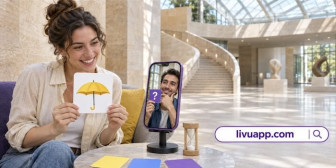
Most conversations follow a familiar order. One person asks a question, the other answers, and the exchange continues from there.
Reversing that order creates a surprisingly different experience.
In the “answer first” game, one participant gives an answer without revealing the question. The other person must imagine what question could have produced it. An answer such as “Tuesday evening” might belong to “When do you usually call your family?” or “When did you finally finish that book?” The actual question may be completely different.
The activity introduces curiosity, humor, and creative thinking into a first conversation. Through a live app video call, participants can use expressions, gestures, and nearby objects as clues while they try to reconstruct the hidden question.
It requires no special preparation and can move easily between playful and meaningful topics.

The basic version has four steps:
Suppose the answer is, “A yellow umbrella.”
The other participant might guess:
The hidden question might actually be, “What object near your front door makes you smile?”
The difference between the guesses and the real question creates several possible conversation paths. Participants can discuss umbrellas, colors, weather, daily habits, or objects connected to positive memories.
Specific answers are easier and more enjoyable to guess than abstract ones.
“A blue bicycle” offers more possibilities than “happiness.” “Seven minutes” creates more curiosity than “a long time.” A concrete answer gives the other participant something they can picture and explore.
Useful first-round answers include:
The hidden question should remain safe and appropriate for a new conversation. It should not require someone to reveal an address, financial information, health details, or private relationships.
If the first guess is far from the hidden question, the answer-giver can provide one clue at a time.
For example:
Answer: “Ten minutes.”
First clue: “It is part of my morning.”
Second clue: “It happens before I leave home.”
Third clue: “It makes the rest of the day feel easier.”
The hidden question might be: “How long do you spend preparing breakfast?”
Layered clues keep both people involved. The guesser has time to revise their interpretation, while the answer-giver decides how much information to reveal.
Clues can be verbal or visual. Someone might hold up a cup, point toward a window, or demonstrate a simple action. These gestures make the game especially suitable for video-based conversations.

The goal is not simply to discover the correct question as quickly as possible. An incorrect but imaginative guess can be more valuable than an accurate one.
If the answer is “a wooden spoon,” someone might ask, “What would you take to a desert island?” That guess is probably wrong, but it creates an entertaining side question: why would anyone choose a wooden spoon?
Participants can pause to explore an interesting guess before returning to the game. This prevents the activity from becoming a rigid quiz.
A useful rule is that the answer-giver must respond briefly to their favorite incorrect question. This gives creative guesses a purpose and encourages both people to think beyond obvious possibilities.
The activity becomes easier when participants agree on a category. Several rounds can use different themes.
Answers may relate to routines, food, transportation, weather, or household objects.
The hidden question could involve a favorite texture, time of day, type of music, or way to spend a free hour.
Participants can answer questions about fictional inventions, unusual travel plans, or impossible choices.
These rounds can focus on harmless memories, such as a childhood snack, an old hobby, or a school subject someone enjoyed.
Answers might describe something a person wants to learn, try, visit, or create.
Categories provide direction without revealing the exact question.
In this variation, both participants must create different questions that lead to the same answer.
The shared answer might be “Sunday morning.”
One participant could ask, “When is the best time to visit a quiet market?” The other might ask, “When do you prefer to clean your room?”
This version shows how the same phrase can have completely different meanings depending on context. It also demonstrates how assumptions shape conversation.
During a 1v1 chat live, participants can write the shared answer on a blank card and hold it toward the camera. Each person then reveals their question separately.
The round works best with simple, flexible answers such as a color, a number, a time, or a familiar object.
Another variation asks the guesser to invent three possible questions for a single answer:
For the answer “a small notebook,” the questions could be:
The answer-giver chooses the question they would most like to discuss. This gives them control over the direction of the conversation and helps both participants discover which topics feel most engaging.
Because the activity is built around questions, boundaries are important.
Participants should avoid guessing sensitive subjects when the answer is ambiguous. If someone says “three years,” it is better to guess a hobby, project, or travel memory than a private relationship or health matter.
Either person can skip an answer or replace the hidden question without explanation. The activity should create options, not pressure.
It is also helpful to alternate roles after every round. This prevents one person from asking all the questions and keeps the exchange balanced.
A nearby object can serve as both an answer and a clue.
Someone might hold up a reusable bottle, a postcard, a kitchen timer, or a pair of headphones. The other participant guesses what question the object answers.
Before showing anything, participants should check for names, addresses, labels, notifications, or other identifying information. The camera can focus closely on the object rather than revealing an entire room.
Objects are optional. A spoken answer is enough if someone prefers to keep their surroundings private.
After several rounds, both participants can choose one hidden or invented question they would like to answer more fully.
This moves the conversation beyond the game. A playful response such as “a train window” might lead to a thoughtful discussion about travel, observation, or places someone hopes to visit.
The final question does not need to be profound. It only needs to inspire genuine interest from both sides.
Conversations usually treat answers as endpoints. The “answer first” game turns them into beginnings.
A color, number, object, or day of the week can lead to multiple interpretations. Each guess reveals something about the person asking it, while the hidden question reveals what the other participant originally had in mind.
By changing the expected order, two people can move beyond predictable introductions and create a conversation that neither could have planned alone. Sometimes the most interesting question appears only after the answer has already been given.
Kevin Jone covers topics spanning lifestyles
View Comments
News from around the world