Those who have the audacity to imagine they can 'manage' temperatures of the nearest planet, don’t waste time, money on CO2. Go to where efforts will be effective. Change Solar cycle, Cosmic rays, Earth’s orbit, Plate tectonics, Ocean currents
When reviewing the history of the Earth’s atmosphere it is fascinating that at first it was all atmosphere and no Earth. And that atmosphere was mainly hydrogen. Then due to the implacable nature of gravity enough of it got together to form our hot Sun, while other items within what has been called the “Frost Belt” agglomerated into the rocky planets. Of which the Earth eventually became the most accommodating to life. Over immense time, this hospitality changed the atmosphere and the rocks. Additions to the original hydrogen came from hot rocks outgassing mainly nitrogen and some carbon dioxide. Moreover, hot rocks have been a continuing source of CO2. And then life was initiated by very early forms of bacteria, which with photosynthesis provided not just oxygen but converted CO2 to food. All on the way to forming cool rocks.
Main “greenhouse gas” is water vapor
Most folk don’t mind cool rocks.
Nowadays, some 99 percent of our atmosphere is nitrogen and oxygen. More detailed at 78% and 21%, with the next most present being argon at 0.93%. Carbon dioxide at only 0.04% is ranked as one of the trace gasses. Of course, the main “greenhouse gas” is water vapor which can range as high as 7% in the humid tropics to 1% on a cold winter’s day. And what we breathe out includes CO2 at some 5% with some 6% being water vapor. And water as a liquid or in the form of vapor is a huge transporter of heat from hot to cool places. In the real world, carbon dioxide contributes little to this, nor as a gas does it store any heat. And the recorded changes in climate trends have been driven mainly by changes in the Sun’s activity and changes in the Earth’s orbit, CO2 has negligible influence.
However, ambitious bureaucrats and politicians have turned it into a molecule with a remarkable political mojo – making fear a growth industry in yet another experiment in in-your-face and in-your-wallet government. Instead of undeserved infamy, carbon dioxide molecules should be celebrated.
Indeed, in its essential role of providing food for life, the observation is that CO2 rocks! The quip is practical because carbon dioxide came from and still comes from hot rocks and in sustaining life is eventually turned into cool rocks. Otherwise known as corals, or with chemical variation rocks originating from carbon dioxide have been called limestone or dolomite. While enjoyed as mountain scenery at, say, Aspen or Davos, it really is magnificently sequestered carbon dioxide. With alteration due to heat and pressure either rock can be appreciated as fine marble.
Life, of which humans are a very small portion, is an essential intermediary step in transporting CO2 from one kind of rock to another kind of rock. Forever.
Originally, life was made possible by a special critter known as cyanobacteria and if society needs to know only one equation it should be the one for photosynthesis. In the simplest of words, it goes like this:
Not only does CO2 make rock, but it adds up to mountains of the stuff
Carbon dioxide + Water + Sunshine = Glucose + Oxygen
The Dictionary of Science by Hammond and Barnhart provides more detail.
“Photosynthesis occupies a primary place in the economy of life. It is the process by which the energy of the Sun is captured and converted to the uses of the living cell. It is, in addition, the beginning process in the transfer of atoms from the inorganic to the organic.”
Not only does CO2 make rock, but it adds up to mountains of the stuff. Indeed, the Dolomite Mountains rise as high as 11,000 feet, which is the ultimate in bleached-out and ocean-deprived coral reefs. The foundations of such mountains would go down thousands of feet below today’s sea levels. Representing an enormous sequestration of carbon dioxide that is visible; unseen are the vast cold-water corals on many ocean floors.
Hot rocks, under the sea and in fiery archipelagoes or rifts, as well as ocean waters are still outgassing CO2, making the amount modern industrial society emits rather small. Using the Vostok core of temps and CO2 concentrations, the record shows that climate warming precedes CO2 increases by some 800 years. Increasing temps force increases in CO2, not the other way around.
So, some rocks provide life-giving carbon dioxide, which lately as a means of raising taxation and inspiring regulation has been getting a bad rap. Unwarranted!
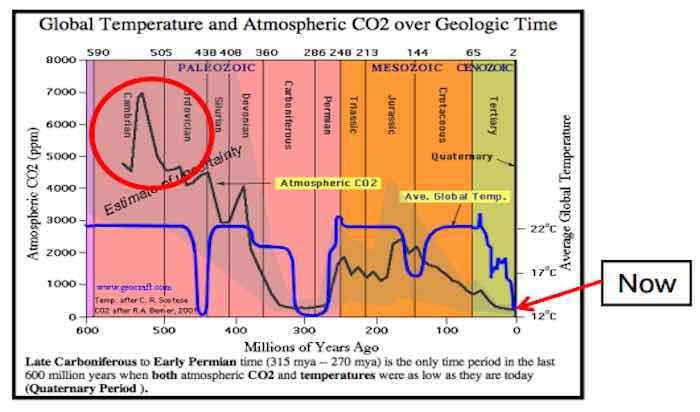
And, going the other way, rocks have been remarkable in sequestering CO2. Indeed, during the Cambrian Period some 550 million years ago, atmospheric concentrations were at 7,000 ppm, or 0.70%, some 17 times higher that today’s paltry 400 ppm.
Global Temperature and Atmospheric CO2 over Geologic Time
Sea-level corals have been quietly turning a politically powerful trace gas into traceable rock
And where did all of that atmospheric CO2 go? Quite simply, it became rocks on the ocean floors or stacked up in scenic mountains.
Geologically speaking today’s atmospheric levels are rather low. Moreover, at lower than 150 ppm, all life on our formerly hospitable planet would begin to shut down.
Sea-level corals have been quietly turning a politically powerful trace gas into traceable rock. That it works within natural geological trends, is recorded by the long rise in sea levels of some 300 feet since the start of the latest interglacial, some 12,000 years ago. Along with this has been the 10 C rise in temperature.
In looking to the optimistic side, corals have been turning CO2 into cool rocks for hundreds of millions of years. They thrive in tropical temperatures and don’t care if the sea level is going up or down. Whatever it is, they will be there. Been doing it for hundreds of millions of years.
Understandably, the recent and outstanding rise in carbon dioxide levels has been accompanied by the remarkable “greening” of global vegetation. As measured by satellites, wherever plants grow, from the poles to the tropics, or from the seas to rocky mountain highs. Thanks to CO2 in its diverse forms, life exists, and for mankind the best that it has ever been.
As a postscript, for those who have the audacity to imagine they can “manage” the temperature of the nearest planet, don’t waste time and money on CO2. Go to where efforts will be effective. Change the solar cycle, cosmic rays, the Earth’s orbit, plate tectonics and ocean currents.
Bob Hoye (BobHoye.com) has been researching investments for decades, which eventually included the history of financial and political markets. He considers now to be the most fascinating time for both since the Great Reformation of the 1600s. Bob casts a caustic eye on all promotions and, having a degree in geophysics, is severely critical of the audacity that a committee can “manage” not just the economy, but also the temperature of the nearest planet. He has had articles published in major financial journals and, as a speaker, has amused assemblies in a number of cities, from London to Zurich to Tokyo.