

By Sierra Rayne ——Bio and Archives--June 1, 2014
Global Warming-Energy-Environment | CFP Comments | Subscribe | Email Us

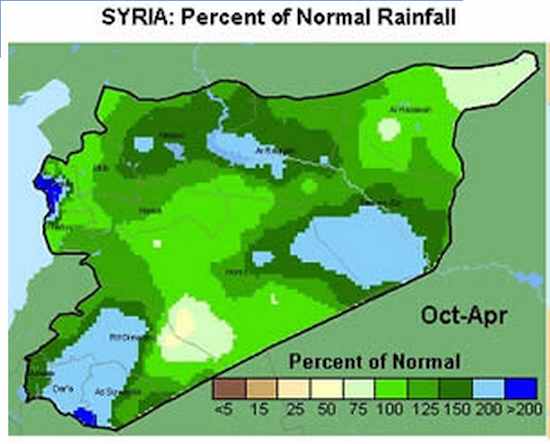 This doesn't sound consistent with a six-year long drought and crop failure apocalypse.
Even the previous USDA's 2009 report on Syria noted that "normal to above normal rainfall in western and northern wheat growing areas [between October 2008 and April 2009] helped improve overall grain production prospects this year."
The real evidence will lie in Syria's crop production data over the past several decades to determine if, in fact, Syria suffered "the most severe set of crop failures in recorded history" during the period "between 2006 and 2011."
The following figures use United Nations Food and Agriculture Organization data (FAOSTAT) to show the annual and six-year running average wheat and barley yields, production, and area harvested since 1961 in Syria. Wheat and barley account for nearly two-thirds of Syria's cropped area.
This doesn't sound consistent with a six-year long drought and crop failure apocalypse.
Even the previous USDA's 2009 report on Syria noted that "normal to above normal rainfall in western and northern wheat growing areas [between October 2008 and April 2009] helped improve overall grain production prospects this year."
The real evidence will lie in Syria's crop production data over the past several decades to determine if, in fact, Syria suffered "the most severe set of crop failures in recorded history" during the period "between 2006 and 2011."
The following figures use United Nations Food and Agriculture Organization data (FAOSTAT) to show the annual and six-year running average wheat and barley yields, production, and area harvested since 1961 in Syria. Wheat and barley account for nearly two-thirds of Syria's cropped area.
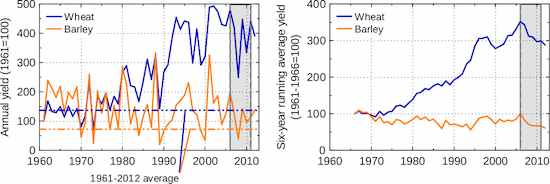
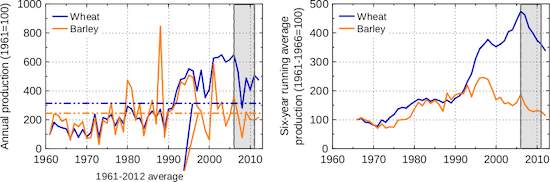
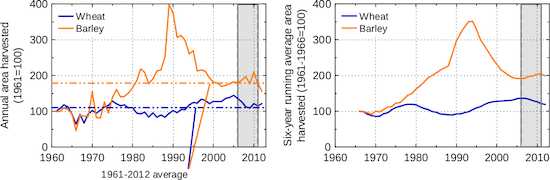 I see no evidence that -- between 2006 and 2011 -- Syria experienced "the most severe set of crop failures in recorded history." And one can imagine that recorded history in Syria can go back quite some time (i.e., well before the UN statistics start in 1961). The agricultural production from 2006 to 2011 wasn't even the worst over this short post-1961 time frame, never mind whatever all of "recorded history" could potentially mean in this part of the world. The graphs above alone rebut the hysterical claims: quod erat demonstrandum.
But this is the narrative that the climate war alarmists have been trying to spin for some time now, namely, that the conflicts in Syria and throughout this region over the past several years have been climate change induced.
I see no evidence that -- between 2006 and 2011 -- Syria experienced "the most severe set of crop failures in recorded history." And one can imagine that recorded history in Syria can go back quite some time (i.e., well before the UN statistics start in 1961). The agricultural production from 2006 to 2011 wasn't even the worst over this short post-1961 time frame, never mind whatever all of "recorded history" could potentially mean in this part of the world. The graphs above alone rebut the hysterical claims: quod erat demonstrandum.
But this is the narrative that the climate war alarmists have been trying to spin for some time now, namely, that the conflicts in Syria and throughout this region over the past several years have been climate change induced.View Comments
Sierra Rayne holds a Ph.D. in Chemistry and writes regularly on environment, energy, and national security topics. He can be found on Twitter at @srayne_ca