

By Jack Dini ——Bio and Archives--October 30, 2024
Global Warming-Energy-Environment | CFP Comments | Subscribe | Email Us
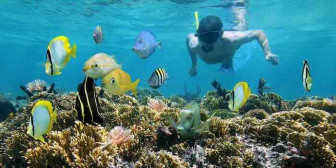
The Great Barrier Reef was pronounced dead in 2016 at the ripe old age of 25 million, but by 2022 parts of it showed the highest coral cover in 36 years. Last year the panic mongers had to admit that ‘the truth is complex.’ (1)
Sixty percent of all human CO2 emissions have been emitted since 1985 but today the corals are healthier than ever. The most detailed underwater survey on the largest reef system in the world has shown that far from being bleached to hell, the corals are more abundant than we have ever seen them. (2)

UNESCO has been threatening to slap an endangered label on the reef for years. They would have looked ridiculous if they had done this whilst corals were at a record high says Jo Nova.
Ten years after corals hit a record low, a survey showed that half of Australia didn’t realize the reef had recovered. Only 3% knew the corals were at a record high, and nearly half the Green voters were as wrong as they possibly could be—they thought coral cover was at a record low. (3)
As Peter Ridd says, the biggest threats to the reef are cyclone and crown-of-thorns starfish plaques, neither of which appear to be any worse now than they were years ago.
In 2021, a coral the size of a carousel is the widest known in the Great Barrier Reef measuring 10.4 meters in diameter. In addition to its record setting width, it stands a little over 5 meters tall, making it the sixth tallest coral in the Great Barrier Reef. The coral is about 421 to 438 years old. It predates European colonization of Australia and has survived as many as 80 cyclones and coral bleaching events. (4)

Corals thrive in multiple degree warmer than today waters and their growth is stunted in cooler environments. The warming peddled by the climate alarmists often characterize Earth’s 500 billion corals as critically endangered by modern global warming. (5)
The science itself says corals have been and continue thriving in the current warm period, just as they have in past warm periods. Within a span of a few pages, Long et al squelches at least 4 false climate alarm narratives:
How much attention will an iconoclastic study like this receive? None, probably. Studies that don’t advance the climate alarm narrative are usually dismissed and ignored. (5)
Statistics on corals barely existed before 1980, and didn’t get semi reasonable until 1998 or so. But with twenty years of data there is no evidence suggesting problems. (7)
Reef scientists often claim that coral bleaching is a new phenomenon that only started in the 1970s due to climate change. But in 1862 the first coal fired power plant was still twenty years away from starting work as a coral destroyer, and carbon dioxide levels were a perfect 286 ppm. There are actually many other early observations of bleaching, including Sir Maurice Yonge in the first major science expedition to the Great Barrier Reef in 1929. (8)
Secret Cove was badly bleached, yet it was teeming with life. But to know this, it is necessary to get under the water. To know that many of the stark white coral are still alive it is necessary to observe them up close. There you can see that the polyps are still very much intact, that the polyps have a carpet-like texture concealing separate corallites. (9)
The fish and other creatures seemed randomly distributed, which is to say they could be found across the reef irrespective of the color of the coral.
It was not at all how the BBC have described coral bleaching at the GBR--they have recently been using the terms ghostly whiter, spooky white. Like a graveyard. These journalists are clueless.
To know that many of the stark white corals are still alive it is necessary to observe them up close. For example, the brain corals did look ghostly white from a few meters away. But up close you can see that the polyps are still very much intact, that the polyps have a crystal-like texture concealing separate corallites.
Jennifer Marohasy says that the journalists and the scientists, from all sides of the political divides, increasingly just add to the established narratives rather than checking the data, or even visiting a coral reef. (9)
New temperature reconstructions using coral skeletons as proxies reveal there has been no apparent net warming inn the Great Barrier Reef, central Indian Ocean, and South China sea since the 19th century, or even in recent decades. (10)
Scientists have discovered a coral reef off the coast of Tahiti that stretches almost two miles long and appears untouched by climate change or human activities. With rose shaped corals as far as the eye can see, it is one of the largest healthy reefs on record. (11)
University of Queensland researchers have uncovered an abundance of healthy, thriving coral along a heavily developed coastline--far beyond what the team expected when they first pitched the project. “We noticed that there was an enormous amount of coral there that we didn’t realize was there—and not in a couple of spots but in the 11 spots we visited.” They estimated the coral cover was 54 percent beyond what was expected. (12)
Dense thickets of ghostly corals shelter myriads of unfamiliar sea creatures have been found covering a vast area of the deep Atlantic, breaking records to become the largest known deep-sea reef. “It’s eye opening, it’s breathtaking in scale,” says Scripps Institution of Oceanography marine biologist Stuart Sandin. (13)
That climate change threatens the extinction of coral reefs is among the least well-founded but most persistent assertions made by climate alarmists. Clearly, they ought to look elsewhere for their fear-mongering diatribes.
View Comments
John William Dini, know to all as ‘Jack’, passed away at the age of 89 on June 17, 2026. He was born in Cleveland, Ohio on Nov. 14, 1936.
He published two books, a technical book on materials science and coatings and another on environmental issues. In retirement, he wrote extensively on various environmental issues for online publications.
He was a skilled leaded glass hobbyist, creating more than 20 lamps and many panels. He was a jogger for many years, competing in over 300 long distance races. He was a slow runner, not wanting to take the glory away from others. His secret was to start slow and taper. He and Anne traveled extensively, visiting over 70 countries.
He is survived by his wife, Anne, of 67 years, and sons Mike, Steve, and Paul. If you were to meet him somewhere, he would sum up his life as ‘peaches and cream’.