

By Institute for Energy Research ——Bio and Archives--July 18, 2012
Global Warming-Energy-Environment | CFP Comments | Subscribe | Email Us
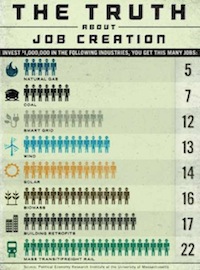 A graphic floating around Facebook called "The Truth About Job Creation" (see below) makes it seem as if the government should be investing in renewable energy and other projects favored by "green" groups. The graphic shows that investing $1 million leads to only 5 jobs in the natural gas sector, but 14 in solar, and so on. Such "demonstrations" are completely irrelevant though for economic health. Government support of "green" projects raises energy prices and actually makes the average worker poorer.
The fundamental problem with the graphic is it assumes that mere job creation is the goal. But in reality, the purpose of having jobs is to transform resources into goods and services that consumers value. Because the graphic offers no information on how much these workers produce in various sectors, it is largely an irrelevant bit of trivia.
A graphic floating around Facebook called "The Truth About Job Creation" (see below) makes it seem as if the government should be investing in renewable energy and other projects favored by "green" groups. The graphic shows that investing $1 million leads to only 5 jobs in the natural gas sector, but 14 in solar, and so on. Such "demonstrations" are completely irrelevant though for economic health. Government support of "green" projects raises energy prices and actually makes the average worker poorer.
The fundamental problem with the graphic is it assumes that mere job creation is the goal. But in reality, the purpose of having jobs is to transform resources into goods and services that consumers value. Because the graphic offers no information on how much these workers produce in various sectors, it is largely an irrelevant bit of trivia.

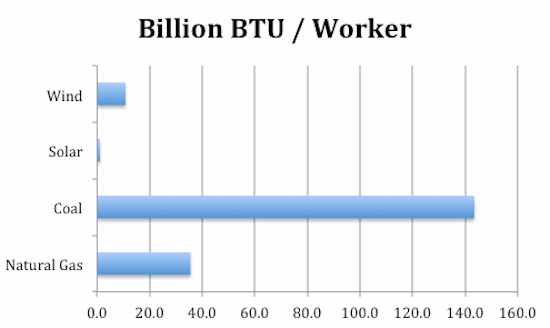
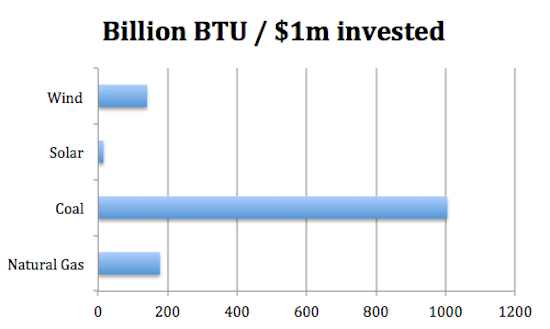 To reiterate, the above charts shouldn't be taken too seriously, as we are relying on ballpark figures from several sources, including the original "Truth About Job Creation" graphic (which itself seems to be based on this PERI report). Our point with the above two charts is merely to show that framing the issue in terms of energy produced shows the superiority of fossil fuels, and also why the "workers per $1 million invested" original figures are relatively low in these fields. Namely, the workers in the fossil fuels sector are so productive that it doesn't take that many of them to produce large amounts of energy, and that's partly why there are fewer workers associated with a given investment of capital.
If it wants to promote the growth of productive, sustainable, high-paying jobs in the energy sector, the federal government merely needs to reduce regulatory barriers and let the market operate.
To reiterate, the above charts shouldn't be taken too seriously, as we are relying on ballpark figures from several sources, including the original "Truth About Job Creation" graphic (which itself seems to be based on this PERI report). Our point with the above two charts is merely to show that framing the issue in terms of energy produced shows the superiority of fossil fuels, and also why the "workers per $1 million invested" original figures are relatively low in these fields. Namely, the workers in the fossil fuels sector are so productive that it doesn't take that many of them to produce large amounts of energy, and that's partly why there are fewer workers associated with a given investment of capital.
If it wants to promote the growth of productive, sustainable, high-paying jobs in the energy sector, the federal government merely needs to reduce regulatory barriers and let the market operate.View Comments
The Institute for Energy Research (IER) is a not-for-profit organization that conducts intensive research and analysis on the functions, operations, and government regulation of global energy markets. IER maintains that freely-functioning energy markets provide the most efficient and effective solutions to today’s global energy and environmental challenges and, as such, are critical to the well-being of individuals and society.