One day in the ninth grade in my little rural junior high school in Boston, Indiana, I saw a demonstration in the science class that has stuck with me ever since. When we came into class, the science teacher had an aquarium set up on the front table. The aquarium had a glass divider which fit down into two channels to keep what was in once side separate from the other. We came in and got quiet. Well, okay, we came in and mostly sat in the chairs behind our tables. When we were sort of paying attention the science teacher poured one side full of cold blue water, then poured the other side full of warm red water. He reminded us to watch what happened when he pulled the divider straight up out of the water. At first nothing happened, but within five or ten seconds, the cool blue water began to spread across the bottom of the aquarium while the warm red water rose in the tank and spread the other way across the top. I was transfixed. Before a minute was up, the top half of the aquarium was all red and the bottom half was all blue. The water didn't even mix much.
Even at the age of 14 I knew I had just witnessed something profound and useful. Applications of this principle soon appeared everywhere I went. I've been noticing them ever since.
Basements were cooler in the summer. Upper floor rooms were warmer in the summer and in the winter, too.
Orchards fared better on slopes or hilltops because they weren't where the coldest air settled in the dales on frosty nights.
In a well pit or in a crawl space, pipes froze at the lower point first.
When I opened a front door in the winter time, cold air flowed in across the floor while warm air fled out of the top of the doorway.
Unless the pump is on, the water at the bottom of a pool will be a little cooler than the water at the top, especially on a sunny day. Set a glass of cold water on the counter for 20 minutes on a warm day. When you drink it, the water on top is warmer than the water at the bottom of the glass.
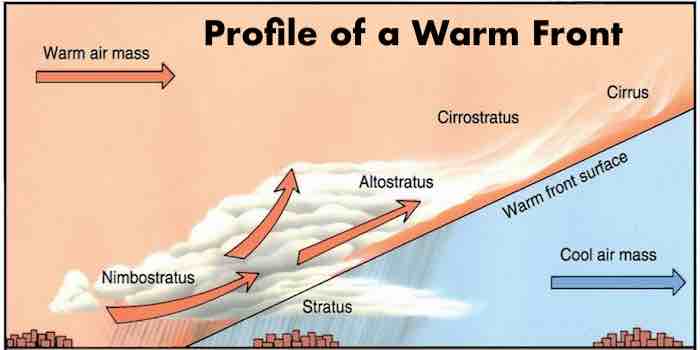
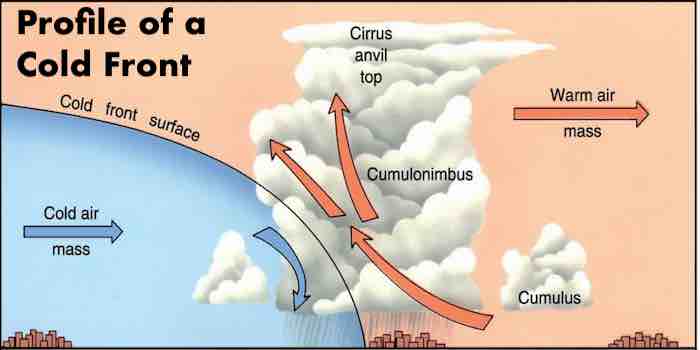
Air masses of different temperatures work in similar ways. Warm air rises and can carry more moisture. Cool air sinks and is usually drier.
Cold air masses have higher relative barometric pressure than warm air masses because cold air is denser and heavier. Gravity pulls down heavy things. Barometric pressure declines as altitude increases because the heavier air, even in a cold air mass, is nearer the ground. Cold air masses spread across North America from the north and northwest, pushing underneath warmer air. When the warmer air rises, moisture condenses to form clouds and rain.
It makes no sense to have heated air and cooled air using the same registers in the ceiling
I like to be comfortable. When indoors I spend very little time on the ceiling and nearly all the rest of it standing on the floor or seated near the floor in chairs.
Air conditioned cooler air settles on the floor. When you turn on the air conditioner, the room cools from the bottom up.
The warmest part of a room is nearest the ceiling. Heated air from the furnace rises to the upper parts of the room first. When you heat a room, it warms from the top down. The upper bunk is always warmer than the lower one in a still room.
It makes no sense to have heated air and cooled air using the same registers in the ceiling. It also makes no sense to have all the return air grills at the top of walls or in the ceiling. They install that way now because it's easier for the HVAC people. You'll notice the price hasn't gone down, however.
In the winter, if you have ceiling fans, you can pull some of the warmest air down off the ceiling toward the floor to mix it. In the summer time, it's better to leave the ceiling fan off because the coolest air is already on the floor. If the room is warm, turning on the ceiling fan the correct direction will help some because it creates a breeze. The breeze evaporates the sweat on your skin to reduce your temperature. The fan doesn't cool the air. Evaporation of moisture makes you feel cooler. That's why we don't use fans much in the wintertime. It's also why you feel cooler when you come out of warm water on the beach. The moisture evaporating from your skin causes heat loss. Grab one of those big towels right away to slow the evaporative process.
If there's a source of cold air, as in a refrigerator, then the fan circulates the cold air to reduce the temperature of the contents. Insulation helps keep the cold inside the appliance. On most days, if you open the fridge door in bare feet, you can feel the cold air flow out of the case onto the floor. That's why my mother who grew up in the Depression would frequently remind me to close the fridge door quickly when I opened it, and also remind me to close the front door quickly in the wintertime. Both of those doors allowed cool air to flow across the floors and warm air to be lost. I was allowed, however, to open the chest freezer and stick my head in on hot days to inhale cold air. The chest freezer was filled with cold air that could not flow out when the door opened. That's the reason why a chest freezer is better than an upright freezer. The upright freezer moves cold air around with a fan so the temperature is uniform. Fans consume electricity and produce heat. Fans moving cold, dry air cause the contents to dry more rapidly. Open the door on an upright freezer and the cold air flows out onto the floor. A chest freezer just fills the chest with cold air and doesn't have to move the air about. The cold air can't drain out of a chest freezer.
Seeing the light come on now and then is what can keep us going on the other days
If you keep a room or two cold in the wintertime to save on heat, opening the door to the warmer part of the house for just a couple of minutes will cool the house somewhat, but will not warm the room. This is because we're standing on the floor. The room warms from the ceiling down. The hallway cools from the bottom up.
High ceilings and transoms are helpful in the summertime because they hold or vent the warmest air. They are not so helpful in the wintertime.
Attic fans are helpful in the summertime once the house warms up because they vent the warmest air from the top of the house. They are not helpful in the wintertime unless you live in a greenhouse or in a very warm place. I'd wager it's a deliberate policy of management that there are precious few attic fans in hell. In fact, I'll bet there aren't many fans of any kind down there.
When cooling a room with a fan, always pull the air in from where it is the coolest. If a room is warm enough for people to sweat, pull the cooler air from the floor toward where people are seated. Allow the warmest air to rise to the ceiling or out the tops of windows and doors.
We never know when we may have the opportunity to learn something profound, so it pays to be alert. After all, we can learn something every day if it's a good day. If you teach, and all of us do at least from time to time, you never know when a lesson you've offered to a child may really stick. Seeing the light come on now and then is what can keep us going on the other days.
Dr. Bruce Smith (Inkwell, Hearth and Plow) is a retired professor of history and a lifelong observer of politics and world events. He holds degrees from Indiana University and the University of Notre Dame. In addition to writing, he works as a caretaker and handyman. His non-fiction book The War Comes to Plum Street, about daily life in the 1930s and during World War II, may be ordered from Indiana University Press.


 One day in the ninth grade in my little rural junior high school in Boston, Indiana, I saw a demonstration in the science class that has stuck with me ever since. When we came into class, the science teacher had an aquarium set up on the front table. The aquarium had a glass divider which fit down into two channels to keep what was in once side separate from the other. We came in and got quiet. Well, okay, we came in and mostly sat in the chairs behind our tables. When we were sort of paying attention the science teacher poured one side full of cold blue water, then poured the other side full of warm red water. He reminded us to watch what happened when he pulled the divider straight up out of the water. At first nothing happened, but within five or ten seconds, the cool blue water began to spread across the bottom of the aquarium while the warm red water rose in the tank and spread the other way across the top. I was transfixed. Before a minute was up, the top half of the aquarium was all red and the bottom half was all blue. The water didn't even mix much.