East of the 100th Meridian in the United States and in nearly all of Canada we have always taken abundant fresh water for granted. The Great Lakes, we used to learn in school, constitute the greatest inland waterway in the world, and is 750 miles long. Lake Superior alone holds three quadrillion gallons of fresh water, 10% of the world’s total. Together, the Great Lakes ecosystem contains 21% of the world’s fresh water.
Canada, besides sharing the shoreline and much of the surface of the Great Lakes, has two million freshwater lakes of its own. Those lakes and rivers contain 20% of the world’s supply. There may be some overlap in these percentages, but the point is that we are blessed with a great quantity of fresh water in North America.
Over the years, I have taken several steps backward into how the Midwest landscape got to be the way it is. The process went something like this.
1. I watched my dad and my grandfather dig post holes in muck soil in Henry County, Indiana. When those holes were done, I looked down inside. From one side, about eighteen inches down, a small stream of water spilled into the bottom of the hole as if flowing from a tiny spigot. I asked where the water came from. It was ground water following a worm tunnel, they said. Interesting, I thought.
2. A couple of years later, my dad and brothers dug a trench across our back yard in Wayne County, Indiana. We found the remains of a red clay drain tile lying on a buried board. What’s that for, I asked? It’s to drain water away underground so we don’t walk in mud all the time.
3. Back in Henry County, I observed digging in a farm field with stacks of red clay tiles all around. What’s that for, I asked? My grandfather said they were tiling a field to drain away ground water where it was near the surface. The water goes from the ground into the tiles and drains away. Hmmm! More interesting! There’s water in the ground? I thought it was dirt down there.
4. My grandparents had a well, it turns out, in a concrete pit under the large back porch. It could be accessed from the cover on top, and also from a doorway into it from the basement. That door was very scary because there was no light and I figured there was all manner of spiders and such in there. I peered into it one day when my grandfather had it open. What I saw I now realize was a shallow well jet pump. The pump sat atop a well. Interesting!
5. The water from the sink in that house was different from the city water we had at our house. It was smoother in the throat and tasted different. It also always had air in it, giving it a silvery appearance in the glass before it turned clear. My grandfather loved it. I did, too.
6. We moved to Wayne County, and after a couple of years the folks bought five acres with a house and small barn beyond the outskirts of a medium-sized town.
The house was on a hill with a slope back toward the north. On the northwest corner of the property was a marsh we always called the swamp, and there was a tiny creek that went through it, fed by two small springs. As one approached the swamp there was a large ceramic tile that stood up out of the ground about three feet. It had a little pipe extending from the side, down low, which trickled a stream of water about the size of a pencil year-round. The tile had a wood cover on top to keep crud and small beasts out of it. I later found out that there was a pipe into the tile with a foot valve attached. That pipe ran uphill just a little ways to where there was a small well house. Inside it was a jet pump. From the well house the line ran to our house on top of the hill. We had a spring-fed well!
7. I began to wonder where the hill we lived on came from. Why is there a hill here, but not on the grandparents’ farm in Henry County? Just down the road in Wayne County there was a stone quarry that produced fine crushed limestone for roads and limestone flags for building stone walls. The quarry was lower in elevation than our place. It was layered in limestone. But above it on the edges there was a gravelly rocky layer, a brownish layer of dirt, then a darker layer of dirt on top of that. What’s that, I asked? I was told it’s a soil profile with gravel on the bottom, then the subsoil, with the top soil on top. Hmmm! Why is there no hill here like at our house? Well, my dad said, because the glacier didn’t put one here. Long pause. . . The what??
Glaciation and glacial geology have occupied much of my imagination ever since. There is so much to learn!
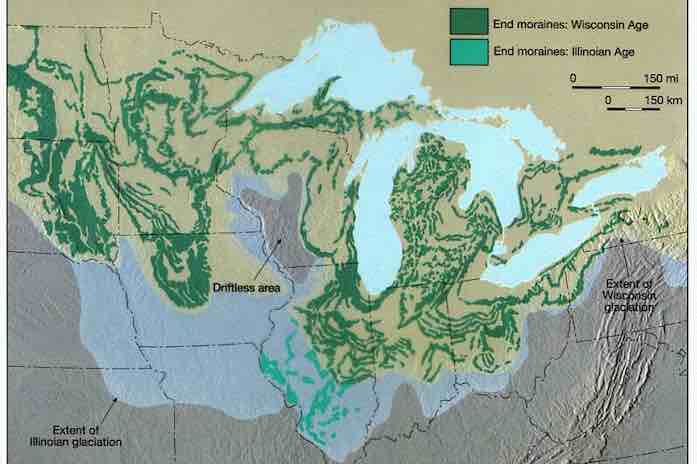
The glacier that left the hill on which our house stood was a continental glacier that receded about 9,000 years ago. It’s hard to even imagine such a colossal thing. It came down our way off the Laurentian glacial shield, in other words, from Canada, scooping out the bottom of Lake Erie and pushing out across what is now Ohio and Indiana. The dark green areas on this map are terminal and lateral moraines, mounds of glacial till and debris left by the receding glacier. One of them I can spot is the moraine where we lived in the 1960s.
The glacial lobe that built our moraine receded toward the northeast, back through the bed of present Lake Erie. As it retreated it paused occasionally, leaving bands of terminal moraines before receding again. In the spaces between bands of terminal moraines, it was often marshy for a few hundred years or so. The last marshy area before reaching the western shore of Lake Erie at Toledo was known in the 19th Century as the Great Black Swamp, more than 130 miles long, the remnant of glacial Lake Maumee, the predecessor to Lake Erie. The Maumee River now drains the former marsh complex and the muck associated with it from Ft. Wayne to Toledo, Ohio with lots of help from drainage ditches dug by settlers and farmers. South of Ft. Wayne in Henry County was the muck farm of my grandfather. The great glacier built it, too.
Continental glaciation brought gifts, many of them taken from the Canadian shield and deposited further south. Among these were incalculable quantities of glacial till in the form of sand, gravel, rocks, and soil. Drive through Sudbury, Ontario sometime to see what was left after the glaciers scrubbed the ground down to the bedrock on the way to Wisconsin, Illinois, and Indiana. There are shiny rocks with scratch marks called striae on them. Stria is Latin for furrow. I knew Mrs. Lafuze’s class would come in handy one day!
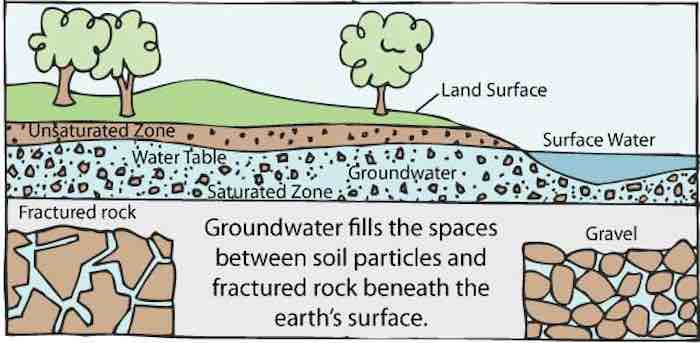
The big discovery that tied together many of my observations was that sand and gravel deposits hold water in the ground between the particles. There is actually a great deal of space between these particles, and that space fills with water at a certain level. Water from the surface trickles down to a line called the water table. The best way to visualize this is to fill a glass with ice cubes, then measure the water it takes to fill the glass. Ground water is held between particles in the water table like water between the ice cubes.
So between particles in the strata below our feet, especially in the glaciated Midwest but also in every river and creek valley, there rests a great store of water which is a little-heralded natural resource. This resource is available to us across much of the Midwest if we know where to look for it.
Shallow wells using jet pumps can be used for water levels to about 35 feet below the surface. The water is sucked up to the pump via a pipe with a foot valve on the end. Below 35 feet, submersible wells, placed down into the water table inside a slotted well casing at greater depths, do a better job. That’s because it’s better to push water rather than to pull it. Water can be pushed a great distance, but it can’t be pulled very far. It’s physics, I guess. At any rate, it’s how stuff works.
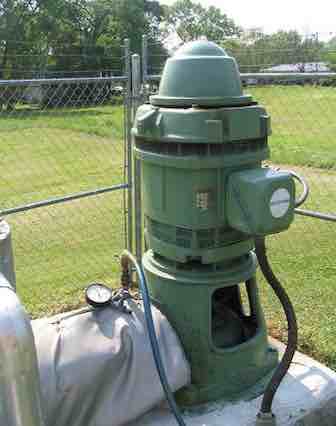
Many cities and towns use wells to supply municipal water. Look around your town in lower-lying areas. Many municipal wells look like this one.
These wells pump from water deposits underground. River beds and flood plains are often the best locations for water extraction. In an emergency, small creek beds and valleys can sometimes produce water for essential functions such as bathing and plumbing. There are ways to drive a well point, sometimes called a sand point, into the ground in the right place and far enough down to tap into the water table. These shallow wells are more susceptible to seasonal variations in rainfall. Most anyone can have their own water supply for irrigation and essentials by catching rain in a rain barrel and attaching a hand pump or an electric pump. It’s easier than pumping it out of the ground.
So once upon a time continental glaciers blanketed most of Canada and much of the American Midwest. They brought us many blessings and gravel pits along with a convenient storage for abundant fresh water.
A few years after discovering the benefits of glaciation, I was able to share this awareness with my own daughter. We had endless fun trying to beat each other to the funny question any time we would see an irregular glacial boulder of granite with its angular polished sides sitting at the end of a driveway or parked in a field. “Do I see something on the side of that rock? There’s something carved there. What does it say?” The answer? Why, it says MADE IN CANADA!
Dr. Bruce Smith (Inkwell, Hearth and Plow) is a retired professor of history and a lifelong observer of politics and world events. He holds degrees from Indiana University and the University of Notre Dame. In addition to writing, he works as a caretaker and handyman. His non-fiction book The War Comes to Plum Street, about daily life in the 1930s and during World War II, may be ordered from Indiana University Press.

 East of the 100th Meridian in the United States and in nearly all of Canada we have always taken abundant fresh water for granted. The Great Lakes, we used to learn in school, constitute the greatest inland waterway in the world, and is 750 miles long. Lake Superior alone holds three quadrillion gallons of fresh water, 10% of the world’s total. Together, the Great Lakes ecosystem contains 21% of the world’s fresh water.
Canada, besides sharing the shoreline and much of the surface of the Great Lakes, has two million freshwater lakes of its own. Those lakes and rivers contain 20% of the world’s supply. There may be some overlap in these percentages, but the point is that we are blessed with a great quantity of fresh water in North America.
Over the years, I have taken several steps backward into how the Midwest landscape got to be the way it is. The process went something like this.
East of the 100th Meridian in the United States and in nearly all of Canada we have always taken abundant fresh water for granted. The Great Lakes, we used to learn in school, constitute the greatest inland waterway in the world, and is 750 miles long. Lake Superior alone holds three quadrillion gallons of fresh water, 10% of the world’s total. Together, the Great Lakes ecosystem contains 21% of the world’s fresh water.
Canada, besides sharing the shoreline and much of the surface of the Great Lakes, has two million freshwater lakes of its own. Those lakes and rivers contain 20% of the world’s supply. There may be some overlap in these percentages, but the point is that we are blessed with a great quantity of fresh water in North America.
Over the years, I have taken several steps backward into how the Midwest landscape got to be the way it is. The process went something like this. 

 These wells pump from water deposits underground. River beds and flood plains are often the best locations for water extraction. In an emergency, small creek beds and valleys can sometimes produce water for essential functions such as bathing and plumbing. There are ways to drive a well point, sometimes called a sand point, into the ground in the right place and far enough down to tap into the water table. These shallow wells are more susceptible to seasonal variations in rainfall. Most anyone can have their own water supply for irrigation and essentials by catching rain in a rain barrel and attaching a hand pump or an electric pump. It’s easier than pumping it out of the ground.
So once upon a time continental glaciers blanketed most of Canada and much of the American Midwest. They brought us many blessings and gravel pits along with a convenient storage for abundant fresh water.
A few years after discovering the benefits of glaciation, I was able to share this awareness with my own daughter. We had endless fun trying to beat each other to the funny question any time we would see an irregular glacial boulder of granite with its angular polished sides sitting at the end of a driveway or parked in a field. “Do I see something on the side of that rock? There’s something carved there. What does it say?” The answer? Why, it says MADE IN CANADA!
These wells pump from water deposits underground. River beds and flood plains are often the best locations for water extraction. In an emergency, small creek beds and valleys can sometimes produce water for essential functions such as bathing and plumbing. There are ways to drive a well point, sometimes called a sand point, into the ground in the right place and far enough down to tap into the water table. These shallow wells are more susceptible to seasonal variations in rainfall. Most anyone can have their own water supply for irrigation and essentials by catching rain in a rain barrel and attaching a hand pump or an electric pump. It’s easier than pumping it out of the ground.
So once upon a time continental glaciers blanketed most of Canada and much of the American Midwest. They brought us many blessings and gravel pits along with a convenient storage for abundant fresh water.
A few years after discovering the benefits of glaciation, I was able to share this awareness with my own daughter. We had endless fun trying to beat each other to the funny question any time we would see an irregular glacial boulder of granite with its angular polished sides sitting at the end of a driveway or parked in a field. “Do I see something on the side of that rock? There’s something carved there. What does it say?” The answer? Why, it says MADE IN CANADA!