

By Hymie Rubenstein ——Bio and Archives--January 19, 2025
Canadian News, Opinion | CFP Comments | Subscribe | Email Us
The easily discredited myth of indigenous “cultural genocide” – see here, here, and here – refuses to die.
According to a January 10 Blackrock’s Reporter story, the Historic Sites and Monuments Board of Canada has cited eight Catholic charities as being complicit in “cultural genocide” against indigenous children. The Board gladly accepted this label only because, “In 2015 the Truth and Reconciliation Commission (TRC) described the Residential Schools as a form of cultural genocide.”
Prior to this recent announcement, all eight were repeatedly honoured for nationally significant works including aid to poor aboriginals.

Their good works meant nothing to the Board which disparaged that:
“Churches both Catholic and Protestant were substantially involved in the establishment, administration and operation of Residential Schools with the aim of converting Indigenous children to Christianity and assimilating them to Euro-Canadian culture” between 1883 and 1969 wrote the Board.
The eight named Catholic charities had been honoured for operating orphanages, hospitals and schools over 300 years. The Board complained the original tributes “did not include a critical consideration of their relationship with Indigenous peoples.”
The eight cited for “colonial assumptions” included the Grey Nuns of Montréal, honoured in 1988 for nursing the poor and the 1871 founding of a hospital in St. Boniface, Manitoba, the first public health institution in Western Canada. The Sisters of Charity of Ottawa, similarly honoured in 1988 for pioneer work in nursing, was also cited. The others six were:

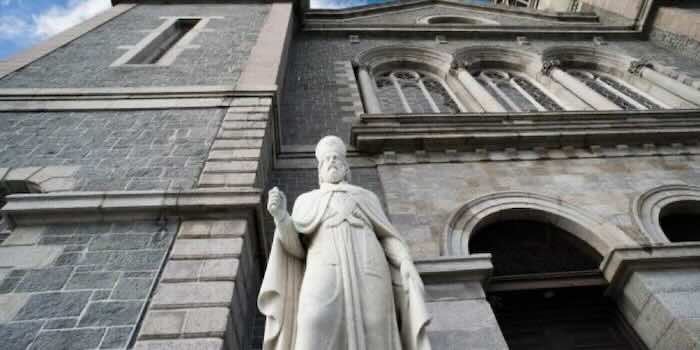
The Monuments Board has rejected new applications for plaques honouring Catholic figures. Newfoundland and Labrador Catholics in 2020 unsuccessfully petitioned for honours for Bishop John Thomas Mullock, builder of the Basilica of St. John the Baptist in St. John’s, Newfoundland.
“The Board felt that while Mullock led an ambitious building program, he was part of a succession of ecclesiastic leaders in St. John’s whose objective was to grow the Catholic Church in Newfoundland,” said Board minutes released through an Access To Information request. “The Board did not recommend John Thomas Mullock for designation as a national historic person.”
While it cannot be denied that the cultural integration of indigenous children was one of the aims of the Indian Residential Schools, just as it continues to be the aim of all public education in Canada for immigrants from non-European countries, calling this goal “cultural genocide,” a concept with no legal and little moral standing, is inflammatory rhetoric with scant little factual underpinning despite its widespread currency in Canada: a July 2015 Angus Reid poll found that 70 percent of Canadians agreed that cultural genocide described the Indian Residential School experience, although most respondents admitted they knew little about the Report or the issue.
Most of all, the cultural genocide charge is rooted in weak social science because it ignores the indisputable fact that human beings can internalize features of two or more cultures, including unrelated languages. The TRC Report wrongly implied that cultural learning and retention are zero-sum games, ignoring the abundant evidence to the contrary. The truth of this is clearly seen in the diversity of Canadian society, where people from a vast array of cultures have successfully integrated into the multicultural mainstream, while retaining many of their native languages, beliefs, and cultural practices. The 2015 TRC Report grudgingly (and perhaps inadvertently) acknowledged that this is as true for aboriginal Canadians as it is for millions of other Canadians when it stated that, “Aboriginal cultures and peoples have been badly damaged, [but] they continue to exist. Aboriginal people have refused to surrender their identity.”
As is also well-documented, Christianity flourished in aboriginal communities across Canada from first contact onwards. So did a desire to internalize European ways of understanding and dealing with the world. Thus, generations of Christian aboriginal parents willingly sent their children to the church-operated residential schools to obtain an education, often alongside European classmates--the sons and daughters of missionaries, Hudson Bay Company personnel, and Indian Affairs employees – a fact the TRC and other reports chose to ignore.
As late as the 1940s and 1950s, when the Indian Act was being amended, many bands and native organizations asked for the schools to remain open. In the 1960s, well after most of IRS had already been closed, several bands lobbied the Department of Indian Affairs to keep some of the remaining schools operating.
As for the orphanages created by the Catholic Church and run by various order of nuns, one Grey Nuns sister administering to orphaned and other children at the Sacred Heart Hospital wrote in 1867 that:
“I must give you a few instances to show you what is the depth of the moral misery which we are called on to relieve. What I tell you will shock you to hear, as it sickens me to tell. It was a rather general custom of the savages in these countries to kill, and sometimes to eat, the orphan children, especially the little girls. Religion has made a great change in this respect, but infanticide is still by no means rare. A mother, looking with contempt on her newly-born daughter, will say, "Her father has deserted me; I am not going to feed her." So, she will wrap up the little one in the skin of an animal, smother her, and throw her into the rubbish heap…. Now you will quite understand that all these wretched people would rather have given their children to us than have killed them, or let them die.
“The barbarous deeds of fifty years ago are occasionally repeated even now, if the Convent Orphanages are far away. But the poor children are usually saved, to be brought to the Convent by some charitable neighbour.”
The complaint that the original tributes “did not include a critical consideration of their relationship with Indigenous peoples,” ignoring the elementary fact that this relationship included saving the lives of countless indigenous people, including many newborn infants.
Hymie Rubenstein, editor of REAL Indigenous Report, is a retired professor of anthropology, University of Manitoba, and a senior fellow at the Frontier Centre for Public Policy.
View Comments
Hymie Rubenstein, a retired professor of anthropology at the University of Manitoba, is editor of —REAL Indigenous Report.