

By Douglas V. Gibbs ——Bio and Archives--October 5, 2025
American Politics, News | CFP Comments | Subscribe | Email Us
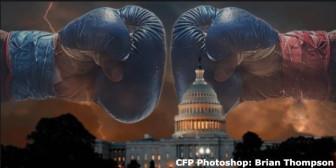
When one takes a look at the original architecture of the United States Government as laid out in the Constitution, it becomes clear that oversight by We the People and the States was not only intentional, but that it was structurally embedded through funding mechanisms. The appropriation of funds by the House of Representatives, the requirement of Senate approval, and the States’ influence over federal budgeting before the emergence of the Sixteenth Amendment provided the reality that sometimes a government shutdown would be necessary. As we are witnessing in the latest episode of government shutdown theater, the consequences may not be the horrible crisis being reported by the media, but a constitutional correction.

Article I, Section 7 of the Constitution mandates that all bills concerning revenue must originate in the House of Representatives. Then, as now, the Lower Chamber was filled with representatives democratically elected by the people from districts established within the States. That made (and makes) the House of Representatives the voice of the People. The Senate, however, was originally composed of members appointed by the state legislatures. These office holders were expected to act as a kind of pseudo-aristocracy, seasoned in the science of politics and loyal to the interests of their respective States. The Federal Government was not designed to be the master but the servant, born of the Constitution and beholden to its authors. It was a deliberately restrained framework of governance, crafted to ensure that any drift toward centralized tyranny could be halted; not by revolution, but by the simple refusal to fund it.
Early on during the Founding Era funding battles echoed today’s standoffs. The disputes weren’t just political, they were philosophical clashes over the scope and soul of the federal government. During George Washington’s terms as President the financial program pushed by Alexander Hamilton (assumption of state debts, creation of a national bank, and a misapplication of protective tariffs) sparked fierce opposition by Thomas Jefferson and James Madison. Jeffersonians viewed Hamilton’s plan as a centralizing power grab. They used votes in Congress to resist or dilute funding mechanisms, especially the Bank of the United States, which they saw as unconstitutional and aristocratic.
The battle led to a compromise, the Funding Act and Residence Act, the latter placing the capital in what would become Washington D.C., a location in the Middle States south of the more industrial and Hamiltonian leaning States in the north. At one point Alexander Hamilton argued in favor of implied powers essentially commenting one needed to be able to read between the lines of the Constitution. He said, “It is not denied that there are implied as well as express powers, and that the former are as effectually delegated as the latter.” Jefferson’s view that all constitutional powers were expressly enumerated fueled his response. “To take a single step beyond the boundaries thus specially drawn around the powers of Congress, is to take possession of a boundless field of power, no longer susceptible of any definition.”

The comment was his way of saying that if you start reading between the lines, you’ll find no limits which he considered to be precisely the danger. He grounded his argument in the Tenth Amendment principle (even before it was ratified), asserting that powers not explicitly delegated by the Constitution were reserved to the States and the People. The philosophical clash echoed today’s battle that ultimately has shut down the government. Jefferson, as do Trump-supporting Republicans, feared a creeping centralization; a desire of Hamilton who did not see it as a road to tyranny, but as a dynamic engine of national strength in a world of empires.
During the final years of the John Adams presidency amid tensions with France, President John Adams pushed for increased military spending, including a standing army and a new Navy. While Jeffersonians recognized the need for military strength when needed, they viewed Adams’ call for these appropriations would empower federal overreach and provoke war. They used budgetary resistance to slow or block Adams’ agenda. In response the Federalist Party established the Alien and Sedition Acts, funded and enforced through federal mechanisms. The plan, however, backfired on the Adams’ administration. Their unpopularity led to electoral backlash and a shift not only in congressional control, but a change in the presidency that saw Thomas Jefferson and his laissez-faire principles ascend to the White House.
Jefferson’s presidency became one of frugality and selective funding. He reduced the national debt each year he was President, except in 1804 when he increased the national debt to fund military action during the First Barbary War.
While Jefferson was committed to reducing federal spending and successfully cut the national debt throughout most of his presidency, the conflict with the Barbary States, specifically Tripoli, required naval expansion and wartime expenditures. In 1804, Congress authorized additional funding for the Navy, including new ships and supplies, which temporarily reversed Jefferson’s trend of debt reduction.
This moment was a powerful example of Jefferson’s constitutional pragmatism. While he opposed standing armies and centralized power, he recognized that defending American sovereignty be it at home or on the high seas required a temporary fiscal pivot. Otherwise, during his presidency he aggressively cut the budget, seeking to eliminate unconstitutional, unnecessary and wasteful spending. He slashed military spending, repealed internal taxes (like the Whiskey Tax), and reduced the size of government by firing about half (the Federalist Party half) of the bureaucracy. Jefferson believed the federal government should be minimal and used the power of the purse to enforce that vision. His refusal to fund tribute payments to the Islamic North African states did trigger a response from the caliphate that existed along the North African Coast and into the coastal area of the Middle East, however, leading to the First Barbary War.
As with Jefferson, the second presidency of Donald Trump has been marked by attempts to reduce the size of bureaucracy and ultimately the size and scope of the federal government. His fiscal policies also echo that of our third President, manifesting in economic improvement largely across the board. The 2024 Census income and poverty data, combined with data over previous years, provides a dynamic picture of changes in income in inflation-adjusted dollars as well as poverty levels. Trump’s numbers, when compared to Obama’s and Biden’s, are proving to be more effective in pulling Americans out of poverty and improving the overall economic picture. During Trump’s first term, according to the numbers, 3,070,000 Americans were lifted out of poverty, a number nearly double that of Biden’s (1,670,000). America boomed during President Trump’s first term, and the same kinds of numbers are beginning to emerge in 2025. President Trump’s agenda is pro-growth, which has been causing incomes to rise across all demographics despite the Democrats’ empty rhetoric.
President Donald Trump has echoed George Washington’s warning against foreign entanglements and international expenditures that fail to serve American interests. His administration’s $1 billion reduction in funding to the United Nations has forced the international organization to announce $500 million in budget cuts and a 20% staff reduction for 2026. Critics warn that distancing the U.S. from the U.N. could be disastrous, but Trump sees the organization as a precursor to global centralization; a system run by faceless, unaccountable bureaucrats.
Like George Washington, he is steering America away from dangerous foreign entanglements; like the delegates at the Virginia Ratification Convention in June of 1788 he views membership in international polities as dubious at best; and like Thomas Jefferson he recognizes the danger of a centralization of power and has been steering America away from it. His aim is not to diminish America into a provincial member of a global regime, but to restore its sovereignty and greatness.
That same battle is now manifesting stateside in the current government shutdown battle. Democrats, aligned with runaway federal spending and hostile to Trump’s policies, have refused to work with Senate Republicans; plunging the country into a standoff with the current shutdown. As Wayne Allyn Root put it, the shutdown is proving to be a very wonderful thing, calling it a “BARGAIN,” and telling folks, “don’t believe the media propaganda. Government shutdown isn’t bad, it’s good! … It’s a great day! We all save $$$.” As am I, Root is urging Americans not to believe the media’s alarmism.
The Democrats are using the shutdown to defend pandemic-era expansions of Obamacare (an unconstitutional law in the first place given that the federal government has no enumerated authority over health care). These expansions were meant to be temporary and do not, as claimed, gut coverage for everyday Americans. The Democrats also seek to preserve benefits for illegal aliens while denying that such funding exists.
They say they oppose Medicaid cuts that are, in truth, reductions in unnecessary spending with minimal impact on services. Their demand for legislative protections for health care programs ignores the constitutional reality that such authority belongs to the States. President Trump understands that federal health care funding is riddled with waste and fraud, and his administration is working to eliminate such.
Shutdowns, despite the media frenzy, do not halt government. Essential services remain intact. Veterans still receive their benefits, Social Security checks go out, and federal employees in critical roles continue working.
For the Trump Administration, this shutdown is an opportunity. It is a chance to reduce the size of government and pursue long-sought federal job cuts. Democrats, meanwhile, are losing ground. They once supported these spending levels but now oppose them simply because Trump is behind them. Their Trump Derangement Syndrome blinds them to consistency. They’re dying on a hill that includes free healthcare for illegal aliens, something they championed in 2019, but now deny. They’ve aligned themselves with the radical fringe of their party, a philosophy alien to the Founders.
Trump and the Republicans, by contrast, are channeling the spirit of Washington, Jefferson, and Madison. They are seeking to return to the original intent of the Constitution. The American People see through the noise. While Democrats rage and litigate, the ultimate court is watching: the Court of Public Opinion. These battles will ultimately shape the upcoming mid-terms, with both political parties vying to strengthen the number of congressional and senatorial seats they occupy. In truth, the shutdown is not just about federal spending. It’s about the soul of the Republic, and the campaign trail ahead.
View Comments
Douglas V. Gibbs of Political Pistachio Conservative News and Commentary, has been featured on “Hannity” and “Fox and Friends” on Fox News Channel, and other television shows and networks. Doug is a Radio Host on KMET 1490-AM on Saturdays with his Constitution Radio program, as well as a longtime podcaster, conservative political activist, writer and commentator. Doug can be reached at douglasvgibbs [at] yahoo.com or constitutionspeaker [at] yahoo.com.