

By Don Mellon ——Bio and Archives--March 18, 2019
American Politics, News | CFP Comments | Subscribe | Email Us
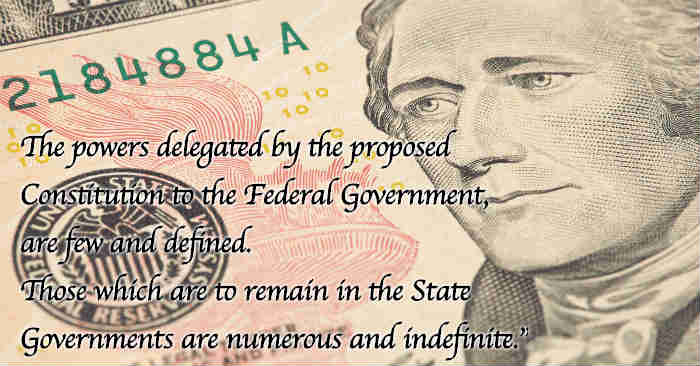 In America, the liberty of We The People is at risk, not from a foreign government, but from our own.
The founders clearly intended that the Federal Government would have a defined set of powers delegated by the Constitution. All other powers necessary for governing would be reserved to the state governments. A single quote in James Madison’s Federalist Papers No. 45 supports that view:
In America, the liberty of We The People is at risk, not from a foreign government, but from our own.
The founders clearly intended that the Federal Government would have a defined set of powers delegated by the Constitution. All other powers necessary for governing would be reserved to the state governments. A single quote in James Madison’s Federalist Papers No. 45 supports that view:
“The powers delegated by the proposed Constitution to the Federal Government, are few and defined. Those which are to remain in the State Governments are numerous and indefinite.”

“The powers not delegated to the United States by the Constitution, nor prohibited by it to the States, are reserved to the States respectively, or to the people.”But who decides whether or not a particular power is delegated to the United States, or reserved to the individual states? Clearly, the states assumed they had an implied right to judge if a power exercised by the Federal Government had been rightfully delegated to it. Without that assumption, they may not have ratified the Constitution. But what determines whether a particular power not explicitly granted in the Constitution is delegate, and to which entity? It had to be more than a coin flip. Can each state independently make a decision concerning whether a power claimed by the Federal Government is rightly, or wrongly, done so?

“In fine, the world would have seen for the first time, a system of government founded on an inversion of the fundamental principles of all governments; it would have seen the authority of the whole society everywhere subordinate to the authority of the parts; it would have seen a monster in which the head was under direction of the members”Later, in his Report of 1800 on the Virginia Resolutions, Madison wrote that the word “states” in the Tenth Amendment referred to the people of the states – not the state legislatures. So, whatever power is implied is reserved to the people. And what power do the people have in the Constitution? The power to vote. But the power to vote is already granted in the Constitution; it is not created by the Tenth Amendment. Alexander Hamilton noted another power that the states held to prevent the Federal Government from assuming powers not delegated to it. It was military power. The states could fight the Federal Government on the field of battle, if necessary. Hamilton make the case for the strong military power of the states compared to the Federal standing army in Federalist Paper No. 28, as follows: First, the states were concerned about a federal standing army in time of peace. So, the Constitution required that the army be re-authorized every two years and gave the states the power to defund a national standing army.
“It may safely be received as an axiom in our political system, that the state governments will in all possible contingencies afford complete security against invasions of the public liberty by the national authority.”If, back then, the states’ military power lent confidence to them retaining power not delegated to the federal government, today that factor is long-since gone. The test of States v. Federal military power was settled in the American Civil War. So, what enables a state to maintain control over powers not delegated and limit the central government to only powers delegated? Does any authority granted by the Tenth Amendment, or any other founding document, allow states to decide if powers assumed by federal laws are Constitutionally legitimately delegated to Washington, D.C.?
View Comments
Don Mellon wrote summaries for each of the 85 Federalist Papers for posting on the Texas-based website http://www.teaparty911.com. Mellon has edited and contributed many articles about the intent of the Founders in drafting the U.S. Constitution, noting how states have surrendered their powers granted by the Constitution. He is a Vietnam-era military veteran, and holds a PhD in Physics from Iowa State University. Now retired from Texas Instruments, he lives in East Texas.