
By Colin Alexander ——Bio and Archives--November 17, 2024
Canadian News, Opinion | CFP Comments | Subscribe | Email Us
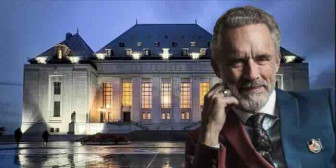
In the National Post of October 11, Jordan Peterson related how his re-education ordered by the College of Psychologists of Ontario (CPO) has run aground. The regulators wanted to brainwash him after he expressed un-woke opinions. Evidently, however, they have failed to find someone to give him the mind-bending they said he needed as a condition for retaining his licence.

While this development is salutary, there is a bigger challenge. Canadians no longer live under the rule of law as it really is. No matter how much money you have—and, mercifully, Dr. Peterson could afford to prove the point—Canada’s justice system is law unto itself. Canadian courts routinely ride roughshod over Lord Chief Justice Hewart’s dictum from 1923: “[I]t is not merely of some importance but is of fundamental importance that justice should not only be done, but should manifestly and undoubtedly be seen to be done.”(1)
Too often judges preside over cases where they have a readily evident bias or personal connection. Then they defer, as they may, to favoured interests. Here, however, is the best advisory statement I know of, in the American Judicial Code: “Any justice, judge, or magistrate judge … shall disqualify himself in any proceeding in which his impartiality might reasonably be questioned.”(2)
Another foundational problem, recently confirmed by Chief Justice Wagner, is that the courts—his court, anyway—may freely override stare decisis (common law precedent). “Apart from considering [[historic] decisions as part of our legal cultural heritage,” he said, “no one today will refer to a decision from 1892 to support his claim.” He added that “sometimes a decision from five years ago is an old decision ….”(3)
Ironically, the Supreme Court overrode century-old precedents when declaring that Marc Nadon, a judge on the federal court of appeal, was ineligible to join their cozy club. As I explain in my book Justice on Trial, historically many appointments to the Supreme Court did not meet qualifications ruled, with one judge dissenting, necessary for Justice Nadon.

Dr. Peterson’s case came under administrative law, which covers numerous unaccountable tribunals—human rights tribunals and the self-regulating overseers of the professions like law, medicine and teaching. He contested, unsuccessfully, the CPO’s re-education diktat in Ontario’s Divisional Court, before Justices Backhouse, Schabas and Krawchenko, with Justice Paul Schabas taking the lead.(4)
My first problem is that Justice Schabas had previously been involved personally on the side of the argument directly opposite that of Dr. Peterson. In June 2018 Mr. Schabas, as he then was and as head of the Law Society of Ontario (LSO), oversaw the imposition on lawyers of their controversial Statement of Principles (SOP). It required, as a condition of licensing, affirmation of a commitment to Equity, Social and (Corporate) Governance (ESG). In due course the LSO withdrew the SOP following protests like Elias Munshya’s in the April 2019 edition of Canadian Lawyer:
Justice Schabas cited several comments similar to this one as being unacceptable: “Dr. Peterson posted a tweet in May 2022 in which he commented on a Sports Illustrated Swimsuit Edition cover with a plus-sized model, saying: ‘Sorry. Not Beautiful. And no amount of authoritarian tolerance is going to change that.’”
Countering the case against him, Dr. Peterson asserted that reliance on their Code of Ethics was insufficient for the CPO to constrain expression of his “off duty opinions.” It says that “[p]ersonal behaviour becomes a concern of the discipline only if it is of such a nature that it undermines public trust in the discipline as a whole or if it raises questions about the psychologist’s ability to carry out appropriately his/her responsibilities as a psychologist.” How then does saying you do not behold beauty meet any of these constraints?
Justice Schabas continued, “The [CPO’s investigating] Panel also noted Dr. Peterson’s reliance on the Supreme Court’s decision in Grant v. Torstar, 2009 SCC 61, [2009] 3 SCR 640, a defamation case which held at para. 42, that “freedom of expression and respect for vigorous debate on matters of public interest have long been seen as fundamental to Canadian democracy … all Canadian laws must conform to it.” Having been noticed, this settled law went missing in the court of Justice Schabas.
Administrative law in Canada now has the courts reviewing the merits of a decision for reasonableness only so long as it is not absurdly unreasonable. There being no objective criteria for reasonableness judges may, without accountability, reward friends and clobber others.
Except for defamation and inciting violence, Europe’s Charter of Fundamental Rights essentially ended, in 2000, the courts’ power to constrain public comment, even criticism of themselves. It says, “Everyone has the right to freedom of expression. This right shall include freedom to hold opinions and to receive and impart information and ideas without interference by public authority and regardless of frontiers.” There is no mumbo-jumbo about reasonableness in a free and democratic society. How can a right be fundamental in other free and democratic countries but not in Canada?
So I now ask: Why did the court of Chief Justice Wagner decline to hear Dr. Peterson’s appeal and allow Justice Schabas’ Decision to stand? Sustained now by the courts, unaccountable administrators may deprive people of their livelihood, at will, while disregarding the rights that the Charter purports, erroneously, to protect.
Dr. Peterson’s case shows, yet again, that Canadians need to press legislators to end self-regulation by lawyers. That happened in 2007 for England and Wales after publication of Sir David Clementi’s report. And, especially, we also need credible accountability for judges
Ottawa resident Colin Alexander’s latest books are Justice on Trial: Jordan Peterson’s case shows the need to fix a broken system; and The Ballad of Sunny Ways: Popular traditional verse about living, loving and money.
Book links
Justice on Trial: Jordan Peterson’s case shows the need to fix a broken system
View Comments
Colin Alexander’s degrees include Politics, Philosophy, and Economics from Oxford. His latest book is Justice on Trial, Jordan Peterson’s book and others show we need to fix the broken justice system.