Somewhere along the line, I guess people got the idea that loyalty is a negative thing. I suppose they assume that the people who want loyalty from others don't deserve it, or see it as a way to avoid accountability. If you think every leader is a despot in waiting, or a corrupt power-abuser, then maybe the notion of loyalty takes on a creepy quality to you.
But loyalty, at its essence, is a good quality - however determinedly the cynics among us have tried to turn it into a bad one. It's the first positive train we associate with Boy Scouts. It's something we wouldn't dream of denying to our family or our friends. And it transcends the individuals who might be in a position at a given moment. I was a loyal Minnesota Vikings fan even when Brad Childress was the head coach - not because I had any use for him (he was all the things people think Donald Trump is, and wretchedly more), but because his success meant the team's success as long as he was around.
A truly loyal fan doesn't root for his own team to lose so the coach will be fired. A loyal American doesn't sow chaos in the federal government to cause problems for a president he doesn't like. Elections are the time to get rid of the president if you can. The rest of the time, if you work for him, your job is to help him govern.
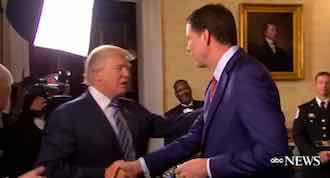
So if it's really true that Trump asked James Comey for "loyalty" as Comey says, there is no reason to assume the worst possible interpretation of that - that Trump wanted Comey to provide loyalty to Trump personally, and to Trump's personal best intersts, regardless of what was best for the country. That's what everyone seems to assume this request must have meant, and it's certainly what Comey thinks it meant.
But let's consider how things are in Washington these days.
Federal employees and federal contractors at just about every level ignore their responsibility to protect classified or confidential information, leaking it to the news media like a defective faucet whenever they believe it will serve a personal or political agenda for them to do so. Even members of the White House staff apparently can't be trusted to keep information to themselves about what happens behind closed doors.
And in the news media, day after day after vomit-inducing day, we hear information of questionable reliability sourced to "people familiar with the situation" who do not give their names, because they are not supposed to be talking and would lose their jobs if they did. The fact that this is a normal, everyday thing is not a defense of the behavior at all. It is the very reason it should be taken so bloody seriously.
Into this atmosphere comes Donald Trump, elected president whether the Beltway likes it or not, trying to govern the nation. We all know he is a political novice doesn't know the ways of Washington. We also know he was elected in part to change the ways of Washington, because they are not producing very good results for the American people. Those around him should be doing everything they can to help him succeed. Instead, many of them are proving themselves to be untrustworthy with their leaks and other actions to undermine the president they swore to serve - not him personally, but his pursuit of the duties to which the American people elected him.
When Trump asks Comey for loyalty in that environment, there is no reason that should be understood to mean my-king-right-or-wrong type loyalty. More likely, it means, "No one here seems trustworthy and everyone has their own agenda. I want you to assure me that you're here to help me succeed, not to undermine me."
That is hardly an unreasonable request given the present atmosphere in Washington, nor is it hard to understand Trump's concern given Comey's apparent distaste for him. And considering that Comey memorialized their conversations in a memo and then leaked it to the media through a third party, I'd say Trump's concerns ultimately proved to be very well founded.
People in the executive branch should be loyal to the president - not to him personally no matter what he does, but to his pursuit of the goals he was sent there to achieve. That kind of loyalty is good. We need more of it. And a president has every right to ask for it.


 Somewhere along the line, I guess people got the idea that loyalty is a negative thing. I suppose they assume that the people who want loyalty from others don't deserve it, or see it as a way to avoid accountability. If you think every leader is a despot in waiting, or a corrupt power-abuser, then maybe the notion of loyalty takes on a creepy quality to you.
But loyalty, at its essence, is a good quality - however determinedly the cynics among us have tried to turn it into a bad one. It's the first positive train we associate with Boy Scouts. It's something we wouldn't dream of denying to our family or our friends. And it transcends the individuals who might be in a position at a given moment. I was a loyal Minnesota Vikings fan even when Brad Childress was the head coach - not because I had any use for him (he was all the things people think Donald Trump is, and wretchedly more), but because his success meant the team's success as long as he was around.
A truly loyal fan doesn't root for his own team to lose so the coach will be fired. A loyal American doesn't sow chaos in the federal government to cause problems for a president he doesn't like. Elections are the time to get rid of the president if you can. The rest of the time, if you work for him, your job is to help him govern.
Somewhere along the line, I guess people got the idea that loyalty is a negative thing. I suppose they assume that the people who want loyalty from others don't deserve it, or see it as a way to avoid accountability. If you think every leader is a despot in waiting, or a corrupt power-abuser, then maybe the notion of loyalty takes on a creepy quality to you.
But loyalty, at its essence, is a good quality - however determinedly the cynics among us have tried to turn it into a bad one. It's the first positive train we associate with Boy Scouts. It's something we wouldn't dream of denying to our family or our friends. And it transcends the individuals who might be in a position at a given moment. I was a loyal Minnesota Vikings fan even when Brad Childress was the head coach - not because I had any use for him (he was all the things people think Donald Trump is, and wretchedly more), but because his success meant the team's success as long as he was around.
A truly loyal fan doesn't root for his own team to lose so the coach will be fired. A loyal American doesn't sow chaos in the federal government to cause problems for a president he doesn't like. Elections are the time to get rid of the president if you can. The rest of the time, if you work for him, your job is to help him govern.