

By David Robb ——Bio and Archives--June 11, 2026
American Politics, News | CFP Comments | Subscribe | Email Us
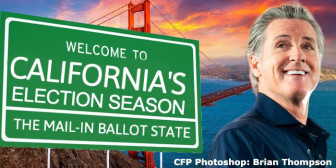
Some people say that elections in California are broken. They aren't. They are working just as designed to maintain the current power structure and support the illusion that the people have a voice in their own government.
I realize that statement could put me squarely in the category of "election denier conspiracy theorist", but after years of investigating California voter rolls and election systems, that is the only conclusion I can come to.

I didn't start that way. I hoped to find that our elections were secure, honest, and could be trusted to reflect the true will of the people. As a scientist, that was my starting hypothesis. Also as a scientist, I followed the data where it led. It wasn't a pretty trip.
The current primary has finally brought attention to the massive potential for election fraud in our election systems. The problems range from dirty voter rolls to vulnerable electronic systems to vote by mail, among many other issues. Election fraud has been going on for years, but there are two reasons why it is getting so much attention now.
First is that it is so blatant now that it is almost impossible to ignore or explain away. The Los Angeles mayor's race is an obvious example, but there are problems in almost every other race, including that for the governor. Late ballot dumps, impossible counts, videos of ballot buying and fraudulent registrations, and many other "anomalies" are reported daily. Even the mainstream media, however reluctantly, has had to report these obvious bits of evidence.
Second, there is an awareness and vigilance in the public that did not exist before. Widespread public concern for election integrity started to grow with the 2020 elections. Legitimate claims of election fraud were dismissed and even criminalized. The mainstream media tossed out terms like "election deniers", and "conspiracy theorists", and "insurrectionists" to denigrate anyone who questioned the legitimacy of the elections. Courts refused to hear election cases, finding excuses such as "lack of standing" to avoid having to adjudicate such political hot potatoes. A county elections clerk was sentenced to years in jail for simply doing the Federally mandated job of preserving election records that could prove fraud.

The more the media mocked, the more that "authorities" claimed all was safe and secure. The more issues that independent investigators found and reported, the more public awareness of problems grew. It was also educational. As people starting discussing and sharing information more people started to learn what to look for, and why things that had been taken for granted were actually dangers.
All that has been happening in the primary, both seen and unseen, has just been a run-up--practice for the November elections. The elections this fall may be the most significant we may ever see in our lifetimes. Quite literally, the future of our country is at stake. While cast as a contest between Democrats and Republicans, in reality it is a contest between those who believe people should have the right to choose their own leaders and to preserve a Constitutional Republic, and those who disdain the populace as ignorant sheep whose only value is in supporting the power elite who are entitled to rule over them.
One side wants fair and honest elections that reflect the legitimate will of the people. The other side sees elections as theatre to keep the masses entertained while the real rulers get on with things. One side wants to win fairly. One side wants to win by any means fair or foul.
It is said that California leads the way and the rest follow. From interactions with researchers across the country, I know that the problems that are so obvious here also exist to lesser degrees in every other state in the nation. We can look at some of the obvious problems here so that others can learn.
One of the most obvious issues is vote by mail. As far back as 1995, the Carter-Baker Commission identified vote by mail, known as absentee voting, as one of the most dangerous election practices ever. The great danger in vote by mail is that we have no idea who is actually returning a ballot.
Because there is no way to know who is actually returning a vote by mail ballot, the number of different ways these ballots support election fraud is huge. Ballots can be stolen from mailboxes, people can sell their ballots (illegal, but done), people can be paid to submit registrations with delivery addresses that send the ballot to fraudsters,.
Ballots sent to dead voters, or to addresses of people who have moved, or people who only exist in the voter rolls, or to non-citizens, all can be completed and returned and will be counted just as though .they came from legitimate voters. Once counted, it is impossible to find these bad ballots and remove a fraudulent vote.
California has also implemented another known fraud supporting practice--drop boxes. Investigations into the 2020 elections showed how drop boxes could be used to deliver fraudulent ballots for counting. California requires every county to have ballot drop boxes in numbers proportional to the number of voters in the county.
Other fraud promoting policies in California include the assumption that driver license applicants are citizens eligible to vote unless they indicate otherwise, requiring ID to vote is illegal, voters no longer have to vote in their own precinct, the intersection of two roads can be used as a residential address for registration, to name just a very few.
One of the most egregious policies is the extended counting period that allows ballots to arrive and be counted for days after election day--time for ballots to be generated to "adjust" counts, as appears to be happening in Los Angeles.
These are but a few of the many ways that California leads the nation in supporting election fraud. Many of us who have been investigating election issues have hard evidence of such occurrences. It is a virtual certainty that such fraud has happened in the recent primary.
There are two major categories of election fraud. There is what I call "retail fraud" which is where only small numbers of votes are affected. Such things as submitting ballots for dead voters, or stealing a ballot or two from a mailbox are examples. Courts like to handle these cases because there is a clear crime, a recognized perpetrator, a prescribed punishment, and since the number of votes involved is generally too small to affect the outcome of an election, they are non-controversial.
In the last decade or so, a second category--"wholesale fraud" has come to dominate elections. Weaknesses in the election systems such as the vote by mail exploits above, coupled with internet access to critical election systems including voter rolls, election records, and tabulator systems, coupled with the fact that virtually all ballot processing is now done electronically based on ballot images, and the opportunities for large scale election manipulation are huge.
Fraud mechanisms targeting these vulnerabilities are often difficult to detect, seldom have identifiable perpetrators, can affect enough votes to sway any election, including a national election, have no clear remedy, and many perpetrators are out of reach of most courts. The problem is compounded by the fact that there are virtually no remedies available even if massive fraud is demonstrated. No judge wants to take on any cases of wholesale fraud, as it is a no-win situation for them.
The situation is not hopeless, though. Citizen volunteers can help by canvassing to identify unqualified voters. Addresses can be checked to find improper registrations. People who did not vote by mail but were told they had already voted should file police reports for civil rights violations. Although states have authority run their own elections, the Constitution allows Congress to step in as needed. Let your congress critter know you want action. Call or write them demanding they pass the SAVE Act. Make your voice heard. You have more power than you might think. Make California great again!
View Comments
David Robb is a practicing scientist and CTO of a small firm developing new security technologies for detection of drugs and other contraband. Dave has published extensively in TheBlueStateConservative, and occasionally in American Thinker.