

By Dr. Bruce Smith ——Bio and Archives--December 29, 2024

Living out in the Heartland far away from the seats of national power and military might, and pretty far away from any kind of military base, war memorabilia can be pretty scarce. As boys with World War II veteran dads, the nearby kids I knew played army and but learned very little of the life they had known before we came along.

Our TV shows were about WWII, and we had those green army men to play with, and GI Joe first came along in 1964, but our dads didn’t speak of the real thing much, for reasons we didn’t know to ask about. Our familiarity with things military came from the popular culture and from three other places available in most every county seat in the country. Those places were American Legion halls, armories, and court house lawns.
Court houses are often good places to pick up a little local military history. There are often lists of names of those lost, and sometimes lists of all who served. This is the case at the Henry County Court House in New Castle, Indiana. The memorial to those who served from that county in World War II has been there for a long time, but I didn’t discover it until I was an adult doing research for a book. Inside is a list of all who served from the county. My dad’s name is on that list. Close to my dad’s name is another Lt. Smith, but that one has a gold star beside it. I discovered in my research that the other Lt. Smith was an only child, too, but he didn’t come back home like my dad did.

There are lots of gold stars beside names on that list, more than 200 of them just from that one small county in Indiana. Because my dad’s name did not have a star beside it, I get to be here to tell this story. It’s a heavy responsibility that I take very seriously.
Outside on court house lawns there are usually historical artifacts to be found, and these are often military artifacts since they are usually abundant after wars and more or less portable. In the eastern half of the country there may be Civil War cannons along with Civil War monuments both South and North. Very rarely are there monuments to the Spanish-American War, although there are some. Because American participation in the Great War of 1914-1918 was the most significant since the Civil War fifty years before, there are often relics to be seen at court houses. The E. M. Viquesney sculpture of an American Doughboy with hand held high in victory is fairly common and once in a while there are relics of the Great War as well.
The court house at Milford, Massachusetts has an artillery piece from the Great War, and there are nearly always other memorabilia to be found. World War II relics are found on nearly every court house lawn. My adopted county seat town in Wayne County Indiana provided my introduction to these objects. When driving around the court house there is still an M5 Stuart light tank and a 37mm antitank gun to be found, both from World War II. I have walked right up to them many times.
A year or more ago I was driving along the old National Road, US 40, in Brazil, Indiana. I was enjoying the storefront architecture on a sunny summer day. Up ahead I could see the wide lawns of the Clay County Court House. Without really meaning to I looked to the left, then looked back to the right and saw this sitting on the west side of the building in the green grass. Now there’s something you don’t see every day, I said to myself.
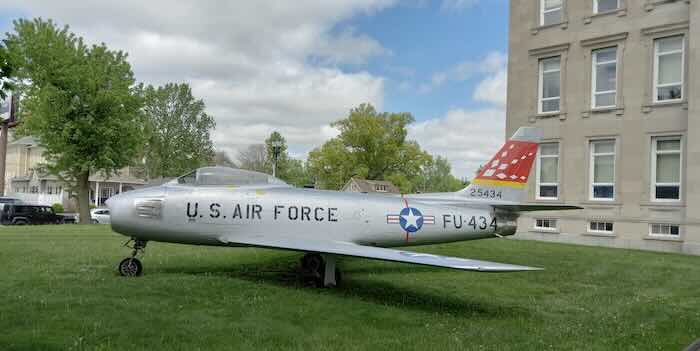
Formerly operational aircraft are not a common sight on court house lawns or anywhere else outside of museums. This one was parked in the grass and was very well maintained. The front corner plexiglass canopy was missing but has since been replaced with a new one.
Apparently it’s possible to get replacement parts for the F-86 if you know where to look. Like other court house relics anyone can walk right up to this one and put a hand on it. It really isn’t all that big. The intake for the single jet engine is right up front, so the pilot is sitting astride all that power while he’s flying. There are 20mm cannon gun ports on each side of the engine cowling just behind the intake. For the life of me I don’t know how ammunition could have been fed up to them or where it could have been stored. These jet fighter pilots fired those guns like earlier prop-driven planes had done because the F-86 was from the Korean War era before there were air-to-air missiles. The F-86 Saber was the primary American jet fighter in the Korean War, the first jet fighter capable of competing in combat with the Soviet MiG-15. It was built in large numbers by the US and its allies and served in many air forces from 1947 to 1959.
Nope, you don’t see one of those every day, but I really want to talk to the guy who landed it there. I’d shake his hand.
The only F-86 Sabre still flying in Europe, and the world's only airworthy F-86A taking off during the Spring Air Show, Duxford, England.
View Comments
Dr. Bruce Smith (Inkwell, Hearth and Plow) is a retired professor of history and a lifelong observer of politics and world events. He holds degrees from Indiana University and the University of Notre Dame. In addition to writing, he works as a caretaker and handyman. His non-fiction book The War Comes to Plum Street, about daily life in the 1930s and during World War II, may be ordered from Indiana University Press.