

By Mark Macneill ——Bio and Archives--September 20, 2026
Canadian News, Opinion | CFP Comments | Subscribe | Email Us
“Oh, what a tangled web we weave, when first we practise to deceive.” Sir Walter Scott wrote those words more than two centuries ago. They come to mind when examining the web connecting Mark Carney, Brookfield, Canada's net-zero policies, and billions in public and private capital.

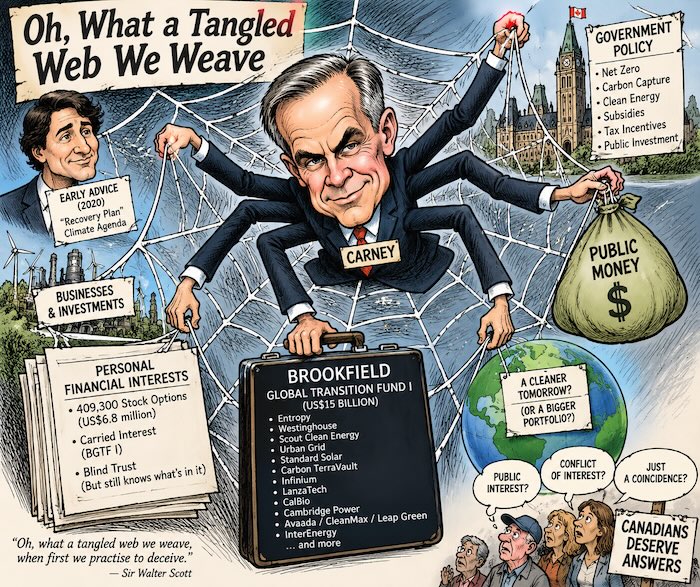
The story began before Carney became prime minister in 2025. By 2020, Carney was informally advising Justin Trudeau on Canada's post-pandemic economic recovery. Contemporary reporting described him as a sounding board for an ambitious recovery plan that included climate policy.
Then came Brookfield. Carney joined the investment giant in 2020 and helped build its transition-investment business. He co-led Brookfield Global Transition Fund I (BGTF I), a roughly US$15-billion fund designed to generate returns from the enormous movement of capital accompanying the transition toward net zero.
The transition strategy reached across many of the very industries increasingly shaped by government climate and energy policy:
| Investment/platform | Business |
|---|---|
| Entropy | Carbon capture and storage |
| Westinghouse | Nuclear technology and services |
| Scout Clean Energy | Wind and renewable development |
| Urban Grid | Utility-scale solar and battery storage |
| Standard Solar | Commercial and community sola |
| Carbon TerraVault | Carbon capture and sequestration |
| Infinium | Low-carbon e-fuels |
| LanzaTech | Carbon recycling and low-carbon fuels |
| CalBio | Renewable natural gas |
| Cambridge Power | Battery storage and renewables |
| Avaada / CleanMax / Leap | Green Renewable-energy platforms |
| InterEnergy | Energy and renewable infrastructure |
Soon public policy and private investment began occupying some of the same ground. Consider Entropy. In 2022, Brookfield committed up to C$300 million to the Alberta carbon-capture company through its Global Transition Fund. Then, in 2023, the federally created Canada Growth Fund committed C$200 million and entered a long-term carbon-credit arrangement intended to provide greater revenue certainty to Entropy.
None of that establishes wrongdoing. Governments routinely use tax incentives, guarantees and public investment to encourage private capital. But another thread remains. When Carney left Brookfield, he did not sever every economic connection to its transition investments. Parliamentary testimony subsequently discussed his entitlement to carried-interest payments from BGTF I—deferred compensation linked to the performance of the fund.
Then there are Carney’s options on Brookfield. At December 31, 2024, Brookfield disclosed that Carney held 409,300 unexercised Brookfield Asset Management stock options: 209,300 exercisable at US$35.13 and 200,000 at US$40.07. Their combined intrinsic value was US$6,813,892. They carried expiration dates in 2033 and 2034. Options are important because their value changes with Brookfield's share price. They are not merely a record of what someone was paid years ago; while outstanding, their economic value can rise or fall with the underlying shares.
Meanwhile, Carney's political involvement was becoming increasingly formal. In September 2024, the Liberal Party appointed him chair of the leader's economic-growth task force. Months later Trudeau resigned, Carney entered the leadership contest, won, and became prime minister.
His investments were subsequently subjected to conflict-of-interest arrangements, including a blind trust and an ethics screen. Yet a blind trust presents an interesting problem when the beneficiary already knows what went into it. It may prevent him from knowing what a trustee subsequently buys or sells. It cannot erase his knowledge of the businesses, investments and strategies with which his financial interests had been associated.
That leaves Canadians with legitimate questions. When government policy encourages carbon capture, nuclear energy, renewable power, batteries and sustainable fuels, do investments associated with BGTF I benefit? When public money, tax incentives, or guarantees improve the economics of those industries, can that ultimately affect the value of Carney's deferred carried-interest entitlement? And what is the present status of those 409,300 Brookfield options?
These facts do not establish corruption. Policy overlap does not establish improper motive. Nor does a profitable investment demonstrate that a government decision was made to benefit its investors. But that is precisely why transparency matters. Canadians should not have to choose between accusations and assurances. They should be able to follow the money, examine the relationships and judge the evidence themselves. When political power, public money, private investment and personal financial interests become woven together, sunlight is not partisan. It is simply good government.
View Comments
C. Mark MacNeill is a lifelong student of legal history, political philosophy, and public affairs. He writes on issues ranging from constitutional and administrative law to public finance, governance, and Canadian political culture. His professional experience includes legal consulting, strategic advisory work, corporate governance, and public policy analysis.
He lives on Cape Breton Island, Nova Scotia