

By David Robb ——Bio and Archives--November 18, 2026
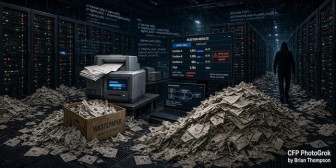
The first part of this series discussed the transition from paper based voter rolls to electronic databases, and some of the ways these databases can support fraud in elections. That discussion is continued here and expanded with discussion of another catastrophic change to our election systems--another of those "it seemed like a good idea at the time".

Besides the creation of voter databases, a second change that has greatly assisted fraud is the transition from hard copy records to electronic records. Prior to 1990, most elections were conducted using paper ballots that the voters marked and submitted in person. When the polls closed, those ballots were counted by hand and the totals recorded on paper forms. The paper poll pads gave accurate counts of the number of voters who came to vote, and the total had to match the number of ballots. Counts of voter selections could be verified by independent recounts, and any discrepancies would show up quickly. Audits were relatively simple. All that is gone, too. California, and other states even made it illegal to hand count ballots.
Today, in every state, ballot forms are scanned electronically, the voter selections are identified by electronic inspection of the scan images, and vote totals added by software tally programs in electronic tally computers. Every step of this process happens out of sight of any human observer, every step is vulnerable to manipulation, and every step is independent of the actual voter choices indicated on their ballot. That paper ballot is now just so much wastepaper.
All the machines that perform the scans, tally the choices, and accumulate the results are just software controlled computers that do what the software tells them to do. Supposedly, that software is carefully inspected, tested, and certified as honest and reliable. And yes, that software might be accurate, but there is actually no guarantee that the software that was certified is actually the software running on the machines.
Some will say that there are hundreds of thousands of machines in use, and it would be impossible for someone to change the software on all of them, or even enough of them to make a difference, and besides, chain of custody logs would show that they were all properly updated in accordance with certification requirements. The trouble is that all those machines are obtained from only a handful of vendors who supply the software used to update those hundreds of thousands of machines. In addition, most of the software traces back to a few, or even a single source.

There is a single point of failure where the software that is used to update the machines in an election can be substituted prior to distribution so that the machines will appear to be running certified software when in reality, they are corrupted. Random switching of votes?, Fractional vote splits? Totals moved from one candidate to another?, Images duplicated and the duplicates totaled? All these and more have been observed and reported by reliable investigators, some even in courtrooms with judges watching. The result? Crickets.
Is this protected by law? Most states have made it illegal to inspect the software actually running in election systems to see if it matches the software that was certified. Furthermore, post election "updates" can erase the evidence of improper software making it impossible to determine after the fact what software was actually running. Anyone foolish enough to question the system, or even try to look beneath the hood can be prosecuted for election interference, tampering, or some other offense. Just trust us. You don't want to know how the sausage is made.
When a ballot image is created, it is just a computer file like any other electronic image. Anyone who has used photo editing software knows how easy it is to copy, delete, or modify images. Want a different selection for governor? Erase one mark and add another. Don't like the choice for Senator? PhotoShop. has the solution. You can even be selective so only certain contents are changed to make it look like it is a real, unmodified ballot. The editing process can even be automated--no humans need apply.
Once an image exists, paper "ballots" can be printed to backfill or otherwise add counts to the totals. The same high speed printers used to produce all the personalized mass mail junk we receive are also used to print ballots. They can also be used to mass produce individualized fake ballots for those late night last minute ballot deliveries that all seem to be for one candidate. Since we no longer count all the ballots in one evening, late arriving ballots are a feature, not a bug. Which ones are real? Which are fake? Does it happen? Only the last question can be answered, and that answer is emphatically yes! Again, multiple observations, including recorded security videos show the process in action.
These are just a few of the mechanisms of modern voter fraud. Gone are the good old days of a few bad votes here and there, insufficient to affect much of anything outside a few local elections. Now, thanks to bad law and opaque technology, we can have mass fraud on a scale sufficient to determine even the largest national elections.
We haven't even gotten to questions around internet access and external manipulation of election systems and results. The CrowdStrike event of a few years back demonstrated that many election systems were internet accessible, even those which, by law, were not supposed to be internet connected.
In the midterm elections, Oregon''s election systems were exposed for an indefinite period. They claim nothing was taken, but did not report what might have been added. The hacking of major highly-secured systems for banking and major control system shows how vulnerable even the best systems are today.
Even the lowly poll pads used at polling locations have network access to voter rolls in order to check if someone already has a vote recorded for them, and to indicate they have voted. In most locations, those poll pads are supposed to be connected to a secure, dedicated access point, yet most are simply connected to unsecured public access points. After all, what difference does it make? True, the protocols are supposed to prevent unauthorized access, just like all the other systems that have been hacked recently have protocols to prevent unauthorized access. Move along, nothing to see here.
Most states have laws that require election equipment not to be connected to the Internet. Many of the machines used include WiFi modems that don't care whether the network they connect to are secure, private, or the Internet. Even if they do not connect directly, if any other machine, including a laptop or desktop administrator computer is internet connected, that network is compromised.
There are agents actively scanning for new internet connections, so even a second or two of connection can be enough for discovery and malware injection that would allow easy future access. I have brought up new systems and seen attacks start within seconds of internet connection. Even an accidental connection might last long enough.
How many election networks were exposed, even briefly? How many systems had software planted to allow hidden access? Any antivirus firm will tell you that there is malware that they can't detect--they only know it is there when it does something obvious. Even without malware, if an IP address of a device is known and it is attached to an Internet connected network, it can often be accessed and controlled. Reliable cyber security experts have demonstrated access to scanners, tabulators, and other election systems time and again, even in courtroom settings.
Our election systems are far less secure than most industrial and financial systems, yet our officials tell us not to worry--all is safe and happy. How many systems have been hacked to plant malware that would only act during the final hours of an election, remaining dormant and invisible until needed, and then self-erasing afterwards?
We have many enemies, several with highly sophisticated state sponsored hacking teams. Our own government used the Stuxnet virus to disrupt the operation of the uranium processing systems Iran was using. I am sure they would be happy to return the favor for our elections. How much would China or North Korea like to be able to choose our president, or our congress members. Would they find DSA more to their liking than MAGA? We even have our own home-grown hackers. Our own Deep State also has a "vote".
In the next part we will look at fraud supporting changes to our election systems that don't involve computers or databases, or machines. Many of them appear to be well-intentioned, but we all know where the road of good intentions leads. Have we arrived yet?
View Comments