

By Hymie Rubenstein ——Bio and Archives--March 1, 2025
Canadian News, Opinion | CFP Comments | Subscribe | Email Us
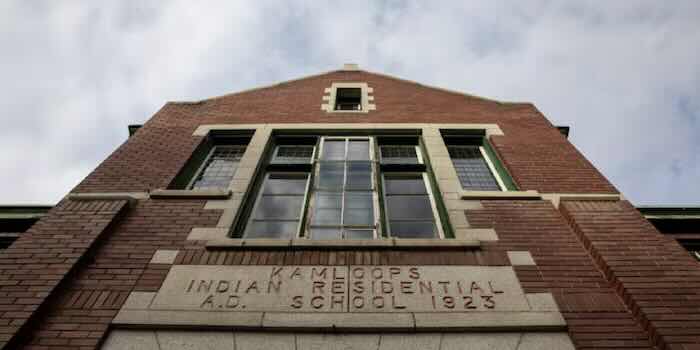
Dallas Brodie, a B.C. Conservative MLA has refused her party leader's request to remove a social media post that critics say amounts to residential school denialism.
Brodie, official opposition attorney general critic, says this charge despite facing backlash for her post on X, formerly known as Twitter.

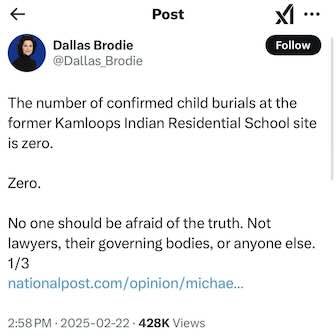
Brodie was coming to the defence of another lawyer, James Heller.
As discussed below, Heller urged the Law Society of B.C., of which he is a member, to change its training material to say there were "potentially" burial sites at the former residential school in Kamloops – instead of more definitive language.
"The stand I'm taking is rooted in the need for truth. And I don't think standing for truth takes away anything from the severity of what happened at the residential schools," she told reporters in the legislature Monday. "I'm a lawyer. I believe in evidence, truth and pursuit of truth, and I think lawyers should be allowed to ask questions."
However, Brodie's Conservative colleague, A'aliyah Warbus, a member of the Sto:lo Indian Band and the party's House leader, said on social media:
"Inform yourself, get the latest facts, research, AND talk to survivors. Questioning the narratives of people who lived and survived these atrocities, is nothing but harmful and taking us backward in reconciliation."
Conservative Leader John Rustad also said he asked Brodie to take down the post but she refused to do so.
"When the tweet was first put up, I was concerned it may be misinterpreted as opposed to being about the fact that there haven't been any graves ... or any bodies at that particular site exhumed or found, versus the whole issue of the residential schools," Rustad said. "I asked her to take [the post] down because of that concern."
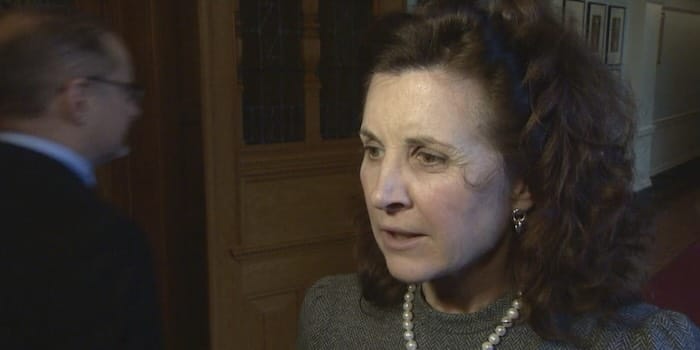
Rustad says there is no denying the horrors of residential schools, though he failed to mention what these “horrors” consisted of or whether they have ever been proven beyond a reasonable doubt, the standard necessary in criminal proceedings.
"[Children] went to school. They were taken from their families, and more than 4,000 children did not return home. Those children died in residential schools."
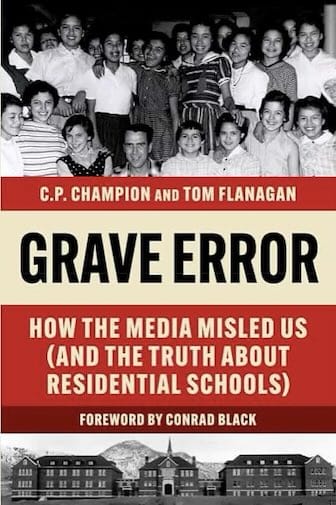
A mountain of evidence produced by dozens of distinguished scholars and celebrated editorial writers located available here, here, here, here, and here shows these accusations to be invented, false, distorted, or thoroughly decontextualized. Grave Error: How The Media Misled Us (and the Truth about Residential Schools) is the best known of these exposés.
This has not prevented indigenous activists from ignoring or dismissing these studies using inflammatory rhetoric and/or emotional appeals as their only talking points.
Grand Chief Stewart Phillip of the Union of B.C. Indian Chiefs, for example, says Brodie's comments cause pain to residential school survivors and their families.
"I find such remarks to be absolutely disgusting, repugnant and ugly," he said.
B.C. Attorney General Niki Sharma claims that during her law career, she worked with residential school survivors, who have fought hard for decades to have their truth recognized.
"It's been a long and painful journey to those people," Sharma said. "I'm disappointed that her first question to me as critic would be based on a form of denialism of residential schools.”
Sean Carleton, an Indigenous Studies professor at the University of Manitoba, who proudly identifies as a “settler historian” said residential school denialism is not just denying that residential schools existed, but involves a "strategy to try and shake public confidence in established truth by minimizing, downplaying and twisting facts… to shake public confidence in the truth."
Carleton is concerned that some politicians are using such statements as a wedge issue.
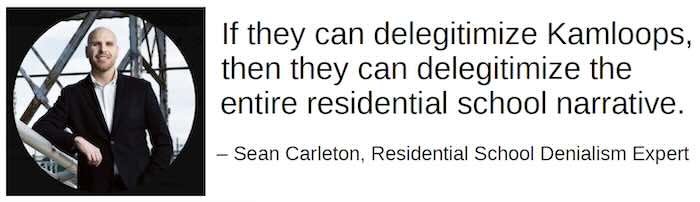
"If they can delegitimize Kamloops, then they can delegitimize the entire residential school narrative," he said.
The overarching context of this assertion is the May 27, 2021, the Tk'emlúps te Secwépemc Indian Band announcement that ground penetrating radar provided "confirmation of the remains of 215 children" at the school site. But the band later revised its language to describe the finding as "potential burial sites." The band itself “delegitimized Kamloops” changed the wording last year to "anomalies" – soil disturbances of unknown origin – an assertion so-called residential school denialists like Dallas Brodie would surely accept.
Moreover, that the May 2021 announcement continues to reverberate nearly four years later absent the remains of a single body recovered from the site also proves that Sean Carleton is spot on when in arguing that, “If they can delegitimize Kamloops, then they can delegitimize the entire residential school narrative.”
This is why so much attention is also being paid to another British Columbian, also a lawyer labelled a “denialist.”
This recent echo involves British Columbia barrister James Heller, now suing the Law Society of B.C. (LSBC), of which he is a mandated member, for libel.
Suing your very own law society is a rare occurrence. Doing so based on accusations that the society engaged in “bad faith, high-handedness, arrogance, malice” and betraying its ethical duties is rarer still.
Rarest of all, is James Heller’s charge that his society refuses to accept verified truth, in this instance that there has never been a discovery of missing children buried in unmarked graves at Kamloops.
As one media house reported, “Have the bodies of 215 children been found in an unmarked burial site at the Kamloops Indian Residential School? The factual answer to that question is ‘no.’”
According to his lawsuit, Heller’s attempts to get the LSBC to acknowledge that elementary truth has tarnished his reputation.
What is so troubling about Heller’s battle is that the LSBC seems most concerned with protecting a sacred narrative that has penetrated the conscience of most Canadians.
As the minority of contrarian commentators have found out, questioning the prevailing narrative about the Kamloops discovery is a taboo subject because it challenges the veracity of what are termed “Indigenous knowings,” otherwise called the sacred teachings orally passed down from generation to generation by largely unidentified indigenous “knowledge keepers.”
These knowings, rooted in indigenous modes of understanding and interpreting “reality,” are seen as taking precedence over Western (read “colonial”) modes of knowing based on the scientific method rooted in the objective search for truth.
The LSBC, an organization expected to embrace Enlightenment truth-telling and justice seeking, seems to have been captured by indigenous knowledge production. Accordingly, questioning any part of the prevailing narrative about Kamloops and similar discoveries, especially their factual basis, is now verboten.
Heller began challenging his society’s interpretation of Kamloops last year in an email requesting LSBC educational material be amended to guarantee its factual accuracy. This soon evolved into a dispute at its September 24, 2024, annual general meeting that is now before the Supreme Court of British Columbia.
The source of the lawsuit is the following statement in the Law Society’s Indigenous training course for B.C. lawyers:
In July 2024, Heller asked course providers to amend the statement because no bodies had been found or confirmed after more than three years.
He could have well added that “what survivors have been saying all along” does not by itself prove that these “sayings” are truthful.
According to the lawsuit, the LSBC well knew that the appropriate terminology had been addressed in a case before Indigenous B.C. Chief Justice Leonard Marchand who ruled that the phrase “potential unmarked burials” was not biased.
More telling still, the lawsuit shows that terms such as “potential,” “possible,” and “suspected” unmarked burial sites were used repeatedly in the June 2023 interim report by Kimberly Murray, the Independent Special Interlocutor for Missing Children and Unmarked Graves and Burial Sites. For example, she wrote, “In May 2021, the Tk’emlúps te Secwépemc (BC) announced the confirmation of up to 215 potential unmarked burials at the site of the former Kamloops Indian Residential School.”
Most telling of all, as already mentioned, in May 2024, the Kamloops Indian Band revised its website, changing the word “remains” to “anomalies” to reflect uncertainty about what had been found in an apple orchard near the school, albeit contrary to the strong assertions of its “knowledge keepers.”
The LSBC knew “that terminology such as ‘potential burials’ regarding the findings made on the former Kamloops Indian Residential School grounds was responsible, factually accurate and not indicative of intolerance, denial or bias,” claims the lawsuit.
The resolution noted attempts were made to have the course providers correct the original statement but to no avail, and so the resolution called on member lawyers to implore the society to replace the language with: “discovery of a potentially unmarked burial site on the former Kamloops Indian Residential School grounds,” in keeping with the Kamloops Indian Band revision of “burials” to “anomalies.”
Heller suggested the resolution speaks to the legal profession's core as “adherence to facts and evidence is a cornerstone of the practice of law” and “training materials should not contain factual errors, and in particular should not knowingly spread falsehoods.”
Speaking to his resolution, Heller said, “It would be great if the authorities and experts in RCMP would finally do the necessary work, likely some kind of excavation, to ascertain the truth of the matter, something Kamloops Band leaders have consistently rejected.
“But until that time, it’s inaccurate and misleading to suggest that there’s been any such discovery,” added Heller, whose comments drew a torrent of criticism from speakers.
The final vote saw 1,683 society members oppose the resolution and 1,499 vote in favour of it, with 590 abstaining.
At the meeting, Heller said he had been accused of being racist but was surprised to get as many votes in favour of his resolution given opposition from law institutions – such as the BC Civil Liberties Association, Canadian Bar Association BC Branch, and BC First Nations Justice Council – leading up to the AGM.
One critic of the resolution was the B.C. First Nations Justice Council (BCFNJC), which, in a press release, called the resolution a “so-called correction” seeking “to supplant countless testimonies, reports and investigations with a factually incorrect narrative that is rooted in the silencing and dismissal of residential school survivors.”
The press release went on to reference a “growing disillusioned sect” denying the horrors of residential schools and the harm caused by “denialism.”
Yet the lawsuit counters that “Contrary to the BCFNJC statement and as known by the (LSBC), the resolution was not motivated by racism, ‘residential school denialism,’ ‘genocide denialism’ or other such vile and disreputable factors.”
The LSBC posted a link to the press release in an online statement, knowing it was defamatory, the lawsuit alleges. It also claims attempts to get the LSBC to take down the press release and issue an apology and a retraction had failed.
“It has kept the press release online despite knowing of its false and damaging nature and which conduct reflects bad faith, high-handedness, arrogance, malice and a marked departure from ordinary standards of decent behaviour,” reads the lawsuit.
The suit also alleges that the LSBC’s conduct was “a betrayal of the ethical duties it is entrusted to enforce.”
Heller “has suffered damages to his reputation and distress, anxiety, stigmatization, embarrassment and fear for his well-being as a result of the (LSBC’s) conduct,” it claims.
Heller is seeking an apology, a retraction and damages.
So far, the LSBC has not published a defence. It has also declined to comment as the case is currently before the court.
Hymie Rubenstein, editor of REAL Indigenous Report, is a retired professor of anthropology, University of Manitoba, and a senior fellow at the Frontier Centre for Public Policy.
View Comments
Hymie Rubenstein, a retired professor of anthropology at the University of Manitoba, is editor of —REAL Indigenous Report.