

By Daniel Greenfield ——Bio and Archives--September 11, 2016
American Politics, News | CFP Comments | Subscribe | Email Us
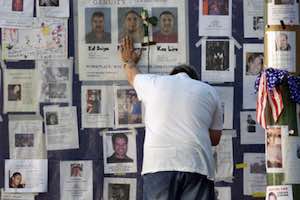 Time brings distance to all events. No pain is as fresh twenty years later as on the day it happened. The shock of the impossible becomes the new normal and then it becomes more background noise.
"A single death is a tragedy, a million deaths is a statistic," Joseph Stalin said. The statisticians in Doha, Tehran and Riyadh know it quite well when they count up their numbers. Compound death is more than a statistic; it is incomprehensible.
The banal media coverage of September 11 grapples with a story too big to tell that can only be broken down into human fragments of personal stories
Time brings distance to all events. No pain is as fresh twenty years later as on the day it happened. The shock of the impossible becomes the new normal and then it becomes more background noise.
"A single death is a tragedy, a million deaths is a statistic," Joseph Stalin said. The statisticians in Doha, Tehran and Riyadh know it quite well when they count up their numbers. Compound death is more than a statistic; it is incomprehensible.
The banal media coverage of September 11 grapples with a story too big to tell that can only be broken down into human fragments of personal stories
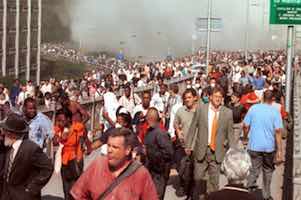 The West has tried to make war into a moral force by governing its means, without regard to its ends. But in the Muslim world, war is moral so long as its ends are Islamic-- the means are a technicality that Islamic scholars may squabble over the way they do over every petty matter, but in practice it's anything goes so long as it serves the Ummah. And even those technical debates over civilians in war and terrorism are governed by the ultimate welfare of the Ummah.
What happens when people who believe that the ends justify the means fight against people who believe that the ends never justify the means? In Afghanistan and Iraq the people who believed that the ends justify the means have gained their ends-- while we have lost both the ends and the means, not going far enough for the hawks and going too far for the doves.
The West has tried to make war into a moral force by governing its means, without regard to its ends. But in the Muslim world, war is moral so long as its ends are Islamic-- the means are a technicality that Islamic scholars may squabble over the way they do over every petty matter, but in practice it's anything goes so long as it serves the Ummah. And even those technical debates over civilians in war and terrorism are governed by the ultimate welfare of the Ummah.
What happens when people who believe that the ends justify the means fight against people who believe that the ends never justify the means? In Afghanistan and Iraq the people who believed that the ends justify the means have gained their ends-- while we have lost both the ends and the means, not going far enough for the hawks and going too far for the doves.
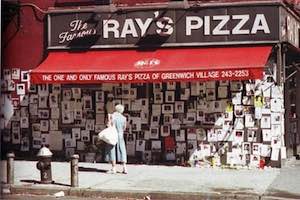 This is the broken way of war that we practiced in Vietnam and Korea, constrained by invisible boundaries of our own making that did not prevent us from bombing cities, but did keep us from wiping out entire villages. To our enemies, these morals of ours seem every bit as senseless as their foot washing regulations seem to us. Why do the people who bombed Dresden beat their breasts over Mai Lai, and why was Shock and Awe acceptable, but not Abu Ghraib?
The answers invariably come down not to some externally consistent philosophy or divine law, but our need to feel good about ourselves by setting up a code that makes us seem moral in our own eyes. That makes us feel good about war. And the first law of that code is that killing en masse without really meaning to is more moral than pointing a gun at a man and pulling the trigger. This is the plausible deniability morality of the firing squad which uses enough dummy cartridges so that no one can be sure who fired the shot. No wonder drone attacks are a favorite of an anti-war administration putting as much automation and distance as possible between the soldier and his target.
Laws tell much about a people. Our need to legislate the use of force, and their need to legislate everything but the use of force. We have learned to be afraid of our lurking potential for evil.
It is a fear absent in Islam where a man who serves Allah cannot be a devil no matter what he does, but we know all too well that the devil can come wrapped in a saintly cause. We know it so well that we sometimes forget that while devils do occasionally come wearing halos, mostly they come wearing horns. To our great pain and woe, we have forgotten that we are not our own enemies.
A hundred years ago the attacks of September 11 would have marked the beginning of a war, but in this century they only marked a day of pain and sorrow, and years of a war that was never truly a war. It is this conflicted un-war that the anniversary marks. A war that never ends, because it never began.
War is a framework for violence, which the Muslim world hardly needs. While we search for an enemy to declare war on, all they need is a Fatwa with a clerical argument dubbing us the enemy, our nation, our soldiers, our civilians and our children. All of us.
We have no comfortable war framework except nation building which pretends that war is really the Peace Corps with bombs, habitat for humanity with the homes blown up before they can be rebuilt.
Are we fighting because they attacked us or because girls in Afghanistan can't go to school or for some figment of regional stability in a country where stability isn't even a word. That lack of clarity is fragmentation. And fragmentation makes all stories seem senseless.
The pain and shock of the attacks gave us a measure of clarity. We were hit hard enough that we felt once again that justice was on our side and we no longer had to feel guilty for standing up for ourselves. In a society whose highest morality has become that of the victim, we were suddenly victims and entitled to defend ourselves.
The need to question ourselves temporarily went away and it felt good. For a brief shining moment the country became aware of external enemies and was united. We stopped being fragments warring with each other and we became Americans.
Had that clarity been sustained, the country today would be a dramatically different place. But it diminished and fell apart, and our identity went with it.We were once again our own enemies and the real enemy went unrecognized. Now the anniversary of the attacks has become like the memory of an old war that was fought once, but no longer really matters. The nation is at war, but it doesn't know that it's at war. And those who know that we are at war, often can't even state who the enemy is.
Without that clarity and unity, all we have are fragments, individual stories without the means to wrap them together. Stalin was right, a million deaths is a statistic unless you find a way to bring together what it means to an entire people. For the Holocaust, it was "Never Again." For 9/11 it was a more ambiguous, "United We Stand", but what do we stand for and what do we stand against?
The anniversaries have long since been reduced to a national therapy session, with pain released and healed in the media's own talking cure. But it isn't the pain that matters, it's what we do with it that counts. We have not yet lost the war-- but we are losing it, and unless we decide as a nation what we stand for and what we stand again, then we will lose. It will take time, like our banks we are too big to fail, but given enough appeasement, enough immigration and enough terrorism-- it will come.
Over a decade of war has passed, and before that a thousand years of war with lulls and pauses, but the din of the scimitar being sharpened for war never truly stopped. Each year that passes is a chance to learn the lessons of the years that have gone by and to remedy their mistakes. The best way to pay tribute to the dead is to unlearn our mistakes so that what happened to them will not happen again. Everything else is the fragmentation of self-indulgence, the therapy of tears, the sensitivity of grief, that will ease our pain, but not our fate.
This is the broken way of war that we practiced in Vietnam and Korea, constrained by invisible boundaries of our own making that did not prevent us from bombing cities, but did keep us from wiping out entire villages. To our enemies, these morals of ours seem every bit as senseless as their foot washing regulations seem to us. Why do the people who bombed Dresden beat their breasts over Mai Lai, and why was Shock and Awe acceptable, but not Abu Ghraib?
The answers invariably come down not to some externally consistent philosophy or divine law, but our need to feel good about ourselves by setting up a code that makes us seem moral in our own eyes. That makes us feel good about war. And the first law of that code is that killing en masse without really meaning to is more moral than pointing a gun at a man and pulling the trigger. This is the plausible deniability morality of the firing squad which uses enough dummy cartridges so that no one can be sure who fired the shot. No wonder drone attacks are a favorite of an anti-war administration putting as much automation and distance as possible between the soldier and his target.
Laws tell much about a people. Our need to legislate the use of force, and their need to legislate everything but the use of force. We have learned to be afraid of our lurking potential for evil.
It is a fear absent in Islam where a man who serves Allah cannot be a devil no matter what he does, but we know all too well that the devil can come wrapped in a saintly cause. We know it so well that we sometimes forget that while devils do occasionally come wearing halos, mostly they come wearing horns. To our great pain and woe, we have forgotten that we are not our own enemies.
A hundred years ago the attacks of September 11 would have marked the beginning of a war, but in this century they only marked a day of pain and sorrow, and years of a war that was never truly a war. It is this conflicted un-war that the anniversary marks. A war that never ends, because it never began.
War is a framework for violence, which the Muslim world hardly needs. While we search for an enemy to declare war on, all they need is a Fatwa with a clerical argument dubbing us the enemy, our nation, our soldiers, our civilians and our children. All of us.
We have no comfortable war framework except nation building which pretends that war is really the Peace Corps with bombs, habitat for humanity with the homes blown up before they can be rebuilt.
Are we fighting because they attacked us or because girls in Afghanistan can't go to school or for some figment of regional stability in a country where stability isn't even a word. That lack of clarity is fragmentation. And fragmentation makes all stories seem senseless.
The pain and shock of the attacks gave us a measure of clarity. We were hit hard enough that we felt once again that justice was on our side and we no longer had to feel guilty for standing up for ourselves. In a society whose highest morality has become that of the victim, we were suddenly victims and entitled to defend ourselves.
The need to question ourselves temporarily went away and it felt good. For a brief shining moment the country became aware of external enemies and was united. We stopped being fragments warring with each other and we became Americans.
Had that clarity been sustained, the country today would be a dramatically different place. But it diminished and fell apart, and our identity went with it.We were once again our own enemies and the real enemy went unrecognized. Now the anniversary of the attacks has become like the memory of an old war that was fought once, but no longer really matters. The nation is at war, but it doesn't know that it's at war. And those who know that we are at war, often can't even state who the enemy is.
Without that clarity and unity, all we have are fragments, individual stories without the means to wrap them together. Stalin was right, a million deaths is a statistic unless you find a way to bring together what it means to an entire people. For the Holocaust, it was "Never Again." For 9/11 it was a more ambiguous, "United We Stand", but what do we stand for and what do we stand against?
The anniversaries have long since been reduced to a national therapy session, with pain released and healed in the media's own talking cure. But it isn't the pain that matters, it's what we do with it that counts. We have not yet lost the war-- but we are losing it, and unless we decide as a nation what we stand for and what we stand again, then we will lose. It will take time, like our banks we are too big to fail, but given enough appeasement, enough immigration and enough terrorism-- it will come.
Over a decade of war has passed, and before that a thousand years of war with lulls and pauses, but the din of the scimitar being sharpened for war never truly stopped. Each year that passes is a chance to learn the lessons of the years that have gone by and to remedy their mistakes. The best way to pay tribute to the dead is to unlearn our mistakes so that what happened to them will not happen again. Everything else is the fragmentation of self-indulgence, the therapy of tears, the sensitivity of grief, that will ease our pain, but not our fate.
View Comments