

By Kelly O'Connell ——Bio and Archives--June 25, 2012
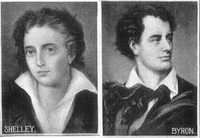 Since poetry is no longer widely read, even towering luminaries like Byron and Shelley are dismissed out-of-hand. Yet lessons gleaned from such famous persons often tower over any other source of wisdom. The greatest 19th century literary hero was George Gordon, Lord Byron. His supposed exploits in Childe Harold's Pilgrimage fascinated the public, making him Elvis-like. Part of his fame lay in his apparent autobiographical verse, whereas his scandalous reputation as a womanizer also won fans, as well as enemies. He left the UK under extraordinary criticism, yet died a revolutionary hero in Greece.
George Gordon Byron was son of profligate gambler Captain John Byron and heiress Catherine Gordon. His father fled to France soon after the birth, dying 3 years later. The first ten years of Byron's life were surrounded by relative poverty as his father had squandered his wife's money as well as his own. Byron was born with a clubfoot and this slight deformity was to have a profound effect on his future temperament. In 1798, Byron's great-uncle William died, granting him the baronial title and estate at Newstead Abbey in Nottinghamshire. Abandoning ordinary life, Byron studied at Harrow and Cambridge. Then began Byron's writing life, as well as his reputation for high-spirited, even wild, behaviour. In 1807 Byron took his seat in the House of Lords, then left for Europe for two years. On return home, aged 24, Byron's days of fame and notoriety began. Childe Harold's Pilgrimage elevated Byron to the ranks of literary genius beside Shakespeare, and ensured he became the most influential British poet known throughout Europe. Byron himself remarked, "I awoke one morning and found myself famous."A series of unfortunate events caused Byron to leave England forever, his reputation shattered in polite society, similar to his own father's indiscretions, according to Enita Eisler's Byron: Child of Passion, Fool of Fame. The scandal became too much and Byron left England permanently for the Continent. Yet, Byron was not a simple-minded scoundrel, according to several leading authors. Jacques Barzun wrote "Byron and the Byronic" in The Atlantic Monthly, regarding the essential unfairness of assuming Byron was the same as his literary characters. Another author, Phyllis Grosskurth, makes a similar point in Byron: The Flawed Angel.
Percy Bysshe Shelley (1792-1822) was born to a wealthy family in Sussex, England, son of a member of parliament. Educated at Eton and Oxford University, there he encountered radical writers such as William Godwin. He was expelled for publishing a pamphlet called "The Necessity of Atheism." Shelley eloped with 16-year-old Harriet Westbrook, had two children, then separated. In 1814, Shelley seduced another 16-year-old -- Mary, daughter of radical writers William Godwin and Mary Wollstonecraft. They traveled in 1816 to Lake Geneva with Lord Byron. Shelley wrote poetry and Mary conceived her novel 'Frankenstein'. In 1816, Shelley and Mary married, a few weeks after Harriet drowned herself. In 1818, itinerant Shelley moved to Italy where two of his children died while Mary suffered a nervous breakdown. On July 8th, 1822 Shelley drowned.According to Paul Johnson in Intellectuals, Shelley was both extremely talented and very single-minded pursuing change in society. His priorities were to give societal leadership over to intellectuals -- especially poets. His extraordinary A Defense of Poetry laid open his plans for intellectuals to take over society, much like we see today. He claimed: "Poets are the unacknowledged legislators of the world".
In his poetry, Shelley certainly practiced what he preached. He was a great poet -- and his poetry can be understood on may levels. But at the deepest level, at the level Shelley himself intended , it is essentially moral and political. He is the most thoroughly politicized of English poets; all of his major and many of his minor poems have a call for social action of some kind, a public message.Given the inherent immorality of socialism of the kind Shelley preached, we cannot give him a pass on his work merely on aesthetic grounds. The intent of a writer does matter, after all.
Byron was a leader of the era's poetic revolution, he named Alexander Pope as his master; a worshiper of the ideal, he never lost touch with reality; a deist and freethinker, he retained from his youth a Calvinist sense of original sin; a peer of the realm, he championed liberty in his works and deeds, giving money, time, energy, and finally his life to the Greek war of independence. In his dynamism, sexuality, self-revelation, and demands for freedom for oppressed people everywhere, Byron captivated the Western mind and heart as few writers have, stamping upon nineteenth-century letters, arts, politics, even clothing styles, his image and name as the embodiment of Romanticism.
View Comments
Kelly O’Connell is an author and attorney. He was born on the West Coast, raised in Las Vegas, and matriculated from the University of Oregon. After laboring for the Reformed Church in Galway, Ireland, he returned to America and attended law school in Virginia, where he earned a JD and a Master’s degree in Government. He spent a stint working as a researcher and writer of academic articles at a Miami law school, focusing on ancient law and society. He has also been employed as a university Speech & Debate professor. He then returned West and worked as an assistant district attorney. Kelly is now is a private practitioner with a small law practice in New Mexico.