

By Institute for Energy Research ——Bio and Archives--June 29, 2019
Global Warming-Energy-Environment | CFP Comments | Subscribe | Email Us
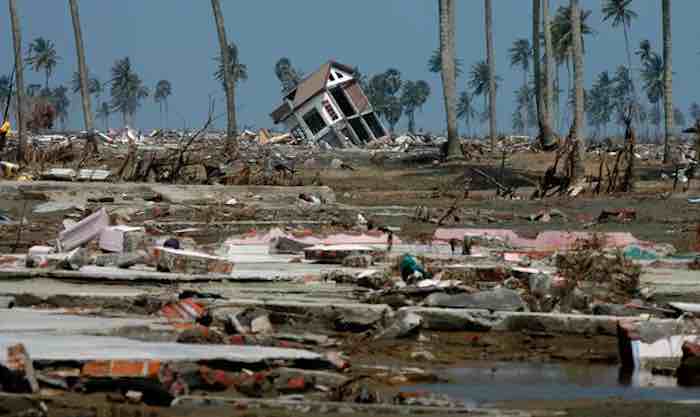 An Earth scientist's recent article making the rounds on social media highlights a terrifying conversation he had with "a very senior member" of the IPCC, which is the UN's body devoted to studying climate science. The upshot of their conversation was that millions of people will die from climate change, a conclusion that leads the author to lament that humans have created a consumption-driven civilization that is "hell bent on destroying itself."
As with most such alarmist rhetoric, there is little to document these sweeping claims--even if we restrict ourselves to "official" sources of information, including the IPCC reports themselves. The historical record does not justify panic, but instead should lead us to expect continued progress for humanity, so long as the normal operation of voluntary market interactions continues without significant political interference to sabotage it.
An Earth scientist's recent article making the rounds on social media highlights a terrifying conversation he had with "a very senior member" of the IPCC, which is the UN's body devoted to studying climate science. The upshot of their conversation was that millions of people will die from climate change, a conclusion that leads the author to lament that humans have created a consumption-driven civilization that is "hell bent on destroying itself."
As with most such alarmist rhetoric, there is little to document these sweeping claims--even if we restrict ourselves to "official" sources of information, including the IPCC reports themselves. The historical record does not justify panic, but instead should lead us to expect continued progress for humanity, so long as the normal operation of voluntary market interactions continues without significant political interference to sabotage it.
It was the spring of 2011, and I had managed to corner a very senior member of the Intergovernmental Panel on Climate Change (IPCC) during a coffee break at a workshop... The IPCC reviews the vast amounts of science being generated around climate change and produces assessment reports every four years. Given the impact the IPPC's findings can have on policy and industry, great care is made to carefully present and communicate its scientific findings. So I wasn't expecting much when I straight out asked him how much warming he thought we were going to achieve before we manage to make the required cuts to greenhouse gas emissions. "Oh, I think we're heading towards 3°C at least," he said. ... "But what about the many millions of people directly threatened," I went on. "Those living in low-lying nations, the farmers affected by abrupt changes in weather, kids exposed to new diseases?" He gave a sigh, paused for a few seconds, and a sad, resigned smile crept over his face. He then simply said: "They will die."

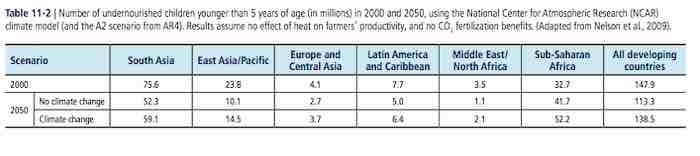
The Fourth Assessment Report (AR4) pointed to dramatic improvement in life expectancy in most parts of the world in the 20th century, and this trend has continued through the first decade of the 21st century (Wang et al., 2012). Rapid progress in a few countries (especially China) has dominated global averages, but most countries have benefited from substantial reductions in mortality. There remain sizable and avoidable inequalities in life expectancy within and between nations in terms of education, income, and ethnicity (Beaglehole and Bonita, 2008) and in some countries, official statistics are so patchy in quality and coverage that it is difficult to draw firm conclusions about health trends (Byass, 2010). Years lived with disability have tended to increase in most countries (Salomon et al., 2012). If economic development continues as forecast, it is expected that mortality rates will continue to fall in most countries; the World Health Organization (WHO) estimates the global burden of disease (measured in disability-adjusted life years per capita) will decrease by 30% by 2030, compared with 2004 (WHO, 2008a). The underlying causes of global poor health are expected to change substantially, with much greater prominence of chronic diseases and injury; nevertheless, the major infectious diseases of adults and children will remain important in some regions, particularly sub-Saharan Africa and South Asia (Hughes et al., 2011). [IPCC Fifth Assessment Report, Working Group II, Chapter 11, bold added.]Later in that same chapter, we see the following table, which is illustrative of the general pattern when it comes to long-term projections about climate change harms to humanity:
 Source: IPCC AR5, Working Group II, Chapter 11
As the table indicates, the absolute number (let alone the percentage of the population) of undernourished children in all developing countries, even with climate change, is projected (with certain assumptions) to drop by 9.4 million from the year 2000 to 2050. It's true that the number increases in sub-Saharan African, but it falls in every other region. (It also rises in sub-Saharan Africa even without climate change.) We should also keep in mind that UN projections assume the populations in 26 African countries will at least double by 2050, meaning that the percentage of children who are malnourished still drops even in sub-Saharan Africa and even with climate change, according to the UN's estimates.
As I have explained often here at IER--most recently in this article--when it comes to climate change, the big projected damages don't occur until many decades into the future. But for those people, standard economic growth will have raised their baseline standard of living by so much, that even if the UN-endorsed best-guess projections of climate change are accurate, those humans will still be much better off than we are today.
Source: IPCC AR5, Working Group II, Chapter 11
As the table indicates, the absolute number (let alone the percentage of the population) of undernourished children in all developing countries, even with climate change, is projected (with certain assumptions) to drop by 9.4 million from the year 2000 to 2050. It's true that the number increases in sub-Saharan African, but it falls in every other region. (It also rises in sub-Saharan Africa even without climate change.) We should also keep in mind that UN projections assume the populations in 26 African countries will at least double by 2050, meaning that the percentage of children who are malnourished still drops even in sub-Saharan Africa and even with climate change, according to the UN's estimates.
As I have explained often here at IER--most recently in this article--when it comes to climate change, the big projected damages don't occur until many decades into the future. But for those people, standard economic growth will have raised their baseline standard of living by so much, that even if the UN-endorsed best-guess projections of climate change are accurate, those humans will still be much better off than we are today.
 Source: Our World In Data
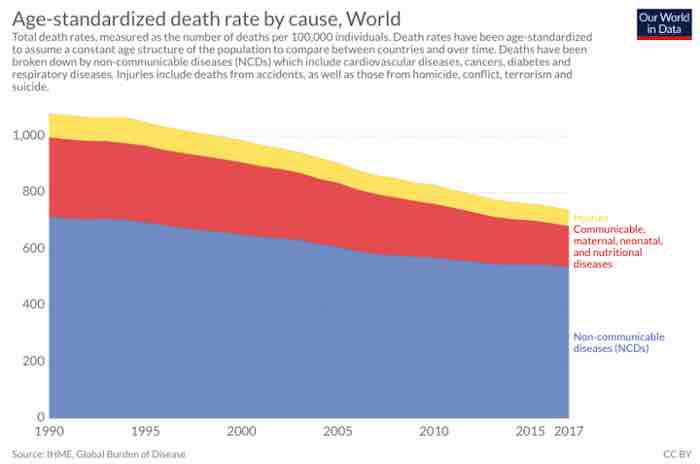
As the chart indicates, the death rates from various types of causes have fallen sharply around the world, particularly those from communicable diseases, and all within the last 20 years--when climate change was ostensibly becoming a deadly problem for humanity that only "deniers" could ignore.
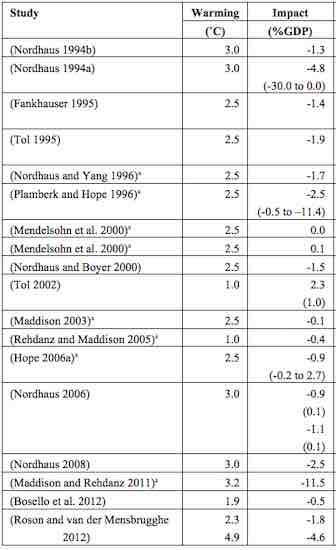
For another line of evidence, let me show you a table where the UN did give us some measures of "aggregate" damages from climate change. Specifically, in Chapter 10 of the AR5 we see the following table summarizing the climate change economics literature on the subject:
Source: Our World In Data
As the chart indicates, the death rates from various types of causes have fallen sharply around the world, particularly those from communicable diseases, and all within the last 20 years--when climate change was ostensibly becoming a deadly problem for humanity that only "deniers" could ignore.
For another line of evidence, let me show you a table where the UN did give us some measures of "aggregate" damages from climate change. Specifically, in Chapter 10 of the AR5 we see the following table summarizing the climate change economics literature on the subject:
 Source: Table 10.B.1, IPCC AR5, Working Group II, p. 82.[1]
As the table summarizes, even for warming of 3 degrees Celsius, all but one of the studies predicted non-alarming amounts of damage. (I discuss the table more in this article.) Now I should emphasize that although the impacts are measured in GDP terms, these damage estimates include things like impacts on human health and mortality. It isn't simply a measured reduction in the flow of TV output because some of the factories are under the sea.
In any event, it should be clear from the table that--contrary to James Dyke--we should not expect millions, let alone billions (!), of people to die from climate change. Even if climate change proceeds as the peer-reviewed literature assumes in the most pessimistic emissions scenarios, it will probably merely mean that people in the year 2100 will only be a lot richer than we are, as opposed to a whole lot richer.
Source: Table 10.B.1, IPCC AR5, Working Group II, p. 82.[1]
As the table summarizes, even for warming of 3 degrees Celsius, all but one of the studies predicted non-alarming amounts of damage. (I discuss the table more in this article.) Now I should emphasize that although the impacts are measured in GDP terms, these damage estimates include things like impacts on human health and mortality. It isn't simply a measured reduction in the flow of TV output because some of the factories are under the sea.
In any event, it should be clear from the table that--contrary to James Dyke--we should not expect millions, let alone billions (!), of people to die from climate change. Even if climate change proceeds as the peer-reviewed literature assumes in the most pessimistic emissions scenarios, it will probably merely mean that people in the year 2100 will only be a lot richer than we are, as opposed to a whole lot richer.
View Comments
The Institute for Energy Research (IER) is a not-for-profit organization that conducts intensive research and analysis on the functions, operations, and government regulation of global energy markets. IER maintains that freely-functioning energy markets provide the most efficient and effective solutions to today’s global energy and environmental challenges and, as such, are critical to the well-being of individuals and society.